Cardano Staking Explained: How ADA Staking Works
One of Cardano's signature features is staking — a way to earn rewards on the ADA you already hold while helping secure the network. The good news is that Cardano's design lets you stake without locking up or handing over your coins. This guide explains how ADA staking works, in plain English.
The 20-second version
Staking ADA means delegating it to a stake pool that helps run the network. You keep full control of your coins, they're never locked, and you earn rewards roughly every five days. Rewards are not guaranteed and ADA's price still moves.
What is ADA staking?
Cardano is a proof-of-stake network, which means it's secured by people staking ADA rather than by mining. If staking in general is new to you, start with what staking is.
On Cardano, you don't run a stake pool yourself — you delegate your ADA to one. Delegation tells the network 'count my ADA towards this pool's chance of producing blocks'. In return, you share in the rewards. Crucially, your ADA stays in your own wallet the whole time.
How delegation works
- Stake pools are operators that produce blocks. There are thousands to choose from.
- Delegation assigns your ADA's stake to a pool — your coins never move and aren't locked.
- Epochs are roughly five-day periods; rewards are calculated and paid out each epoch.
- You stay in control — you can spend your ADA or switch pools at any time.
Because your coins are never locked or transferred, ADA staking is considered relatively low-friction compared with some other networks that require lock-up periods. You stake from a wallet such as Lace, Yoroi or Eternl, or via a hardware wallet for extra security — see how to store Cardano safely.
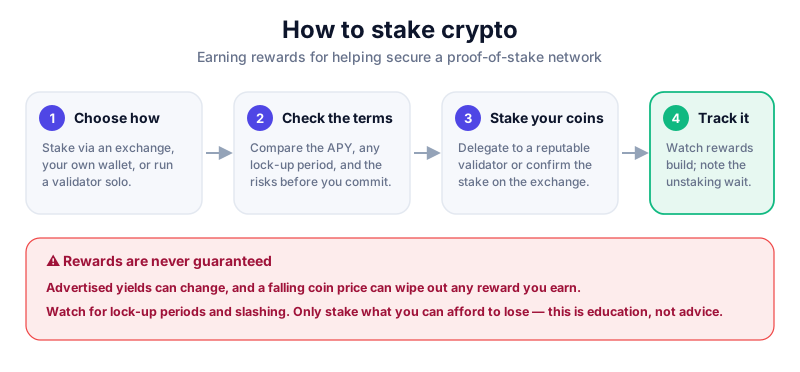
Rewards and risks
Rewards vary over time and by pool, and they're paid in ADA. Annual returns have historically sat in the low single-digit percentages, but they are not fixed or guaranteed — don't treat any quoted figure as a promise.
Staking isn't free money
Rewards are paid in ADA, so if ADA's price falls, the value of your holding can drop more than any rewards add. Staking does not remove crypto's volatility. Only stake what you can afford to leave at risk, and never borrow to buy ADA. This is education, not financial advice.
Avoiding staking scams
Legitimate Cardano staking never asks you to send your ADA away or share your seed phrase. You delegate from your own wallet and keep your coins. One habit worth adopting from day one: delegate from a hardware wallet like the Trezor Safe 5, so staking never means exposing your keys.
Red flags to ignore
Any 'staking' site promising fixed high returns, asking for your seed phrase, or telling you to deposit ADA to an address it controls is a scam. When in doubt, see how to avoid crypto scams.
Key takeaways
- Staking ADA means delegating to a stake pool — your coins stay in your wallet.
- ADA is never locked; you can spend or switch pools anytime.
- Rewards are paid each epoch (about five days) and are not guaranteed.
- Real staking never asks for your seed phrase or for you to send coins away.
Frequently asked questions
Is my ADA locked when I stake it?
No. Unlike some networks, Cardano never locks your ADA when you delegate. Your coins stay in your wallet and you can spend or move them at any time.
How much can I earn staking ADA?
Returns vary by pool and over time and aren't guaranteed — historically in the low single-digit percentages annually. Treat any quoted rate as an estimate, not a promise.
Can I stake ADA from a hardware wallet?
Yes. You can connect a Ledger or Trezor to a compatible wallet app and delegate while keeping your keys offline — the safest way to stake larger amounts.
Keep reading
What Is Cardano (ADA)? A Plain-English Guide
A beginner-friendly explanation of Cardano and its ADA token: what it is, how its proof-of-stake blockchain wo
How to Buy Cardano (ADA) Safely: A Step-by-Step Guide
A beginner-friendly, step-by-step guide to buying Cardano (ADA) safely — choosing an exchange, verifying your
How to Store Cardano (ADA) Safely
Keep your Cardano (ADA) safe: hot vs cold wallets, the best ADA wallets, using a hardware wallet, and seed-phr