Cardano vs Ethereum: A Fair Comparison
Cardano and Ethereum are both proof-of-stake platforms for smart contracts, and they're often compared head-to-head. They share some DNA — Cardano's founder co-founded Ethereum — but they take very different approaches. This guide lays out a fair, balanced comparison so you can understand the trade-offs, not pick a 'winner'.
The 20-second version
Ethereum is the larger, more established smart-contract platform with by far the biggest app ecosystem. Cardano is smaller and takes a slower, research-first approach. Both use proof-of-stake. Neither is 'better' — they suit different priorities.
The quick background
Ethereum launched in 2015 and pioneered programmable smart contracts, becoming the home of most DeFi and NFT activity. Cardano launched in 2017, built by Ethereum co-founder Charles Hoskinson around a peer-reviewed, academic philosophy. Both moved away from mining: Ethereum switched to proof-of-stake in 2022, while Cardano was proof-of-stake from the start.
Side by side
| Feature | Cardano (ADA) | Ethereum (ETH) |
|---|---|---|
| Launched | 2017 | 2015 |
| Consensus | Proof-of-stake (Ouroboros) | Proof-of-stake |
| Smart contracts | Yes (since 2021) | Yes (since 2015) |
| Ecosystem size | Smaller, growing | Largest in crypto |
| Developer philosophy | Research-first, peer-reviewed | Faster, iterative |
| Energy use | Very low | Very low (post-2022) |
| Staking | Delegate, no lock-up | Stake or use staking services |
The table simplifies a lot, but the headline is clear: Ethereum leads on size, maturity and the sheer number of working applications; Cardano differentiates on its methodical, research-led approach and low-friction staking.
Where each one is strong
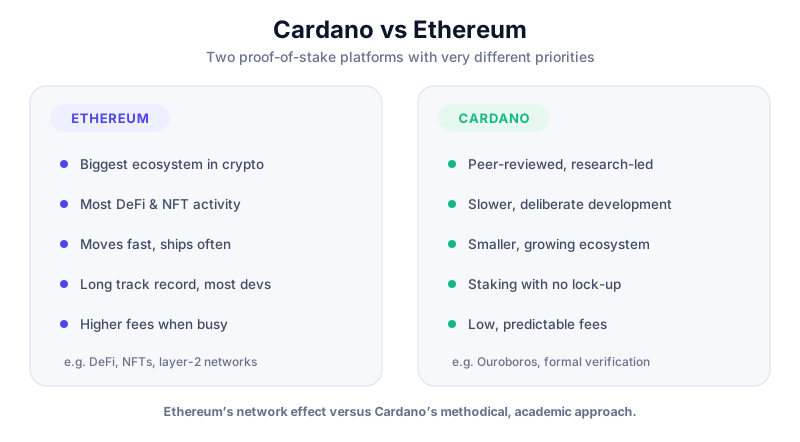
Ethereum's strengths: the deepest ecosystem of apps, the most developers, the most liquidity, and a long track record. If a crypto application exists, it usually exists on Ethereum first. The main trade-off is that fees on Ethereum's main network can spike when it's busy.
Cardano's strengths: a careful, formally-verified engineering approach, generally low and predictable fees, and staking that never locks your coins. The trade-off is a smaller ecosystem and a slower pace of feature delivery, which frustrates some users.
So which is 'better'?
Neither — and that's the honest answer. They optimise for different things, and many people in crypto pay attention to both. The right lens isn't 'which should I buy' but 'what is each one good at'. Whichever way you lean, the storage rule doesn't change: serious amounts belong offline, on a hardware wallet like the Trezor Safe 5.
Not a buy signal
Comparing two assets is not a recommendation to buy either. Both ADA and ETH are volatile, and a bigger ecosystem doesn't guarantee returns. Only risk what you can afford to lose, never borrow to buy crypto, and treat this as education, not financial advice.
Key takeaways
- Both Cardano and Ethereum are proof-of-stake smart-contract platforms.
- Ethereum has the larger, more mature ecosystem; Cardano takes a slower, research-led path.
- Ethereum can have higher fees when busy; Cardano fees are typically low and predictable.
- Neither is objectively 'better' — and comparison is not a reason to buy either.
Frequently asked questions
Is Cardano trying to replace Ethereum?
Not exactly. Cardano competes in the same smart-contract space, but its founders frame it as a different, research-led approach rather than a straight replacement. In practice both coexist.
Which has lower fees?
Cardano's fees are typically low and predictable. Ethereum's main-network fees vary with demand and can spike, though layer-2 networks built on Ethereum reduce this considerably.
Do both use proof-of-stake?
Yes. Cardano has used proof-of-stake since launch; Ethereum switched from mining to proof-of-stake in 2022. Both are far more energy-efficient than Bitcoin.
Keep reading
What Is Cardano (ADA)? A Plain-English Guide
A beginner-friendly explanation of Cardano and its ADA token: what it is, how its proof-of-stake blockchain wo
What Is Ethereum? A Plain-English Guide
A beginner-friendly explanation of Ethereum: what it is, how it differs from Bitcoin, what smart contracts do,
Cardano Staking Explained: How ADA Staking Works
A plain-English guide to staking Cardano (ADA): how delegation works, stake pools, rewards, the risks, and how