Cosmos Staking Explained: How Staking ATOM Works
Staking is how the Cosmos Hub stays secure — and how ATOM holders can earn rewards for taking part. But staking isn't free money: it comes with lock-up periods and real risks. This guide explains how Cosmos staking works in plain English, and what to weigh up before you start.
The 20-second version
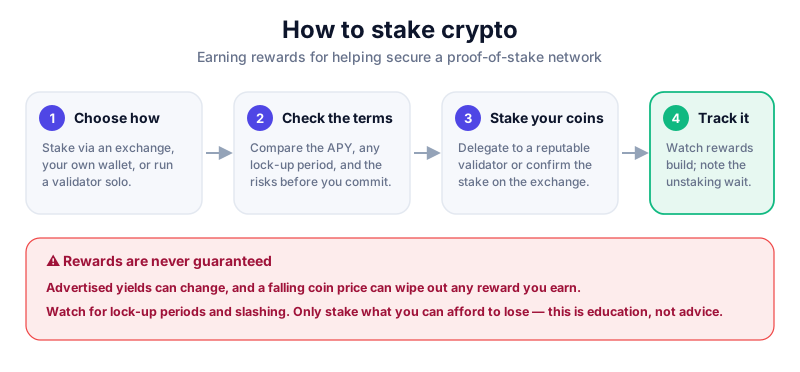
Staking ATOM means delegating it to a validator who helps secure the Cosmos Hub. In return you earn rewards. Your coins stay yours, but they're locked, and there's a multi-week unbonding period before you can move them again. Rewards aren't guaranteed.
What is staking on Cosmos?
The Cosmos Hub uses a system called proof-of-stake. Instead of energy-hungry mining, the network is secured by validators who lock up ATOM as a kind of security deposit. The more honestly-staked ATOM backs the network, the harder it is to attack. If you'd like the bigger picture first, see what is staking and what is Cosmos.
Most people don't run a validator themselves. Instead they delegate their ATOM to one — pointing their stake at a validator they trust, who does the technical work. The delegator shares in the rewards and the risks.
Where rewards come from
Staking rewards on Cosmos come from two sources: newly created ATOM (inflation) and a share of transaction fees. The validator takes a small commission, and the rest is split among delegators.
- Reward rates vary over time with network conditions and how much ATOM is staked overall.
- Commission differs between validators — it's worth comparing.
- Inflation cuts both ways — rewards come partly from new ATOM being created, which dilutes holders who don't stake.
Rewards are not guaranteed income
Advertised staking yields are estimates, not promises, and they're paid in ATOM — whose price is volatile. A double-digit yield means little if the token's value falls further. Only stake what you can afford to lock up and potentially lose. This is education, not financial advice.
The risks: unbonding and slashing
Two features of Cosmos staking surprise newcomers, and both matter.
- Unbonding period — when you decide to unstake, your ATOM is locked for a fixed period (commonly around three weeks) before it's free to move. During that time it earns nothing and you can't sell it.
- Slashing — if your chosen validator misbehaves or goes offline for too long, a portion of the staked ATOM (including yours) can be destroyed as a penalty. Choosing a reliable validator matters.
Crucially, you don't hand your coins to anyone. Staking is done from your own wallet, and you keep control of your keys throughout — see how to store ATOM safely. One habit worth adopting from day one: delegate from a hardware wallet like the Ledger Nano X, so staking never means exposing your keys.
How to stake safely
- Stake from a wallet you control, ideally connected to a hardware wallet — never by 'sending' ATOM to a website that promises to stake it.
- Spread risk by choosing an established validator with a sensible commission and a strong uptime record.
- Remember the unbonding lock-up before you commit funds you might need soon.
Beware fake 'staking' offers
Any site or message asking you to deposit ATOM to 'unlock' rewards, or promising guaranteed returns, is almost certainly a scam. Real staking never requires giving up your seed phrase. See how to avoid crypto scams.
Key takeaways
- Staking delegates ATOM to a validator to help secure the Cosmos Hub and earn rewards.
- Your coins stay yours and you keep your keys — staking is done from your own wallet.
- There's a multi-week unbonding period, and slashing can destroy part of your stake.
- Rewards are estimates, not guaranteed income — only stake what you can afford to lock up.
Frequently asked questions
Can I lose money staking ATOM?
Yes. Slashing can reduce your stake if your validator misbehaves, and ATOM's price can fall regardless of rewards. Staking is not risk-free.
How long until I can access unstaked ATOM?
After you unstake, there's an unbonding period — commonly around three weeks on the Cosmos Hub — during which the ATOM is locked and earns no rewards.
Do I give up control of my coins when I stake?
No. You delegate, but the ATOM stays in your wallet under your keys. Be very wary of any service asking you to transfer coins to it to stake.
Keep reading
What Is Cosmos (ATOM)? A Plain-English Guide
A beginner-friendly explanation of what Cosmos and its ATOM token are, how the 'internet of blockchains' works
Cosmos IBC Explained: The Inter-Blockchain Communication Protocol
A plain-English guide to IBC, the Cosmos protocol that lets independent blockchains transfer tokens and data —
How to Store Cosmos (ATOM) Safely (Step by Step)
Keep your Cosmos ATOM safe from hackers and mistakes: hot vs cold wallets, hardware wallets, seed-phrase backu