DAO Governance Explained: How On-Chain Voting Works
If a DAO is a group that runs on shared rules, governance is the machinery that turns member opinions into decisions. This guide explains how DAO governance actually works — proposals, voting power, quorums, and the difference between on-chain and off-chain votes — plus the weaknesses every participant should know.
The 20-second version
DAO governance is how members propose and vote on decisions. Voting power usually comes from governance tokens, votes can be on-chain or off-chain, and proposals need enough participation (a quorum) to pass. In practice, large holders often dominate.
The life of a proposal
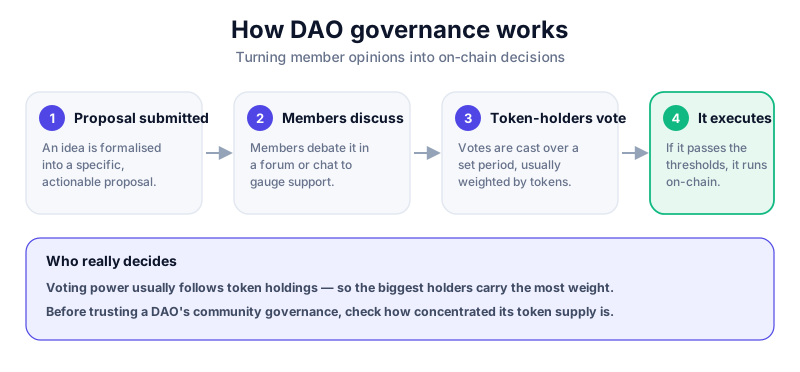
Governance generally follows a cycle. Someone raises an idea, the community discusses it informally, it's written up as a formal proposal, and then members vote. If it passes the required thresholds, it's executed — sometimes automatically by a smart contract.
- Discussion — an idea is floated in a forum or chat to gauge support.
- Proposal — it's formalised with specific, actionable wording.
- Voting — members cast votes over a set period, usually weighted by tokens.
- Execution — if thresholds are met, the decision is enacted on-chain or by the team.
Where voting power comes from
In most DAOs, one token equals one vote, so influence scales with how many governance tokens you hold. Some DAOs use membership NFTs for one-person-one-vote-style models, and others experiment with systems designed to reduce whale dominance.
- Token-weighted voting — common, simple, but favours large holders ('whales').
- One-member-one-vote — fairer in theory, harder to keep sybil-resistant.
- Delegation — members hand their voting power to a trusted representative who votes on their behalf.
On-chain vs off-chain voting
Not every vote touches the blockchain. On-chain voting records each vote as a transaction and can trigger automatic execution, but voters pay gas fees. Off-chain voting (often via signed messages on platforms like snapshot-style tools) is free and popular for signalling, but results then have to be carried out by someone trusted.
A quorum — the minimum participation needed for a vote to count — is used to stop a tiny minority from pushing through major changes. Setting it too high stalls decisions; too low risks capture.
The pitfalls of DAO governance
- Whale dominance — concentrated token ownership can override the wider community.
- Voter apathy — turnout is often very low, undermining legitimacy.
- Vote buying and bribery — markets have emerged where influence can be rented.
- Complexity — proposals can be technical, so many members vote blindly or not at all.
Don't buy tokens to chase profit
Governance tokens exist to enable voting, are highly volatile, and are not investments. Never acquire one expecting gains, and only risk what you can afford to lose. This is education, not financial advice.
Check the power distribution first
Before trusting a DAO's 'community governance', look at how concentrated its token holdings are. If a handful of wallets hold most of the supply, decisions are effectively theirs.
Key takeaways
- Governance turns proposals into decisions through structured voting.
- Voting power usually scales with governance tokens, favouring large holders.
- On-chain votes can auto-execute but cost gas; off-chain votes are free signals.
- Low turnout and whale dominance are the biggest real-world weaknesses.
Frequently asked questions
What is a quorum in DAO voting?
A quorum is the minimum amount of participation a vote needs to be valid. It prevents a tiny number of voters from passing major changes, but if set too high it can leave a DAO unable to act.
What does it mean to delegate my vote?
Delegation lets you assign your voting power to another member who votes on your behalf. It helps less-active members stay represented, but concentrates influence in delegates you must trust.
Why is voter turnout in DAOs often so low?
Many members hold tokens passively, proposals can be technical, and on-chain voting costs gas. The result is that a small, motivated minority frequently decides outcomes.
Keep reading
What Is a DAO? Decentralised Organisations Explained
A plain-English guide to DAOs: what a decentralised autonomous organisation is, how members vote, real example
What Is an NFT Marketplace? A Beginner's Guide
A plain-English guide to NFT marketplaces: what they are, how buying and selling works, the main platforms, fe
Real-World NFT Use Cases Beyond Digital Art
Practical NFT use cases beyond profile-picture art: ticketing, memberships, gaming, identity, certificates and