Gas Fees for Beginners
Try to send crypto and you'll quickly meet 'gas' — the fee networks charge to process your transaction. The word is confusing and the costs can surprise you. This guide demystifies gas fees so you're never caught out.
The 20-second version
Gas is the fee you pay to have the network process your transaction. It rewards the miners or validators who secure the chain. Fees rise when the network is busy and fall when it's quiet — and you always pay them in the network's own coin, like ETH on Ethereum.
What 'gas' actually means
The term comes from Ethereum, where every action — sending tokens, using an app — requires a small amount of computing work. 'Gas' is the unit that measures that work, a bit like the fuel a car burns for a journey. You pay for the gas your transaction uses, in the network's native coin.
Other networks use different names and amounts, but the idea is the same: a fee that pays the people securing the chain and stops it being flooded with spam.
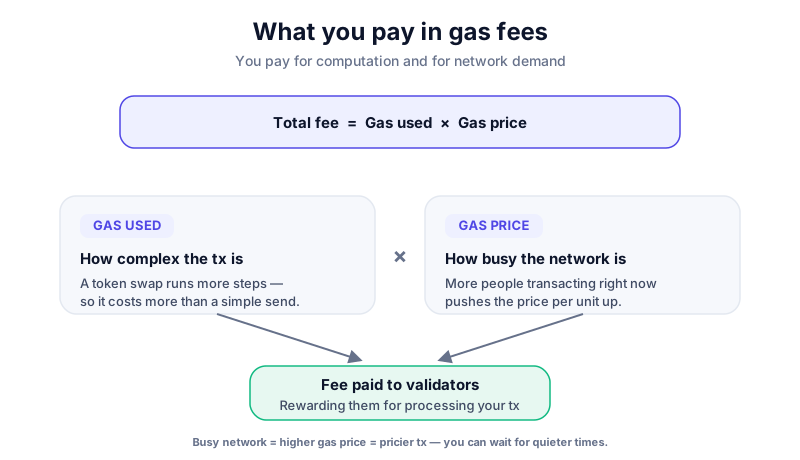
Why fees go up and down
Gas fees work like surge pricing. Block space is limited, so when lots of people want to transact at once, they bid higher fees to get in first. Fees can swing from cents to tens of pounds within hours on a busy network.
- Network congestion — the biggest factor; busy times mean higher fees.
- Transaction complexity — a simple transfer costs less than interacting with a smart contract.
- Which network — fees vary hugely between chains; some are built to be very cheap.
How to avoid overpaying
- Transact when the network is quieter — fees often drop off-peak.
- Check the estimated fee before confirming; most wallets show it.
- Keep a little of the network's coin spare so you can always cover gas.
- For small frequent payments, consider networks designed for low fees.
Always keep some native coin spare
You need the chain's coin to pay gas — even to move a token. Run out and your funds can get 'stuck' until you top up. And never let a high fee panic you into clicking through a suspicious prompt; scammers use fake 'fee' or 'unstuck wallet' pages. This is education, not financial advice.
Key takeaways
- Gas is the fee that pays the network to process your transaction.
- Fees rise with congestion and complexity, and vary a lot between chains.
- You always pay gas in the network's native coin, like ETH on Ethereum.
- Keep some native coin spare, and check the fee before you confirm.
Frequently asked questions
Why are Ethereum gas fees sometimes so high?
Block space is limited, so when demand spikes, users bid higher fees to get processed first. Transacting at quieter times usually costs much less.
Do all cryptocurrencies have gas fees?
Most charge some kind of transaction fee, though the name and amount differ. Some networks are designed specifically to keep fees tiny.
Why do I need ETH to send a token?
Tokens live on a network like Ethereum but the network charges gas in its own coin. Without a little ETH for gas, you can't move your tokens.
Keep reading
What Is a Crypto Transaction?
What happens when you send crypto: how a transaction is signed, confirmed and recorded, why fees and confirmat
Coin vs Token: What's the Difference?
Coins and tokens both trade as 'crypto', but they're not the same thing. A plain-English guide to how they dif
What Is Ethereum? A Plain-English Guide
A beginner-friendly explanation of Ethereum: what it is, how it differs from Bitcoin, what smart contracts do,