Monero vs Zcash: How the Two Privacy Coins Compare
Monero and Zcash are the two most prominent privacy coins, and they take genuinely different approaches to the same problem. This guide compares them fairly — how each hides transactions, where they differ, and the honest trade-offs — without telling you which to buy.
The 20-second version
Monero (XMR) makes privacy mandatory for every transaction. Zcash (ZEC) makes it optional, using zero-knowledge proofs, so most ZEC transactions are actually transparent. Both face regulatory pressure. Neither is 'better' in the abstract — they're built on different philosophies.
Two approaches to privacy
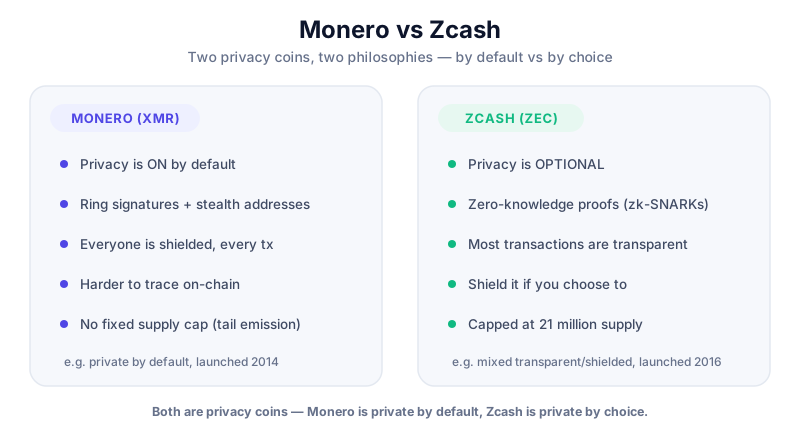
The core difference is simple. Monero hides the sender, receiver and amount on every transaction, with no way to turn it off. Zcash gives users a choice between 'transparent' addresses (which work like Bitcoin) and 'shielded' addresses (which are private).
In practice, because shielded transactions are optional and historically less convenient, a large share of Zcash activity has been transparent. Monero's 'private by default' design means its privacy applies uniformly across the whole network — which many see as its key strength.
The technology
- Monero uses ring signatures, stealth addresses and RingCT. Privacy is broad and automatic, but transactions are larger and the approach is statistical rather than mathematically absolute.
- Zcash uses zero-knowledge proofs (zk-SNARKs) — advanced cryptography that can prove a transaction is valid while revealing nothing about it. When fully shielded, this is very strong privacy.
- Both are open-source and actively developed, with the privacy debate shaping their roadmaps.
Side by side
| Feature | Monero (XMR) | Zcash (ZEC) |
|---|---|---|
| Launched | 2014 | 2016 |
| Privacy | Mandatory, every tx | Optional (shielded) |
| Core tech | Ring signatures + RingCT | Zero-knowledge proofs |
| Max supply | No fixed cap (tail emission) | 21 million |
| Typical use | Private by default | Mixed transparent/shielded |
| Regulatory pressure | High | High |
Honest trade-offs
Neither coin is universally 'better'. Monero's always-on privacy is its biggest selling point, but it also makes the coin a bigger target for delistings. Zcash's optional model is more palatable to some exchanges and regulators, but it means privacy is only as good as the share of users who actually shield their transactions.
Both have committed communities, real-world use, and ongoing development — and both share the same regulatory headwinds. The right way to think about them is by their design philosophy, not by chasing price.
A fair warning
Both XMR and ZEC are highly volatile and carry extra regulatory risk as privacy coins — they can be delisted or restricted. Only risk what you can afford to lose, never borrow to buy, and check the rules where you live. This is education, not financial advice.
A VPN encrypts your traffic and hides your IP — sensible on public Wi-Fi and before logging into any exchange. NordVPN also blocks known phishing and malware sites. It's privacy, not anonymity — it won't undo on-chain traceability.
Key takeaways
- Monero makes privacy mandatory; Zcash makes it optional via shielded addresses.
- Monero uses ring signatures and RingCT; Zcash uses zero-knowledge proofs.
- Monero has no fixed supply cap (tail emission); Zcash caps at 21 million.
- Both face heavy regulatory pressure — they're volatile and can be delisted, so only risk what you can afford to lose.
Frequently asked questions
Which is more private, Monero or Zcash?
Monero is generally considered more private in practice because every transaction is shielded by default. Zcash's shielded transactions can be equally strong, but only a portion of ZEC activity actually uses them.
Which is easier to buy?
Both can be harder to find than mainstream coins due to privacy-coin delistings. Availability of XMR and ZEC depends heavily on your region and which exchanges still list them.
Is one a better investment?
We don't give investment advice. Both are volatile and carry extra regulatory risk. Focus on understanding how each works rather than chasing price, and only risk what you can afford to lose.
Keep reading
What Is Monero (XMR)? A Plain-English Guide
A beginner-friendly explanation of Monero (XMR) — the privacy-focused cryptocurrency. How it works, why it's c
What Are Privacy Coins? The Regulatory Debate, Fairly
A balanced, plain-English explainer of privacy coins like Monero and Zcash — how they work, why people use the
How to Buy Monero (XMR) Safely: Step by Step
A safe, beginner-friendly walkthrough of how to buy Monero (XMR) — choosing an exchange, the privacy-coin catc