Tron and USDT: Why So Much Stablecoin Runs on It
If you've ever sent USDT, there's a good chance it travelled over Tron. A very large share of all Tether (USDT) in circulation lives on the Tron network. This guide explains why that happened, how the fees stay so low, and the trade-offs worth understanding before you rely on it.
The 20-second version
Tron became the default rail for USDT because transfers are fast and very cheap. That convenience comes with trade-offs: more centralisation, regulatory attention, and the need to always pick the right network when sending.
Why USDT ended up on Tron
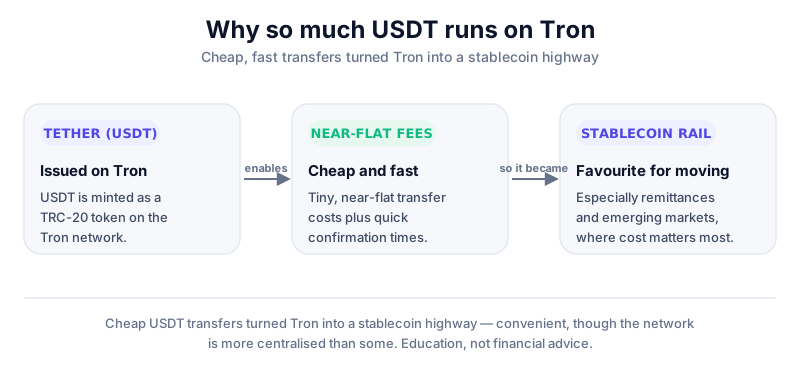
USDT is a stablecoin — a token designed to stay worth about one US dollar. It exists on several blockchains, but Tron became one of its biggest homes for a simple reason: cost. Sending USDT on Tron typically costs a tiny fraction of what the same transfer costs on Ethereum.
For people moving money across borders, paying overseas workers, or shifting funds between exchanges, those savings add up quickly. That practical advantage drove enormous USDT volume onto Tron's TRC-20 token standard.
How transfers stay so cheap
Tron keeps fees low through its design. It uses a small set of validators for high throughput, and it has a resource model where holding (or 'freezing') TRX gives you Energy and Bandwidth — allowances that can let you send transfers at little to no direct cost.
- TRC-20 is the token standard USDT uses on Tron.
- Energy and Bandwidth are consumed by transactions; staking TRX provides them.
- If you don't have enough, the network simply burns a small amount of TRX to cover the transfer.
To learn how the resource model connects to staking, see Tron staking explained.
The trade-offs
Cheap and fast is appealing, but it isn't free of downsides. Be clear-eyed about them: Whichever way you lean, the storage rule doesn't change: serious amounts belong offline, on a hardware wallet like the SafePal S1.
- Centralisation — Tron relies on just 27 elected validators, far fewer than Bitcoin or Ethereum.
- Issuer control — USDT is issued by Tether, a centralised company that can freeze specific addresses if required by law.
- Regulatory attention — cheap stablecoin rails have drawn scrutiny over illicit use, and Tron's founder faces SEC charges he denies.
- Network mismatch risk — USDT on Tron is not interchangeable with USDT on Ethereum; sending to the wrong network can lose funds.
Stablecoins aren't risk-free
A stablecoin is only as sound as its issuer and its reserves. 'Stable' means it aims to hold a dollar value — not that it's guaranteed or insured. This is education, not financial advice.
Using USDT on Tron safely
- Always confirm the network. When sending USDT, pick Tron (TRC-20) on both ends — sender and receiver must match.
- Keep a little TRX in your wallet to cover Energy/Bandwidth so transfers don't get stuck.
- Send a small test amount first, confirm it arrives, then send the rest.
- Double-check the receiving address character by character — malware can swap a copied address.
Self-custody for larger amounts
Holding USDT on an exchange means the exchange controls the keys. For meaningful sums, move it to a wallet you control — see how to store Tron safely.
Key takeaways
- Tron is a leading rail for USDT because transfers are fast and very cheap.
- Low fees come from Tron's validator design and its Energy/Bandwidth model.
- Trade-offs include centralisation, issuer control, and regulatory scrutiny.
- Always match the network (TRC-20) when sending, and keep a little TRX for fees.
Frequently asked questions
Is USDT on Tron the same as USDT on Ethereum?
It represents the same dollar value, but they live on different networks and are not directly interchangeable. You must use a matching network on both ends, or use a bridge/exchange to move between them.
Why is sending USDT on Tron so cheap?
Tron's design favours high throughput and low fees, and its Energy/Bandwidth model lets users who stake TRX send transfers at little to no direct cost.
Can my USDT on Tron be frozen?
Yes — Tether, the issuer, can freeze specific USDT addresses to comply with the law. This applies to USDT on any network, not just Tron.
Keep reading
What Is Tron (TRX)? A Plain-English Guide
A beginner-friendly explanation of Tron and its TRX token: what it is, how it works, why so many stablecoins r
What Is a Stablecoin? How the Peg Works (and Fails)
A clear guide to stablecoins: how they aim to hold a steady value, the different types, and the very real peg
Tron Staking Explained (TRX Staking and Freezing)
How Tron staking works: freezing TRX for Energy and Bandwidth, voting for Super Representatives, earning rewar