What Are Real-World Assets (RWA) in Crypto?
Real-world assets, or RWAs, are traditional assets — like government bonds, property or gold — represented as tokens on a blockchain. The idea is to bring trillions of dollars of off-chain value into DeFi. This guide explains how tokenisation works and the risks that make RWAs different from purely on-chain crypto.
The 20-second version
A real-world asset (RWA) is something from the traditional financial world — a bond, a building, a bar of gold — turned into a blockchain token. The token tracks the real asset, but its value depends on a real company actually holding and honouring that asset. That trust requirement is the key difference from native crypto.
The catch worth knowing up front
A token is only as good as its issuer
An RWA token is a claim on something held off-chain by a company or custodian. If that issuer fails, mismanages the asset, or the legal claim doesn't hold up, the token can be worth far less than the asset it represents. RWAs add counterparty and legal risk that pure crypto doesn't have. This is education, not financial advice.
What are real-world assets?
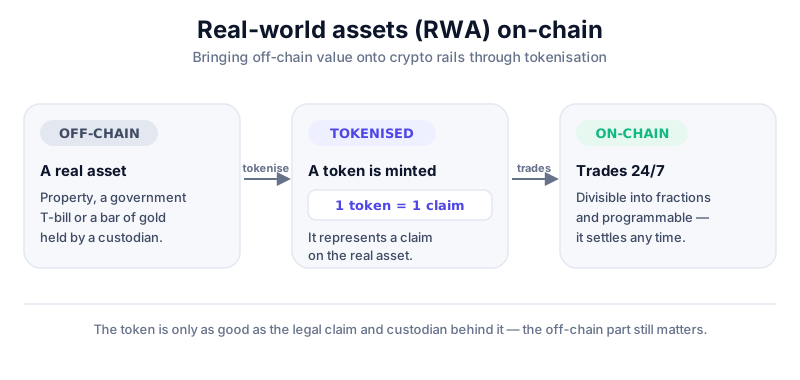
A real-world asset (RWA) is a traditional, off-chain asset represented as a token on a blockchain. The process of creating that token is called tokenisation. The token is meant to track the value of, and sometimes the income from, the underlying asset.
Common examples include:
- Tokenised treasuries — tokens backed by short-term government bonds, which have driven much of the RWA growth.
- Private credit and loans — on-chain claims on real-world lending.
- Real estate — fractional ownership of property.
- Commodities — tokens redeemable for gold or other physical goods.
How tokenisation works
Behind every RWA token is a real-world structure that connects the on-chain token to the off-chain asset. Typically:
- A custodian or legal entity holds the actual asset — the bonds, the deed, the gold.
- An issuer mints tokens that represent ownership or a claim on that asset.
- Oracles and attestations report the asset's value and confirm it still backs the tokens.
- Legal agreements define what rights the token actually gives you.
This off-chain leg is what makes RWAs powerful and risky at the same time: the blockchain part can be flawless while the real-world part fails.
Why RWAs matter
RWAs aim to merge traditional finance with crypto rails. Done well, they can make slow, illiquid assets easier to trade, settle faster, and bring familiar yield — like government-bond interest — into DeFi vaults and stablecoin-yield products.
- Access — fractional tokens lower the entry size for assets like property.
- Liquidity — assets that normally take days to sell can trade around the clock.
- Transparency — holdings and transfers are recorded on a public ledger.
The risks to weigh
- Counterparty risk — you're trusting the issuer and custodian to actually hold and honour the asset.
- Legal and regulatory risk — your rights depend on contracts and on rules that vary by country and are still evolving.
- Redemption risk — turning the token back into the real asset may be restricted, slow, or limited to certain users.
- Smart-contract and oracle risk — the on-chain layer can still be exploited or fed bad data.
Do the homework
Find out who issues the token, who audits the reserves, and what legal claim you actually hold. Treat any RWA promising outsized 'guaranteed' returns with suspicion, and learn how to avoid crypto scams before connecting a wallet or sending funds.
Key takeaways
- RWAs are traditional assets — bonds, property, gold — tokenised on a blockchain.
- Tokenised treasuries have led the recent growth in the sector.
- Each token's value depends on a real issuer and custodian honouring the off-chain asset.
- Counterparty, legal and redemption risks make RWAs different from native crypto.
Frequently asked questions
Are RWAs safer than other crypto because they're backed by real assets?
Not automatically. The backing only helps if the issuer is trustworthy, the reserves are real and audited, and your legal claim is enforceable. That backing also introduces counterparty risk that pure crypto avoids.
What's the most common type of RWA today?
Tokenised short-term government bonds (often called tokenised treasuries) have been the biggest category, because they offer familiar, relatively stable yield that DeFi protocols can build on.
Can I redeem an RWA token for the actual asset?
Sometimes, but often only under specific conditions or for eligible investors. Always check the redemption terms before assuming you can swap a token back for the underlying asset.
Keep reading
What Is Stablecoin Yield? Earning on Dollar-Pegged Crypto
A plain-English guide to stablecoin yield: where the interest actually comes from, the difference between lend
What Is a DeFi Vault? Automated Yield Explained
A beginner-friendly guide to DeFi vaults: how automated yield strategies work, what 'auto-compounding' means,
What Is DeFi? Decentralised Finance Explained
A beginner's guide to decentralised finance: what DeFi is, how lending, trading and yield work without a bank