What Is a Liquid Staking Token (LST)?
A liquid staking token (LST) lets you earn staking rewards without locking your crypto away. You stake an asset like Ether, receive a token in return, and can still use that token across DeFi while the original keeps earning. This guide explains how LSTs work and the risks of the convenience.
The 20-second version
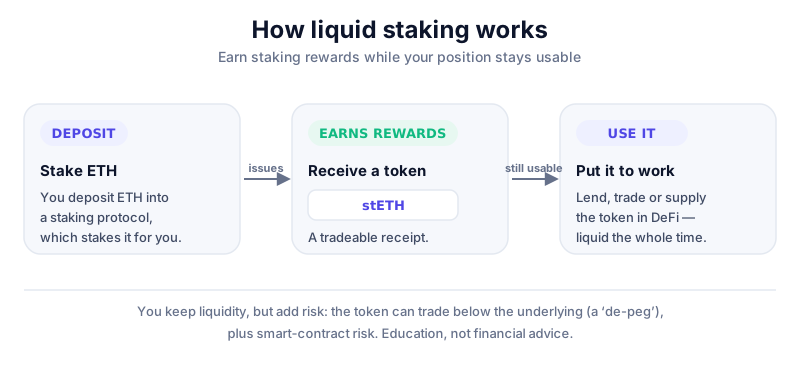
Normally, staking locks your coins so they can secure a network. A liquid staking token gives you a tradeable receipt for your staked coins, so you earn rewards and stay liquid at the same time. The trade-offs: the receipt can trade below its real value, and you take on extra smart-contract and slashing risk.
The risk up front
Liquid doesn't mean risk-free
An LST adds layers on top of plain staking: smart-contract risk in the protocol, the chance the token trades below ('de-pegs' from) the value of the staked asset, and exposure to penalties if the validators misbehave. Only stake what you can afford to lose, and treat this as education — not financial advice.
What is a liquid staking token?
When you stake a proof-of-stake asset like Ether on Ethereum, you help secure the network and earn rewards — but your coins are normally locked and can't be used for anything else.
A liquid staking protocol solves that. You deposit your asset, the protocol stakes it for you, and it issues you a liquid staking token — a tradeable receipt that represents your staked position plus the rewards it earns. You can hold, trade, or use that LST elsewhere while the underlying stays staked.
- Earn while staying liquid — rewards accrue without locking up your capital.
- Composable — LSTs can be supplied to vaults, lending markets and DEXs.
- Lower barrier — pooled staking means you don't need the full minimum to run a validator.
How LSTs track their value
There are two common designs for how an LST reflects accumulating rewards:
- Rebasing — your token balance grows over time as rewards are added, while each token stays roughly 1:1 with the underlying.
- Reward-bearing — your balance stays fixed, but each token is redeemable for steadily more of the underlying asset as rewards accrue.
Either way, an LST is meant to be redeemable for the staked asset (sometimes after an unstaking wait). Its market price should track that redemption value — but it doesn't always, which brings us to the risks. One habit worth adopting from day one: delegate from a hardware wallet like the Keystone 3 Pro, so staking never means exposing your keys.
The risks of liquid staking
- De-peg risk — in stressed markets, an LST can trade below the value of the asset it represents, especially if unstaking is slow.
- Smart-contract risk — a bug in the staking protocol can put deposits at risk; this is on top of the base network's own risks.
- Slashing risk — if the validators behind the protocol misbehave or go offline, a penalty ('slashing') can reduce the staked balance.
- Centralisation risk — if one liquid-staking provider grows too large, it can concentrate power over the underlying network.
Vet the provider
Favour established protocols with public audits, a clear track record, and a healthy spread of independent validators. Connect through a hardware wallet, confirm the official site, and learn how to avoid crypto scams. No staking service will ever need your seed phrase.
Key takeaways
- A liquid staking token is a tradeable receipt for staked crypto that keeps earning rewards.
- It lets you stay liquid and reuse the token across DeFi instead of locking funds away.
- LSTs come in rebasing and reward-bearing designs, both redeemable for the staked asset.
- De-peg, smart-contract, slashing and centralisation risks all apply — stake only what you can afford to lose.
Frequently asked questions
How is liquid staking different from normal staking?
Normal staking locks your coins. Liquid staking gives you a tradeable token in return, so you earn rewards and can still use that token elsewhere — at the cost of extra smart-contract and de-peg risk.
Can a liquid staking token lose its peg?
Yes. In volatile or stressed markets an LST can trade below the value of the underlying staked asset, particularly when unstaking takes time. It's one of the main risks to understand.
Are staking rewards guaranteed?
No. Reward rates vary with network conditions, and slashing penalties can reduce your balance. The value of the underlying asset can also fall regardless of any rewards earned.
Keep reading
What Is a DeFi Vault? Automated Yield Explained
A beginner-friendly guide to DeFi vaults: how automated yield strategies work, what 'auto-compounding' means,
What Is Stablecoin Yield? Earning on Dollar-Pegged Crypto
A plain-English guide to stablecoin yield: where the interest actually comes from, the difference between lend
What Is Staking? How It Works and What It Costs
A plain-English guide to crypto staking: how it secures proof-of-stake networks, how rewards work, and the loc