What Is a Soulbound Token (SBT)?
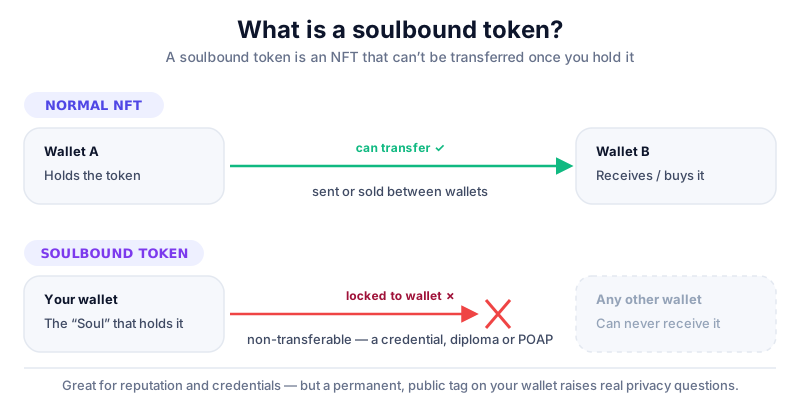
Most NFTs can be bought and sold. A soulbound token (SBT) is the opposite — an NFT that can't be transferred once you hold it. The idea is to represent things you earn rather than things you trade, like credentials, memberships and reputation. Here's how SBTs work and where they're useful.
The 20-second version
A soulbound token is a non-transferable NFT bound to one wallet (or 'Soul'). Because it can't be sold, it's suited to credentials, proof of attendance, or membership — things that should belong to you and you alone.
What is a soulbound token?
The term comes from a 2022 paper co-authored by Ethereum's Vitalik Buterin, which borrowed 'soulbound' from gaming, where some items permanently bind to a character. An SBT works the same way: once issued to a wallet, it stays there and can't be transferred to someone else.
That single restriction changes what the token is good for. A tradable NFT is an asset; a soulbound token is more like a badge, certificate or ID card that's meaningless if it could simply be sold.
How SBTs work
Technically, an SBT is usually an NFT whose smart contract disables transfers. It lives in a wallet — sometimes called a 'Soul' — alongside any other SBTs that wallet has collected over time.
- Issued, not bought: an organisation or contract grants the token to your wallet.
- Non-transferable: you can't sell or send it, so it can't be faked by buying one.
- Verifiable: anyone can check on-chain that your wallet holds it.
What are SBTs used for?
- Credentials: a diploma, course completion or professional certification tied to your wallet.
- Proof of attendance: a token confirming you were at an event (often called a POAP).
- Membership and governance: voting rights in a DAO that shouldn't be bought.
- Reputation: on-chain history that can't be transferred to a fresh account.
Because SBTs can't be traded, they can also help curb sybil attacks — where one person creates many wallets to game a vote or an airdrop. Whichever way you lean, the storage rule doesn't change: serious amounts belong offline, on a hardware wallet like the Ledger Nano X.
Open questions and limits
Privacy is the big concern
A wallet full of permanent, public credentials can reveal a lot about you. SBTs are still experimental, and standards for privacy and revocation are unsettled. Think carefully before binding sensitive information to a public address.
- Lost wallet, lost credentials: if you lose access and have no seed phrase backup, the tokens are gone.
- Revocation: cancelling a credential that's already been issued is technically tricky.
- Adoption: SBTs only matter if institutions actually issue and accept them, which is early days.
Key takeaways
- A soulbound token is a non-transferable NFT bound to one wallet.
- The idea, popularised in 2022, suits credentials, memberships and reputation — not trading.
- SBTs can help reduce sybil attacks and prove identity on-chain.
- Privacy, revocation and lost-wallet recovery remain unsolved challenges.
Frequently asked questions
Can I sell a soulbound token?
No — that's the whole point. SBTs are non-transferable, so they can't be bought, sold or sent to another wallet. That's what makes them suitable for credentials.
Are soulbound tokens the same as NFTs?
They're a special kind of NFT. The technology is similar, but an SBT's smart contract disables transfers, so it behaves like a permanent badge rather than a tradable asset.
What happens if I lose access to my wallet?
The SBTs are tied to that wallet, so losing access usually means losing them. Always back up your seed phrase safely and offline.
Keep reading
What Is an NFT? A Clear Beginner's Guide
What NFTs actually are, how they work as proof of ownership on a blockchain, what they're used for, and the ri
What Is an NFT Collection?
A plain-English guide to NFT collections: what they are, how minting and supply work, what gives them value, a
NFT Utility Explained
What 'NFT utility' really means: access, membership, gaming, ticketing and rewards — plus how to tell genuine