What Is Cardano (ADA)? A Plain-English Guide
Cardano is a blockchain platform, and ADA is the cryptocurrency that powers it. It was built with a research-first philosophy — academic peer review before code — which makes it one of the more distinctive projects in crypto. This guide explains what Cardano is in plain English, how it works under the hood, and how to think about it without the hype.
The 20-second version
Cardano is a proof-of-stake blockchain for sending value and running smart contracts. Its coin is called ADA. Instead of energy-hungry mining, it's secured by people staking ADA. It's known for a slow, peer-reviewed, research-led approach.
What is Cardano?
Cardano is a public blockchain — a shared, decentralised ledger a bit like Ethereum — that lets people send value and build applications without a bank or company in the middle. Its native cryptocurrency is ADA, named after the 19th-century mathematician Ada Lovelace.
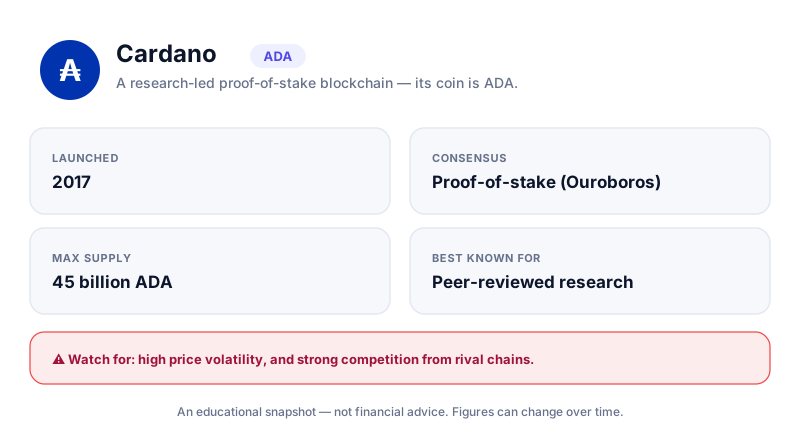
Where Cardano stands out is its philosophy. It was launched in 2017 by Charles Hoskinson, one of Ethereum's co-founders, and is developed with a strong emphasis on academic peer review — research papers are published and scrutinised before features ship. Supporters call this rigorous; critics call it slow. Both have a point.
Three ideas sit at the heart of the project: it's decentralised (no single owner), proof-of-stake (secured without mining), and research-led (formal methods over move-fast-and-break-things).
How Cardano works
Cardano secures its network using a proof-of-stake system called Ouroboros. Instead of miners racing to solve puzzles, ADA holders 'stake' their coins to help validate transactions and produce blocks. This uses a tiny fraction of the energy that Bitcoin mining does. If staking is new to you, our guide on what staking is covers the basics.
- ADA is the coin used to pay fees, stake, and participate in governance.
- Ouroboros is the proof-of-stake protocol that keeps the network secure.
- Stake pools are operators that produce blocks; you can delegate your ADA to one and earn rewards without giving up control of your coins.
- Smart contracts let developers build apps (using a language called Plutus) on top of the chain.
Cardano is built in named eras — Byron, Shelley, Goguen, Basho and Voltaire — each adding capability such as decentralisation, smart contracts, scaling and on-chain governance. Smart contracts went live in 2021, opening the door to DeFi and other applications.
What is ADA used for?
ADA has a few practical roles on the network rather than being purely a token to trade:
- Paying transaction fees when you send ADA or use an app.
- Staking and delegation to help secure the network and earn rewards.
- Governance — ADA holders can vote on proposals and on how the project's treasury is spent.
A fair warning
ADA's price is highly volatile and the platform still competes hard with larger rivals. Only ever risk what you can afford to lose, and never borrow to buy crypto. This guide is education, not financial advice.
The honest case, both ways
Being balanced matters here. On the positive side, Cardano's peer-reviewed approach has produced a network with a strong track record for uptime and a low energy footprint, plus an active research and community base.
On the critical side, that same caution has meant Cardano shipped smart contracts later than competitors, and some have argued its ecosystem of working apps grew more slowly than the marketing suggested. It also faces intense competition from Ethereum, Solana and others. None of this tells you whether ADA is a good or bad buy — only that the project has genuine strengths and real open questions.
Where to go next
Now you know what Cardano is, sensible next steps are learning how to buy ADA safely, how to store it safely, and how ADA staking works. If you're weighing it against the biggest smart-contract platform, see our Cardano vs Ethereum comparison. And however you weigh the trade-offs, keep meaningful holdings in cold storage — a Trezor Safe 5 — rather than on an exchange.
Key takeaways
- Cardano is a proof-of-stake blockchain; its coin is called ADA.
- It's known for a research-first, peer-reviewed approach — thorough but slower to ship.
- ADA is used for fees, staking and governance, not just trading.
- It's volatile and faces strong competition — only risk what you can afford to lose.
Frequently asked questions
Is Cardano the same as ADA?
Not quite. Cardano is the blockchain network; ADA is the cryptocurrency that runs on it. People often use the names interchangeably, but technically they're different things.
Does Cardano use mining like Bitcoin?
No. Cardano uses proof-of-stake, so it's secured by people staking ADA rather than by energy-intensive mining. That makes it far more energy-efficient than Bitcoin.
Who created Cardano?
It was launched in 2017 by Charles Hoskinson, an Ethereum co-founder, with development led by IOHK (now Input Output), the Cardano Foundation and Emurgo.
Keep reading
How to Buy Cardano (ADA) Safely: A Step-by-Step Guide
A beginner-friendly, step-by-step guide to buying Cardano (ADA) safely — choosing an exchange, verifying your
How to Store Cardano (ADA) Safely
Keep your Cardano (ADA) safe: hot vs cold wallets, the best ADA wallets, using a hardware wallet, and seed-phr
Cardano Staking Explained: How ADA Staking Works
A plain-English guide to staking Cardano (ADA): how delegation works, stake pools, rewards, the risks, and how