What Is MEV? Maximal Extractable Value Explained
MEV — Maximal Extractable Value — is one of the less visible but important forces in crypto. It's the extra profit that whoever orders transactions on a blockchain can squeeze out by choosing what goes first. If you've ever had a DEX trade fill at a worse price than expected, MEV may be why. This guide explains it in plain English.
The 20-second version
MEV is profit extracted by reordering, inserting, or excluding transactions in a block. Because pending transactions are public, sophisticated players can jump ahead of yours — sometimes at your expense. Slippage limits and MEV-protected tools help guard against it.
What is MEV?
MEV stands for Maximal Extractable Value (originally 'Miner' Extractable Value). It's the value that can be captured by whoever decides the order of transactions in a block — typically validators or specialised parties working with them.
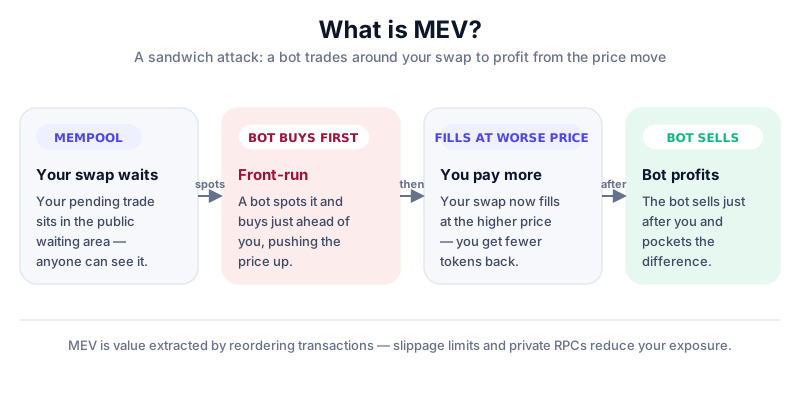
Here's the key fact that makes MEV possible: when you submit a transaction, it usually sits in a public waiting area (the 'mempool') before being confirmed. Anyone can see it. That visibility lets sophisticated players react to your transaction before it settles.
Common forms of MEV
MEV comes in several flavours. Some are harmless or even helpful to the market; others come directly out of ordinary users' pockets.
- Arbitrage — buying an asset cheaply on one DEX and selling it higher on another. Often beneficial, as it keeps prices aligned.
- Front-running — spotting your pending trade and placing the same trade just ahead of it to profit from the price move you're about to cause.
- Sandwich attacks — placing one order just before yours and one just after, so your trade fills at a worse price and the attacker pockets the difference.
- Liquidations — racing to be the one who closes out an under-collateralised DeFi loan and collects the reward.
Why MEV matters to you
For an everyday user, MEV usually shows up as worse-than-expected trade prices. A sandwich attack, for example, can quietly cost you a slice of every large or low-liquidity swap you make on a public DEX.
It can affect your real money
MEV is not a scam, but it can make your trades cost more than you expected. Large swaps, volatile tokens, and thin liquidity all increase your exposure. This is education, not financial advice.
How to protect yourself
You can't eliminate MEV, but you can reduce how much it affects you.
- Set a tight slippage tolerance so a trade fails rather than filling at a bad price.
- Break large trades into smaller pieces to reduce the price impact attackers can exploit.
- Use MEV-protected transaction tools or private order routing where your exchange or wallet offers them.
- Trade more liquid pairs, where the spread an attacker can capture is smaller.
MEV is also being addressed at the protocol level. Various projects aim to make transaction ordering fairer or to share the resulting value more broadly, though this remains an active area of research.
Where to go next
MEV connects to several other core concepts. To understand who actually orders transactions, read about validators; to understand where MEV bites hardest, see what a DEX is and what DeFi is. And however you weigh the trade-offs, keep meaningful holdings in cold storage — a Keystone 3 Pro — rather than on an exchange.
Key takeaways
- MEV is profit from reordering, inserting, or excluding transactions in a block.
- It exists because pending transactions are publicly visible before they confirm.
- Sandwich attacks and front-running can make your trades cost more.
- Tight slippage limits and MEV-protected tools reduce your exposure.
Frequently asked questions
Is MEV illegal?
No. It's a structural feature of how public blockchains order transactions, not a hack. Some forms are harmful to users, though, which is why protections exist.
Does MEV affect Bitcoin?
Far less than smart-contract chains. MEV is most significant on networks with lots of DeFi activity, like Ethereum, where there's complex transaction ordering to exploit.
Can I avoid MEV completely?
Not entirely, but you can minimise it with tight slippage settings, smaller trades, liquid pairs, and MEV-protected routing where available.
Keep reading
What Is a Crypto Validator? A Plain-English Guide
A beginner-friendly guide to crypto validators: what they do, how proof-of-stake works, how to become one, and
What Is a DEX? Decentralised Exchanges Explained
A plain-English guide to decentralised exchanges (DEXs): how they let you swap tokens without an account, how
What Is DeFi? Decentralised Finance Explained
A beginner's guide to decentralised finance: what DeFi is, how lending, trading and yield work without a bank