What Is Sharding? Blockchain Scaling Explained
Sharding is one of the main techniques blockchains use to handle more transactions without slowing down. The idea is borrowed from traditional databases: split the work into pieces so many computers can process them in parallel. This guide explains what sharding is, why it matters for scaling, and the trade-offs it brings.
The 20-second version
Sharding splits a blockchain into smaller parallel pieces called 'shards', so the network can process many transactions at once instead of one chain doing everything. More throughput, but more complexity — and it's still maturing in practice.
The problem sharding solves
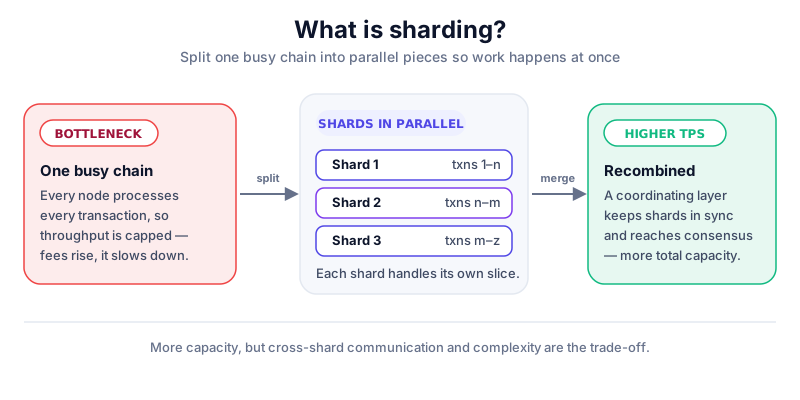
In a traditional blockchain, every computer in the network ('node') has to process and store every single transaction. That keeps the network secure and decentralised, but it also caps how many transactions it can handle. When demand spikes, fees rise and confirmations slow down — a problem often called the scalability trilemma.
Sharding is one answer. Instead of forcing every node to do all the work, the network is split so different groups of nodes handle different portions of it.
How sharding works
The word 'shard' comes from databases, where a large table is broken into smaller pieces to spread the load. A sharded blockchain applies the same idea to transactions and data.
- The network is divided into several shards, each handling its own slice of transactions.
- Nodes are assigned to a shard rather than processing everything, so work happens in parallel.
- A coordinating layer keeps the shards in sync and lets them communicate.
- Total capacity grows roughly with the number of shards.
The result is more throughput without asking every individual computer to do more work — which helps keep the network accessible to ordinary participants.
Sharding in practice
Sharding has long been part of Ethereum's scaling roadmap, though its approach has evolved. Rather than full transaction sharding, Ethereum has leaned on 'rollups' (which process transactions off-chain) combined with 'data sharding' to make storing that data cheaper. Other networks, such as Near and Zilliqa, have pursued sharding more directly.
Sharding is just one scaling tool. Networks like Solana take a different path entirely, optimising a single fast chain. There is no single 'correct' answer — each approach trades off in different ways.
The trade-offs
Sharding is powerful but not free. Splitting a network into pieces introduces real engineering challenges.
- Cross-shard communication is hard — moving value or data between shards adds complexity and delay.
- Security can weaken if any single shard has too few honest nodes defending it.
- Complexity makes the system harder to build, test and reason about.
Scaling is a moving target
How a blockchain scales changes over time as research advances. Treat any specific roadmap as a snapshot, and check a project's own documentation for the current state.
Where to go next
Sharding sits alongside other core ideas in how blockchains operate, like what a validator does and how networks secure themselves through staking. Understanding Ethereum gives the clearest picture of how these pieces fit together. Whichever way you lean, the storage rule doesn't change: serious amounts belong offline, on a hardware wallet like the OneKey.
Key takeaways
- Sharding splits a blockchain into parallel pieces so it can process more transactions.
- The idea is borrowed from how large databases spread their load.
- Ethereum uses data sharding alongside rollups; other networks shard transactions directly.
- It adds throughput but also complexity and cross-shard challenges.
Frequently asked questions
Does sharding make a blockchain less secure?
It can if any individual shard is defended by too few honest nodes. Good sharding designs randomly reassign nodes and add safeguards to keep each shard secure.
Is Ethereum fully sharded today?
Not in the original sense. Ethereum now focuses on rollups for execution and uses data sharding to make storing rollup data cheaper. Check Ethereum's documentation for the current roadmap.
Is sharding the only way to scale a blockchain?
No. Rollups, larger blocks, and faster single-chain designs are all alternatives. Most networks combine several techniques.
Keep reading
What Is Ethereum? A Plain-English Guide
A beginner-friendly explanation of Ethereum: what it is, how it differs from Bitcoin, what smart contracts do,
What Is Solana? A Plain-English Guide
A beginner-friendly explanation of Solana (SOL): what it is, how it differs from Bitcoin and Ethereum, what it
What Is a Crypto Validator? A Plain-English Guide
A beginner-friendly guide to crypto validators: what they do, how proof-of-stake works, how to become one, and