The Ripple vs SEC Case, Explained
For years, XRP was at the centre of one of crypto's most-watched legal battles: the US Securities and Exchange Commission's lawsuit against Ripple. This explainer lays out the facts plainly and fairly — what was claimed, the landmark 2023 ruling, and how the case was eventually resolved. It is not financial or legal advice.
The 20-second version
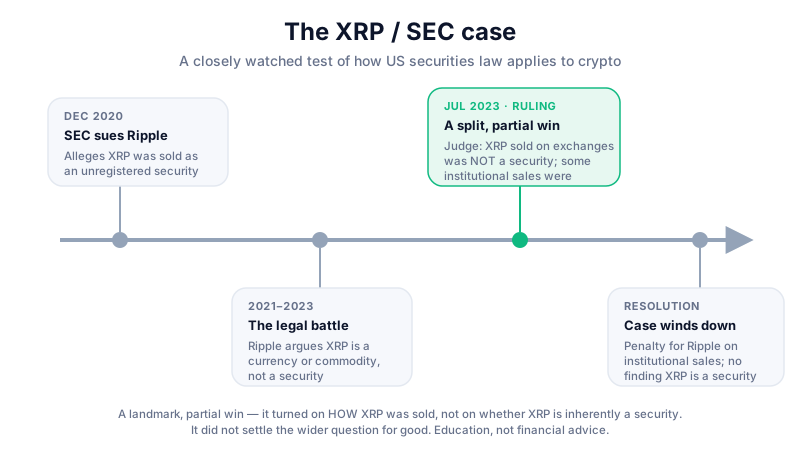
In 2020 the SEC sued Ripple, alleging XRP was sold as an unregistered security. In July 2023 a US court ruled that XRP sold to the public on exchanges was not a security, while certain sales to institutions were. The case later wound down with a financial penalty for Ripple and no finding that XRP itself is a security.
The background
In December 2020, the SEC filed a lawsuit against Ripple Labs and two of its executives. The core claim was that Ripple had raised funds by selling XRP as an 'unregistered security' — meaning, in the SEC's view, that XRP sales should have followed the same rules as selling company shares.
Ripple disputed this, arguing that XRP is a currency or commodity, not a security, and that buyers on the open market weren't investing in Ripple the company. The case became a closely watched test of how US securities law applies to crypto.
The landmark 2023 ruling
In July 2023, a US federal judge issued a split decision that became one of the most cited rulings in crypto. The court drew a distinction based on *how* the XRP was sold:
- Sales to the public on exchanges were not securities. Everyday buyers purchasing XRP on an exchange typically didn't know whether their money was going to Ripple, so those programmatic sales didn't meet the legal test for an investment contract.
- Certain institutional sales were securities. When Ripple sold XRP directly to sophisticated institutional buyers under contracts, the court found those sales did meet the test.
Why this mattered
The ruling was the first time a US court found that a major token sold on exchanges was not, in that context, a security. It was widely seen as significant for the broader industry — though as a district-court decision, it did not set nationwide binding precedent.
How the case was resolved
After the 2023 ruling, the remaining questions centred on penalties for the institutional sales and whether either side would appeal. Over the following period the litigation wound down: a financial penalty was imposed on Ripple related to those institutional sales, and the long-running dispute moved toward closure without any finding that XRP itself is inherently a security.
The practical upshot is that the headline finding — that XRP traded by the public on exchanges was not a security — stood, while Ripple faced consequences specifically for how it had handled direct institutional sales. Whichever way you lean, the storage rule doesn't change: serious amounts belong offline, on a hardware wallet like the Ledger Nano X.
What it does — and doesn't — mean
It's easy to over-read a legal outcome, so here is a careful, balanced summary:
- It does not mean XRP is endorsed or 'safe' to buy. A legal classification is not investment advice and says nothing about price.
- It does not settle US crypto law for every token. The ruling turned on the specific facts of how XRP was sold.
- It does clarify one important question — that buying XRP on an exchange was not, in this case, treated as buying a security.
Legal clarity is not a green light
Regulatory news can move XRP's price sharply in either direction, and the outcome of one case doesn't make any asset a good or safe investment. XRP is highly volatile — only risk what you can afford to lose, never borrow to buy crypto, and treat this as education, not advice.
Key takeaways
- The SEC sued Ripple in 2020, alleging XRP was sold as an unregistered security.
- A July 2023 ruling found XRP sold to the public on exchanges was not a security, but some institutional sales were.
- The case later wound down with a penalty for Ripple and no finding that XRP itself is a security.
- A legal outcome is not investment advice and says nothing about XRP's price.
Frequently asked questions
Did the court say XRP is not a security?
It ruled that XRP sold to the public on exchanges was not a security in that context, while certain direct sales to institutions were. The classification depended on how the XRP was sold, not on XRP as an object.
Does the ruling apply to all cryptocurrencies?
Not automatically. It was a district-court decision based on the specific facts of Ripple's XRP sales. It was influential, but it did not rewrite securities law for every token.
Does this make XRP a good investment?
No. A legal outcome says nothing about whether an asset will rise or fall in value. XRP remains highly volatile, and this article is education, not financial advice.
Keep reading
What Is XRP? A Plain-English Guide
A beginner-friendly explanation of what XRP is, how it differs from Bitcoin, its link to Ripple, and how to th
XRP vs Traditional Payments: How Cross-Border Money Moves
A balanced look at how XRP aims to speed up cross-border payments compared with the traditional banking system
How to Buy XRP Safely (Step by Step)
A clear, safety-first guide to buying XRP: choosing a reputable exchange, verifying your account, placing your