Avalanche Staking Explained (AVAX)
By now you've bought AVAX and tucked it away safely. This lesson covers something you can actually do with it: staking — the system that secures Avalanche and rewards people for taking part. We'll explain how AVAX staking works, the difference between running a validator and delegating, and the real risks to weigh before you lock anything away. Rewards sound appealing, and that's exactly the problem — this is the lesson where a clear head matters most, because 'earn rewards' is the phrase scammers and hype-merchants lean on hardest.
The 20-second version
Avalanche is proof-of-stake: people lock up AVAX to help validate transactions and earn rewards. You can run your own validator (a big technical and capital commitment) or delegate to one (simpler). Staked AVAX is locked for a fixed period, and rewards aren't guaranteed — so understand the trade-offs first.
What staking actually is
Avalanche is a proof-of-stake network, which we first introduced back in how Avalanche works. Instead of miners burning electricity to secure the chain, validators lock up AVAX as a stake. That stake works like a security deposit on a rented flat: behave well and you get it back with rewards on top; cause problems or disappear and you forfeit some of the upside. The genius of the design is that it makes honesty the financially sensible choice — cheating the network would mean putting your own money on the line, and the maths simply doesn't favour the cheat.
This is the same broad idea as Ethereum staking and Solana staking, so if you've met either of those you'll recognise the shape of it immediately. Avalanche just has its own specific rules around minimum amounts, how long you must lock up, and how penalties work in practice. The underlying principle is identical across all three; only the fine print differs. If you understand staking on one proof-of-stake chain, you're most of the way to understanding it everywhere.
Rewards aren't free money
Staking rewards come from new AVAX being issued plus a share of network fees. They're payment for providing a genuine service — helping secure the network — and for taking on real risk in return. They are not a guaranteed yield, and they are absolutely not a reason on their own to buy a volatile asset you wouldn't otherwise want.
Validating vs delegating
There are two ways to take part in staking, and they sit at opposite ends of the effort scale. One is running the whole operation yourself; the other is lending your AVAX to someone who already does. The overwhelming majority of ordinary people choose the second, and for good reason — the first is closer to a part-time job than a passive investment.
| Run a validator | Delegate | |
|---|---|---|
| What you do | Operate a node 24/7 | Lock AVAX with an existing validator |
| AVAX needed | A large minimum stake | A smaller minimum |
| Technical skill | High — you run the infrastructure | Low — done from a wallet |
| Who has the keys | You keep custody | You keep custody (non-custodial delegation) |
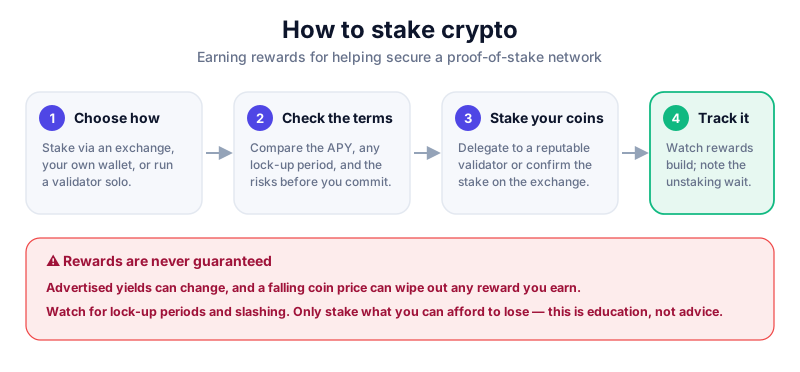
Most people delegate. In plain terms, you keep full control of your AVAX and simply point it at a validator's stake, helping back them up and sharing in the rewards in return for a small fee that they charge. The genuinely reassuring part is that native delegation is non-custodial — you never hand your coins over to anyone, you just assign them to support a validator while they stay firmly in your own wallet. Running a validator yourself is a different beast entirely: it demands reliable hardware, an always-on internet connection that never drops, real technical know-how, and a much larger minimum stake. It's closer to running a small server business than clicking a button — fine if that appeals to you, overkill if it doesn't.
Rewards, lock-ups and uptime
When you stake, you choose a lock-up period up front, and here's the catch people consistently underestimate: your AVAX is committed for that entire time. You cannot sell it, move it, or rescue it if the price falls off a cliff the very next day — it's frozen solid until the term you picked ends. That illiquidity is the real, hidden cost of staking, and it's exactly why the size of the headline reward should never be the only thing you look at. How much you actually earn depends on the amount you stake, how long you lock it for, and the uptime of the validator you chose to back.
- Lock-up — your staked AVAX is completely illiquid until the term you chose ends. Pick a length you can truly live without touching, then assume you'll have to.
- Uptime matters — if the validator you delegate to goes offline too often, rewards get missed, and as a delegator you share in that shortfall through no fault of your own.
- Fees — validators take a cut of delegators' rewards as their fee, so it's well worth comparing rates rather than just picking the first one you see in the list.
- Variable returns — any reward rate you're shown is an estimate, not a promise carved in stone. Treat headline percentages with healthy suspicion, especially the eye-catching ones.
Choosing a validator
If you delegate, look at a validator's uptime history, the fee it charges, and how long it's been operating reliably. A boring validator with a long, steady track record beats a flashy new one promising more. Spreading your stake across more than one can soften the blow if any single one underperforms or drops offline.
The honest risks
We'll say this plainly because plenty of websites won't: staking is not a savings account, and the advertised percentage is not interest in any meaningful sense. It's important to understand exactly what you're signing up for before you lock anything away, because once it's locked, it's locked. Here are the four risks that matter most: One habit worth adopting from day one: delegate from a hardware wallet like the Keystone 3 Pro, so staking never means exposing your keys.
- Price risk — your AVAX can fall in value while it's locked, easily wiping out every penny of rewards and then a great deal more. A nice-looking yield on a falling asset is still, overall, a loss.
- Lock-up risk — you genuinely cannot exit during the staking term, no matter what the market does or how loudly you'd like to. That loss of flexibility is the trade you're making.
- Custody risk — if you stake through a third-party platform instead of native non-custodial delegation, you're trusting that platform with your coins, and platforms can fail, freeze, or be hacked.
- 'Liquid staking' risk — products that hand you a tradeable token representing your staked AVAX add a whole extra layer of smart-contract risk on top of everything else. More moving parts means more that can quietly break.
Education, not advice
Nothing here is financial advice. Staking rewards never make a volatile asset 'safe' — they're a small return wrapped around the same big risks you already had. Only stake what you can afford to lock away and potentially lose, and never share your seed phrase to 'activate' or 'unlock' staking. Real staking never needs it; that request is always, without exception, a scam.
Key takeaways
- Avalanche is proof-of-stake: AVAX is locked up to secure the network and earn rewards.
- Most people delegate to a validator rather than running one.
- Staked AVAX is locked for a fixed term and can't be moved or sold.
- Rewards are variable and don't offset price or lock-up risk.
Frequently asked questions
Can I lose my AVAX by staking?
With ordinary non-custodial delegation, coins aren't 'taken' from you — but your AVAX can fall in value while it's locked, and rewards can be missed if your validator performs poorly. Staking through risky third-party platforms or liquid-staking products adds further ways to lose.
How long is AVAX locked when staking?
You choose a lock-up period within the range the network allows. Your AVAX is committed for that whole time with no early exit, so pick a duration you're genuinely comfortable not touching, whatever the price does in the meantime.
Do I keep control of my coins when delegating?
With native (non-custodial) delegation, yes — you delegate without ever handing over custody. With some exchange or platform staking, the provider holds the keys instead, which is a meaningfully different risk to weigh up before you commit.
Keep reading
What Is Avalanche (AVAX)? A Plain-English Guide
A beginner-friendly explanation of Avalanche and its AVAX token: what it is, how it's structured, what it's us
How Avalanche Works: Three Chains, Subnets & Consensus
A clear look under the hood of Avalanche: the X, C and P chains, what subnets are, and how Avalanche consensus
What Is Staking? How It Works and What It Costs
A plain-English guide to crypto staking: how it secures proof-of-stake networks, how rewards work, and the loc