Solana Staking Explained (Beginner's Guide)
Now that your SOL is bought and safely stored, you can put it to work. Staking is how SOL holders help secure the Solana network and earn rewards in return — and it builds directly on the validators and Proof of Stake we met in lesson two. We'll explain how it works in plain English, where the rewards actually come from, the risks that get conveniently glossed over, and how to stake safely.
The 20-second version
Staking means locking up SOL with a validator to help secure the network, earning rewards in return. You keep ownership of your SOL the whole time, but it's tied up while staked and the rewards aren't guaranteed. It is not free money — understand the risks, especially price risk, first.
What staking actually is
Cast your mind back to how Solana works: the network is secured by Proof of Stake, where validators lock up SOL as a stake, and the more SOL staked with them, the more often they get to process transactions. Staking is simply how ordinary holders join in. You don't need to run a server or buy fancy hardware — you *delegate* your SOL to a validator, and they do the technical heavy lifting on your behalf.
Here's the part that reassures most people: delegating does not hand your SOL over to the validator. You keep full ownership the entire time. The validator can't spend it, can't withdraw it, and can't run off with it. You're lending your stake's *weight* to support them, not the coins themselves. In exchange for helping keep the network secure and honest, you earn a share of the rewards it produces.
Where the rewards come from
It's worth understanding where staking rewards actually come from, because that's exactly the question scams hope you won't ask. On Solana, rewards come from two real sources: newly created SOL (the network issues a small, steady amount of new SOL to reward those securing it) and a portion of the transaction fees people pay to use the network. In other words, it's genuine network activity paying you — not a company conjuring 'returns' out of thin air, which is the hallmark of a Ponzi scheme.
- Issuance — the protocol mints new SOL on a schedule and distributes it to stakers and validators.
- Validator commission — the validator keeps a cut (often just a few percent) for running the infrastructure and keeping it online.
- Variable, not fixed — the reward rate drifts over time with network conditions and is never guaranteed or promised.
Rewards aren't 'interest'
It's tempting to picture a staking yield like a savings-account interest rate, but the comparison is misleading. It's a variable reward for securing a volatile network — and the SOL you earn can fall in value just as fast as the SOL you staked. A '7% yield' means nothing if SOL drops 30%.
How to stake SOL
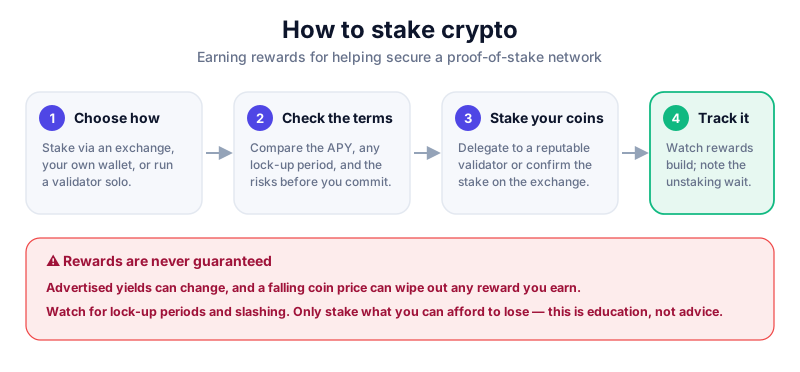
The most common and self-custodial way to stake is straight from a wallet such as Phantom, which has staking built right in. You can also stake through some exchanges, which is simpler to click through but means *they* hold the keys — the same 'not your keys, not your coins' trade-off we keep coming back to. Doing it from your own wallet keeps you in control.
- Use a wallet you control, ideally the hardware-wallet-and-Phantom setup from storing SOL safely for larger amounts. Your keys stay offline; you just authorise the staking.
- Open the staking section and review the available validators. Look at their commission, their uptime track record, and how much SOL is already staked with them.
- Choose a reliable validator. Spreading your stake across more than one helps the network and reduces the risk of any single validator letting you down.
- Delegate the amount you want to stake and confirm the transaction.
- Remember there's an unstaking period — typically a few days, tied to Solana's roughly two-to-three-day 'epochs' — before your SOL becomes freely movable again. You start the unstake, then wait it out; it is not instant, so don't stake money you might need at short notice.
Don't just pick the biggest validator
It's tempting to delegate to the largest, best-known validator, but concentrating stake in a few giants quietly weakens the whole network's decentralisation. Choosing smaller, reliable validators helps keep Solana healthy — and the rewards are broadly the same anyway, so you lose nothing by spreading the love.
The risks worth understanding
Staking gets marketed everywhere as 'passive income', which makes it sound like free money with no downside. It isn't. There are real risks, and the loudest promoters tend to skip past them — so here they are plainly.
- Price risk — by far the biggest, and the one people ignore. If SOL's price falls, your staked SOL is worth less in real terms, easily wiping out any rewards several times over.
- Lock-up — your SOL is tied up and takes an unstaking period (usually a few days) to free. You can't react instantly if the market moves or you need the money.
- Validator risk — a poorly run validator earns you fewer rewards through downtime, and penalties for serious misbehaviour can in principle reduce a stake.
- Smart-contract risk — liquid-staking products (more on those below) add an extra layer of code, and code can have bugs that get exploited.
Staking is not risk-free
A headline yield does not make staking safe — that's the trap. SOL is volatile and your holding can drop far more than any reward could ever make back. Only stake what you can afford to lose, never borrow to do it, and treat anything promising 'guaranteed' high returns as a flashing red warning. This is education, not financial advice.
A note on liquid staking
You'll hear a lot about 'liquid staking', so here's the honest version. Some services give you a new token that represents your staked SOL, which you can then use elsewhere in DeFi while still earning your staking rewards — handy, because normally staked SOL just sits there locked up. The appeal is obvious: your money works in two places at once.
But convenience always has a price, and here it's stacked extra risk. You're now exposed to smart-contract bugs in the liquid-staking protocol, the chance that the representative token trades *below* the value of the SOL it stands for, and a general jump in complexity that makes it harder to know exactly what you hold. None of that makes it forbidden — plenty of people use it sensibly — but understand each layer before you add it. Our final lesson, Solana's ecosystem and risks, zooms out to the wider picture.
Where to go next
You can now stake SOL safely and, just as importantly, you understand why the rewards exist and what can go wrong. The last lesson ties everything together — Solana's ecosystem and risks gives a balanced tour of what's actually built on Solana, from DeFi to NFTs to the wild world of meme coins, with an honest account of the dangers. It's the capstone of the course. One habit worth adopting from day one: delegate from a hardware wallet like the SafePal S1, so staking never means exposing your keys.
Key takeaways
- Staking locks up SOL to help secure the network and earn variable rewards.
- You keep ownership — delegating doesn't hand your SOL to the validator.
- Rewards come from new issuance and fees, and are never guaranteed.
- Price falls, lock-up and validator choice are real risks — only stake what you can lose.
Frequently asked questions
Can I lose my SOL by staking it?
Your delegated SOL isn't handed over, so a validator can't steal it — but you can absolutely lose value if SOL's price falls while it's staked, and your funds are locked for an unstaking period. Liquid-staking products add smart-contract risk on top of all that.
How much can I earn from staking SOL?
The rate is variable and shifts over time — it is not a fixed interest rate, and we deliberately don't quote a target, because any honest figure today could be wrong tomorrow. Whatever the reward, it can be outweighed many times over by a drop in SOL's price.
Is it better to stake through an exchange or my own wallet?
Exchange staking is simpler to set up, but the exchange holds the keys, so you're trusting them. Staking from your own wallet keeps you fully in control — 'not your keys, not your coins' applies to staked SOL just as much as stored SOL.
Keep reading
What Is Solana? A Plain-English Guide
A beginner-friendly explanation of Solana (SOL): what it is, how it differs from Bitcoin and Ethereum, what it
How Solana Works: Proof of History Explained
A clear look under Solana's hood: how it reaches such high throughput, what Proof of History actually is, the
What Is Staking? How It Works and What It Costs
A plain-English guide to crypto staking: how it secures proof-of-stake networks, how rewards work, and the loc