Cosmos IBC Explained: The Inter-Blockchain Communication Protocol
IBC — Inter-Blockchain Communication — is the idea that made Cosmos famous. It's a standard way for separate blockchains to send tokens and messages to each other, securely and without a middleman. This guide explains how it works in plain English and what it means for you.
The 20-second version
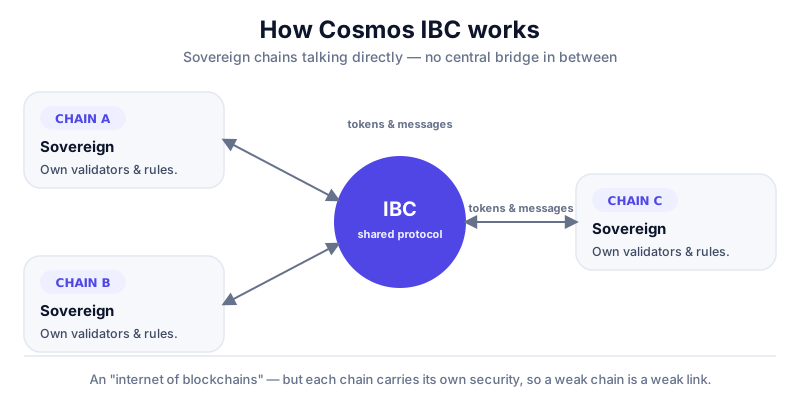
IBC is like email for blockchains: a shared protocol that lets independent chains exchange tokens and data. Each chain stays sovereign, but IBC lets them trust each other's messages without a central operator in between.
The problem IBC solves
By default, blockchains can't see each other. Your tokens on one chain have no idea another chain exists. Historically, moving value between chains meant trusting a 'bridge' — a third party that locks coins on one side and issues them on the other. Bridges have been a frequent target for huge hacks.
IBC takes a different approach. Instead of trusting an outside operator, two chains verify each other directly using lightweight proofs. If you're new to Cosmos, start with what is Cosmos.
How IBC works
You don't need to be an engineer to grasp the core idea. IBC connects two chains through a few moving parts.
- Light clients — each chain runs a tiny tracker of the other chain's state, so it can check the other side is telling the truth.
- Relayers — off-chain helpers that carry packets of data between the two chains. They can't fake messages; they only ferry them.
- Channels — the established connections over which tokens and data flow, a bit like a phone line opened between two parties.
When you send a token over IBC, the original is locked on the source chain and a representation appears on the destination chain. Send it back, and the original unlocks. The receiving chain verifies the proof itself rather than trusting a third party's word.
Why IBC matters
IBC turned Cosmos from a collection of separate chains into a connected network. Today it links dozens of chains and moves substantial value between them, and the standard has spread beyond Cosmos to other ecosystems experimenting with it.
For everyday users, IBC is what lets you move a token from one Cosmos app-chain to another inside a wallet like Keplr, often in seconds. It's a big reason the 'internet of blockchains' idea feels practical rather than theoretical.
What to watch out for
IBC's design avoids the single trusted operator that has doomed many bridges, but it isn't risk-free. Whichever way you lean, the storage rule doesn't change: serious amounts belong offline, on a hardware wallet like the Ledger Nano X.
Cross-chain transfers carry risk
Sending the wrong asset, using the wrong channel, or interacting with a malicious app-chain can lose funds. Double-check the destination, start with a small test transfer, and never approve a transaction you don't understand. This is education, not financial advice.
Key takeaways
- IBC is a standard that lets independent blockchains exchange tokens and data.
- It uses light clients and relayers instead of a single trusted bridge operator.
- It's what makes Cosmos a connected network rather than separate islands.
- Cross-chain transfers still carry risk — test small and verify destinations.
Frequently asked questions
Is IBC a bridge?
It does a similar job — moving assets between chains — but works differently. Classic bridges rely on a trusted operator; IBC has the chains verify each other directly, which removes that single point of failure.
Do I need to understand IBC to use Cosmos?
No. Wallets like Keplr handle IBC transfers for you behind a simple interface. Understanding the basics just helps you transfer more safely.
Can non-Cosmos chains use IBC?
Increasingly, yes. IBC was built for Cosmos but is an open standard, and other ecosystems have begun adopting or experimenting with it.
Keep reading
What Is Cosmos (ATOM)? A Plain-English Guide
A beginner-friendly explanation of what Cosmos and its ATOM token are, how the 'internet of blockchains' works
Cosmos Staking Explained: How Staking ATOM Works
A plain-English guide to staking ATOM on Cosmos: how delegation works, where rewards come from, the unbonding
How to Store Cosmos (ATOM) Safely (Step by Step)
Keep your Cosmos ATOM safe from hackers and mistakes: hot vs cold wallets, hardware wallets, seed-phrase backu