Custodial vs Non-Custodial Wallets Explained
Every crypto wallet falls into one of two camps: custodial (someone else holds your keys) or non-custodial (you hold them yourself). The difference shapes who's responsible if something goes wrong. This guide compares them plainly, without telling you which to pick.
The 20-second version
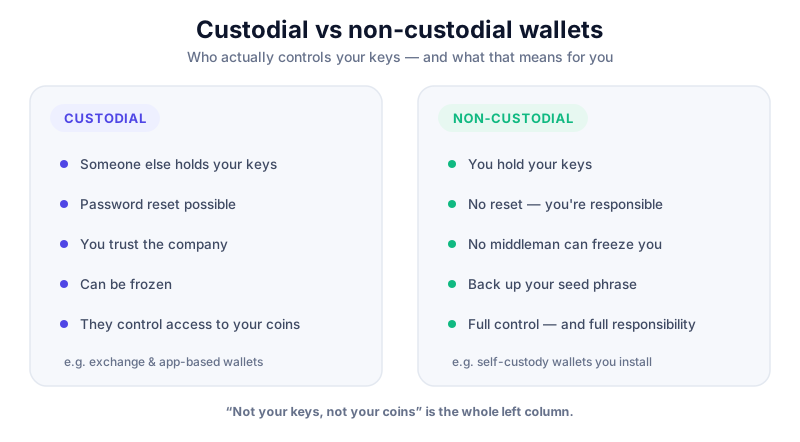
With a custodial wallet, a company holds your keys for you — convenient, but you're trusting them. With a non-custodial wallet, you hold your own keys — full control, but full responsibility. 'Not your keys, not your coins' captures the core trade-off.
Who holds the keys?
Crypto ownership comes down to controlling private keys. A seed phrase is the master backup of those keys. The single question that separates the two wallet types is: who holds them?
- Custodial — a third party (often an exchange like a regulated platform) holds the keys for you. You log in with a password, much like online banking.
- Non-custodial — you hold the keys yourself, in an app or hardware wallet. No one can freeze or access your funds — but no one can recover them for you either.
Custodial vs non-custodial at a glance
| Feature | Custodial | Non-custodial |
|---|---|---|
| Who holds keys | A company | You |
| Recovery if you forget login | Possible via the provider | Only via your seed phrase |
| Can funds be frozen? | Yes, by the provider | No |
| Main risk | Provider hack, failure or freeze | Losing your own keys |
| Ease of use | Beginner-friendly | Steeper learning curve |
| True self-custody | No | Yes |
The trade-offs
Neither type is universally 'safer' — they just move the risk around. Custodial wallets shift responsibility to a company, which is convenient but means trusting that company's security and solvency. Non-custodial wallets put you fully in charge, which removes that trust but makes you the single point of failure.
A hardware wallet is the most popular way to hold your own keys offline. The Ledger Nano X is our top pick — read the full review first, and only ever buy direct from the manufacturer.
Never share your seed phrase
With a non-custodial wallet, your seed phrase is everything. No wallet, exchange or 'support agent' will ever ask for it. Anyone who does is trying to steal your funds.
The balanced verdict
Many people use both: a custodial account for buying and small balances, and a non-custodial wallet for longer-term holdings they want full control over. The right mix depends on how much you hold and how comfortable you are managing your own keys — not on which type is 'best'. For most people, longer-term holdings sit best on a hardware wallet like the Ledger Nano X.
Key takeaways
- Custodial wallets: a company holds your keys; convenient but you're trusting them.
- Non-custodial wallets: you hold your keys; full control, full responsibility.
- Neither is universally safer — they shift risk to different places.
- With self-custody, your seed phrase is everything — keep it offline and private.
Frequently asked questions
Is a non-custodial wallet always safer?
Not automatically. It removes the risk of a provider being hacked or freezing funds, but adds the risk that if you lose your seed phrase, no one can recover your coins. The safest choice depends on your habits.
Are exchange accounts custodial?
Usually, yes. When you buy crypto on a typical exchange and leave it there, the exchange holds the keys. That's why many people move larger amounts to a non-custodial wallet.
Can I switch from custodial to non-custodial?
Yes. You simply withdraw your crypto from the custodial provider to a non-custodial wallet's address. Send a small test amount first to confirm it arrives before moving the rest.
Keep reading
Hot vs Cold Wallets: What's the Difference?
A plain-English hot vs cold wallets comparison — how each works, the security trade-offs, and how to combine b
Bitcoin Wallets Explained
What a Bitcoin wallet really is, the difference between custodial and self-custody, hot vs cold, and how to ch
What Is a Seed Phrase? (And Why You Must Never Share It)
A plain-English guide to seed phrases: what they are, how they back up your crypto wallet, how to store one sa