Fake Airdrop Scams Explained
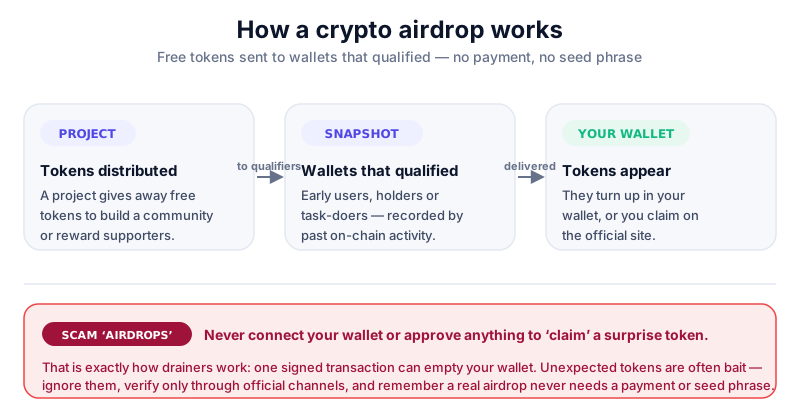
An airdrop is when a project gives away free tokens, often to reward early users. Scammers copy the idea: they advertise a fake airdrop, promise free coins, and use the excitement to lure you onto a malicious site that drains your wallet. This guide explains the bait and how to claim genuine airdrops safely.
The 20-second version
Fake airdrops use 'free tokens' to get you to connect your wallet and sign a malicious transaction, or to hand over your seed phrase. Real airdrops never need your seed phrase and never require an upfront payment. When a stranger offers free crypto, assume it's a trap.
What a fake airdrop is
Fake airdrops exploit one of the strongest pulls in crypto: free money. Scammers promote them through hacked or impersonated social accounts, DMs, comment spam, fake project websites, and even unsolicited tokens that appear in your wallet with a website name baked into them.
The 'claim' page is the trap. It pushes you to connect your wallet and sign something — and that signature is a wallet-drainer transaction that authorises the theft of your tokens. Other versions ask you to pay a small 'gas' or 'verification' fee, or to enter your seed phrase to 'receive' the tokens.
Common fake-airdrop tactics
- Connect and sign — a claim page that asks you to approve a malicious transaction or token approval.
- Seed-phrase theft — a form asking for your recovery phrase to 'verify' or 'receive' tokens.
- Upfront fee — a request to send a small payment to 'unlock' a much bigger reward that never arrives.
- Mystery tokens — unexpected tokens land in your wallet linked to a site; interacting with them triggers the drain.
- Impersonation — fake versions of real, well-known projects, often timed around a genuine airdrop in the news.
Free crypto from a stranger is bait
No legitimate airdrop needs your seed phrase or an upfront payment. If a claim asks for either, it's a scam. Slow down — urgency and FOMO are how these traps work.
How to claim airdrops safely
- Verify the airdrop through the project's official channels — its real website and verified accounts — not a link from a DM or comment.
- Never enter your seed phrase anywhere, and never pay an upfront fee to receive a 'free' airdrop.
- Use a separate burner wallet with little to no value for claiming, so a malicious signature can't reach your savings.
- Read every transaction before signing; reject anything granting broad spending approval or that you don't understand.
- Don't interact with mystery tokens that appear unexpectedly — ignore them rather than clicking through to their site.
Hold savings in cold storage and never connect that wallet to airdrop sites. A hardware wallet like the Ledger Nano X keeps your keys offline — read our review first.
If you've already connected
- If you signed something, move remaining funds to a fresh wallet on a clean device right away.
- Revoke any approvals you granted, then stop using the exposed wallet.
- If you entered your seed phrase, treat that wallet as fully compromised forever — never reuse it.
- Ignore anyone offering paid 'recovery'; that's a second scam targeting victims.
Build the reflex
Pair this with how to avoid crypto scams. Treating every unsolicited 'free token' offer as hostile by default is what keeps you safe.
Key takeaways
- Fake airdrops use free tokens to lure you into signing a drainer transaction.
- Real airdrops never ask for your seed phrase or an upfront fee.
- Verify through official channels and claim with a burner wallet.
- Ignore mystery tokens that appear in your wallet unexpectedly.
Frequently asked questions
How do I know if an airdrop is real?
Confirm it through the project's official website and verified social accounts, not a link someone sent you. Real airdrops never need your seed phrase or a payment to claim.
Are the random tokens that showed up in my wallet a free gift?
Almost never. Unsolicited tokens are usually bait designed to get you to visit a malicious site. Leave them alone and don't interact with them.
I connected my wallet but didn't sign anything — am I safe?
Connecting alone reveals your address but doesn't move funds; the danger is in signing. To be safe, avoid signing anything on that site and consider moving funds if you're unsure what you approved.
Keep reading
Wallet Drainer Scams Explained
How wallet-drainer scams trick you into signing a malicious transaction that empties your wallet in seconds —
How to Avoid Crypto Scams: The Cornerstone Safety Guide
The common crypto scams — fake support, phishing, giveaways, romance and rug pulls — and the simple habits tha
Honeypot Tokens Explained
A honeypot token lets you buy but not sell. Learn how these rug-pull traps are built into smart contracts and