How Hedera Works: Hashgraph, the Council and HBAR
Hedera is the odd one out among major networks: it doesn't use a blockchain at all. Its ledger is a hashgraph — a different data structure with its own consensus trick — and instead of anonymous miners or open validator sets, the network is governed by a rotating council of large global organisations. Whether you find that reassuring or off-putting says a lot about what you want from crypto, so let's take it apart properly.
The 20-second version
Hedera records transactions in a hashgraph — nodes 'gossip' transactions to each other and mathematically agree on order and timing without mining. It's fast, cheap and energy-light. Governance sits with a council of major companies and universities rather than an open community, and HBAR is the fuel: it pays fees, rewards staking, and secures the network.
A hashgraph is not a blockchain
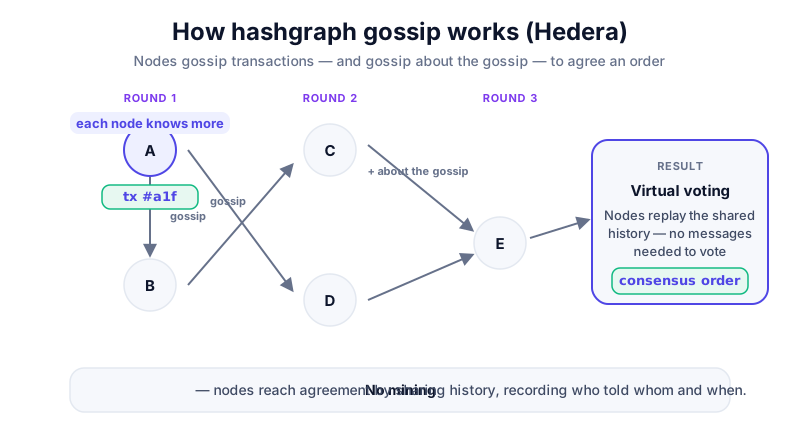
A blockchain is a single chain of blocks, each stacked on the last. A hashgraph is a web of events: every node shares what it knows with random other nodes ('gossip'), and each message carries the history of who told what to whom — 'gossip about gossip'. From that shared history, every node can independently compute what the whole network knows and *when it knew it*, without anyone producing blocks at all.
The practical upshot: no mining race, no competing blocks to throw away, and consensus timestamps that come from the network's collective view rather than from whichever miner won the round. Hedera's consensus achieves what computer scientists call asynchronous Byzantine fault tolerance — a strong formal guarantee that honest nodes agree even if some participants misbehave — and it's the piece of the design Hedera's engineers are proudest of.
Why you should care
For users, the design shows up as speed and predictably tiny fees — transactions settle in seconds and cost fractions of a penny, which is why Hedera pitches itself at high-volume enterprise use: payments, tokenised assets, supply-chain logs, ad-fraud tracking.
The council: governance by committee
Most crypto networks let anyone run a consensus node from day one. Hedera chose the opposite path: consensus nodes are run by the Hedera Governing Council — a rotating group of large corporations, universities and web3 organisations from different industries and continents, each with an equal vote and term limits. The pitch is stability and accountability: named institutions with reputations to lose, instead of anonymous operators.
The trade-off is the obvious one — it's more centralised than open networks, and crypto purists count that as a real cost, not a detail. Hedera's roadmap has long promised progressive decentralisation, including permissionless nodes and community staking, and the network's code went fully open-source over time. Where you land depends on your priorities: if 'no one in charge' is the point of crypto for you, Hedera's model will grate; if predictable governance for enterprise use is the point, it's the feature.
What HBAR actually does
- Pays for everything. Every transaction, token mint, smart-contract call and file write on Hedera costs a small, USD-denominated fee settled in HBAR.
- Secures the network. HBAR holders can stake to consensus nodes; stake-weighting is part of how the network resists manipulation.
- Fixed supply. HBAR's supply is capped at 50 billion, released on a published schedule — no mining, no tail emission.
- Powers the token layer. Hedera's Token Service lets projects issue tokens without writing smart contracts — those operations burn HBAR fees too.
As ever on this site: none of this tells you what HBAR *should be worth* — it tells you what it's *for*. Utility and price are different questions, and only one of them is answerable.
Strengths, honest weaknesses, and where to go next
Strengths: genuinely fast finality, fees small and stable enough to quote in dollars, a strong formal consensus guarantee, energy use among the lowest of any major network, and real enterprise integrations. Weaknesses: council governance is a centralisation trade-off, the permissionless-node roadmap has moved slowly, developer mindshare trails the EVM giants, and HBAR's price has spent most of its life far below its 2021 high — adoption of the network and demand for the coin are not the same thing.
If Hedera interests you, the practical next steps are the same as for any asset on this site: how to buy HBAR safely, and — more importantly — how to store it properly once you have it.
Key takeaways
- Hedera uses a hashgraph — gossip-based consensus with no blocks and no mining
- Its consensus carries a strong formal guarantee (asynchronous Byzantine fault tolerance)
- A rotating council of major organisations runs consensus — stability for some, centralisation for others
- HBAR pays fees, powers staking and token services, with a fixed 50bn supply
- Network adoption and coin price are separate questions — never conflate them
Frequently asked questions
Is Hedera more centralised than other cryptocurrencies?
Its consensus nodes are currently run by council members, which is more centralised than open validator sets like Ethereum's. Hedera argues named, term-limited institutions are more accountable than anonymous operators, and has promised progressive decentralisation. Both readings are fair — decide which property you actually want.
Is hashgraph better than blockchain?
It's faster and more efficient by design, with strong formal guarantees — but 'better' depends on what you're optimising. Blockchains like Bitcoin optimise for open, permissionless participation; Hedera optimises for throughput and governance. Different tools, different trade-offs.
Can I stake HBAR?
Yes — HBAR supports native staking to consensus nodes, and you can delegate from wallets that support it without giving up custody. The universal rule applies: stake from a wallet you control, ideally with keys in cold storage.
Keep reading
What Is Hedera (HBAR)? A Plain-English Guide
A beginner-friendly explanation of Hedera and its native token HBAR — how the Hashgraph network works, what it
How to Buy Hedera (HBAR): A Beginner's Guide
A step-by-step, no-hype guide to buying HBAR safely — choosing an exchange, verifying your account, placing an
How to Store Hedera (HBAR) Safely
Keep your HBAR safe from hackers and mistakes: hot vs cold wallets, hardware wallets, seed-phrase backups, and