How Blockchain Works (Without the Jargon)
A blockchain is a shared record-book that thousands of computers keep in sync, so no single person can secretly rewrite history. That one idea — a ledger nobody owns and nobody can quietly edit — is what makes crypto possible. This guide explains how it actually works, in plain English, with no maths degree required.
The 20-second version
A blockchain is a public list of transactions, grouped into 'blocks' and chained together with cryptography. Many independent computers each hold a copy and agree on what's true, so there's no central master copy to hack or edit.
What a blockchain actually is
Think of a blockchain as a notebook that everyone can read and nobody can quietly erase. Instead of one bank keeping the official ledger, thousands of computers — called nodes — each keep an identical copy. When a new transaction happens, it's broadcast to all of them, every copy updates, and they all check each other's work. There's no head office, no master spreadsheet sitting on one server somewhere.
Here's why that matters. Normally, when you move money, you're trusting a middleman to keep an honest record. Your bank knows your balance; you assume they won't change it on a whim. That works because the bank is regulated and has a reputation to protect — but it also means one organisation holds all the power, and one mistake (or one hack of their database) can affect everyone.
A blockchain flips that around. Because the record is shared and public, you don't have to trust any single company to be honest. You trust the maths and the fact that the copies all agree. If one node tried to lie about your balance, the other thousands would simply ignore it. That's the core idea behind Bitcoin, Ethereum and most other cryptocurrencies — a ledger that no one owns and everyone can verify.
Blocks, chains and hashes
Transactions don't get added one at a time. They're bundled into batches called blocks — a bit like pages in our shared notebook. Roughly every few seconds or minutes, depending on the network, a new page is filled, sealed and added to the back.
What seals each page is a hash — a unique digital fingerprint calculated from everything inside the block. A hash is just a long string of letters and numbers, but it has a magic property: change even one tiny detail in the block and the fingerprint changes completely and unpredictably. Crucially, each new block also stores the *previous* block's fingerprint, so the pages aren't just stacked — they're glued together in order.
- A block holds a batch of recent transactions plus a timestamp.
- A hash is a fingerprint — change one detail and the fingerprint changes completely.
- The chain links each block to the one before it, all the way back to the very first 'genesis' block.
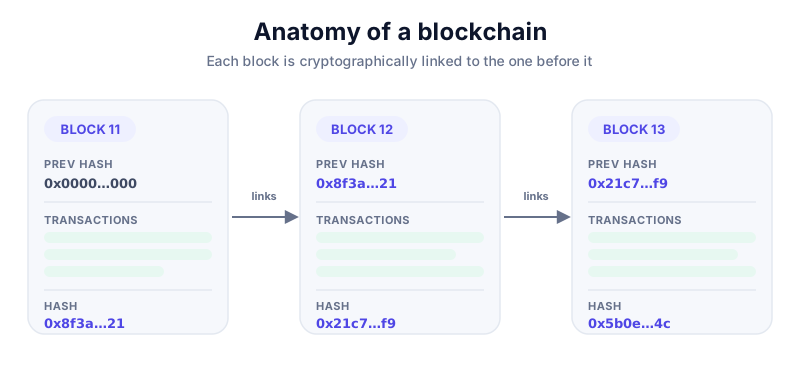
This linking is what makes a blockchain tamper-evident. Suppose a fraudster wanted to rewrite a single transaction in a block from last year — say, to pretend they never spent some coins. Altering it would change that block's fingerprint, which would break the link to the next block, whose fingerprint would then change too, breaking the link to the one after that, and so on right up to the present. To make the forgery stick, they'd have to redo every block since — on a faster timetable than the entire rest of the network is adding new ones. In practice, everyone else's copy would instantly disagree and reject the fake.
How the network agrees: consensus
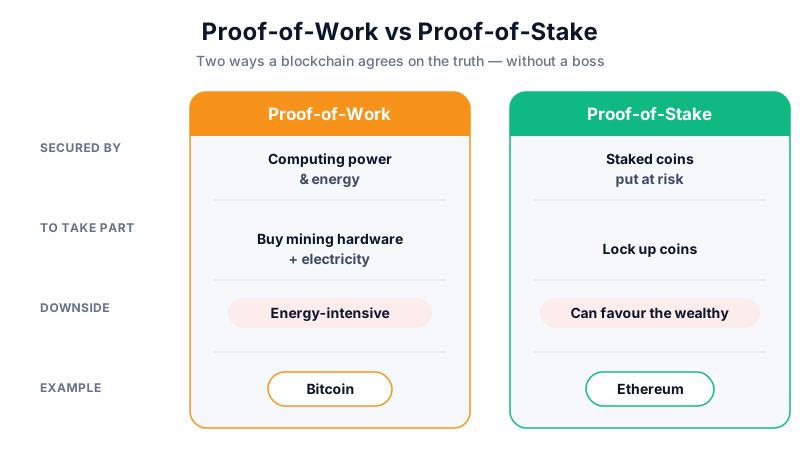
With thousands of independent copies spread around the world, the network needs a way to agree on which new block is the real one — and to stop anyone from cheaply spamming fake ones. This agreement process is called consensus, and there are two common approaches you'll hear about constantly.
- Proof of work (used by Bitcoin): computers compete to solve a hard mathematical puzzle. The first to crack it gets to add the next block and earns a reward in coins. The puzzle is deliberately useless except for being hard — solving it burns real electricity, which is exactly the point: it makes cheating expensive and honesty profitable.
- Proof of stake (used by Ethereum and many others): instead of burning energy, participants lock up coins as a deposit, or 'stake', and are chosen to add blocks. Behave honestly and you earn rewards; try to cheat and the network destroys your deposit. Learn more in what is staking.
Both methods solve the same problem in different ways: they make rewriting history wildly costly, which is the whole point. To change the past, an attacker would need to out-muscle the entire honest network at once — either commanding more computing power than everyone else combined (proof of work) or owning a huge slice of all the staked coins and being willing to lose them (proof of stake). On a large, established network, that's astronomically expensive and usually self-defeating, because the attack itself would crash the value of what you're attacking.
Why decentralisation matters
Because no single computer is in charge, there's no master switch to flip, no single point of failure, and no one office that can be raided, bribed or hacked to rewrite the ledger. Nodes can be anywhere in the world, run by anyone willing to follow the rules. If hundreds went offline tomorrow, the network would carry on without missing a beat.
This is the same principle that separates a centralised and decentralised exchange: one has a company holding the keys and able to freeze your account, the other runs on shared code that answers to no one. Decentralisation is the trait that turns 'a database' into 'a blockchain', and it's the reason these networks are so hard to shut down.
Public, but not always private
Most blockchains are fully public — anyone can inspect every transaction, ever, using a free 'block explorer'. Your real name isn't attached, but your wallet address is visible to all, and addresses can sometimes be linked back to people. 'Pseudonymous' is a more accurate word than 'anonymous'.
The honest limits
Blockchains are clever, but they're not magic — and the crypto internet badly oversells them. Keeping thousands of copies in sync is far slower than a single central database: a traditional payment network can handle tens of thousands of transactions per second, while many blockchains manage a tiny fraction of that. When demand spikes, networks get congested and fees climb (see Ethereum gas fees), which is why so much engineering effort now goes into scaling them.
They also faithfully record mistakes. A blockchain doesn't know or care whether a transaction was a good idea — it just executes the rules. Send funds to the wrong address, or to a scammer, and there's usually no undo button and no support line to call. The same iron rules that protect you from fraudsters also protect the fraudsters from you.
Irreversible by design
The very property that makes a blockchain hard to tamper with also means transactions can't be reversed. Double-check addresses, send a small test amount first when in doubt, and treat 'undo' as something that simply doesn't exist. This guide is education, not financial advice.
Where to go next
Now that the foundations are clear, it's worth seeing how a real network puts them to use. Read how Bitcoin works to watch consensus and blocks in action, explore layer 1 vs layer 2 to understand how blockchains are being scaled up, or look at what DeFi is to see the kinds of applications people build on top of a shared ledger.
Key takeaways
- A blockchain is a shared ledger many computers keep in sync — no central master copy.
- Blocks are chained with cryptographic fingerprints, making tampering obvious to everyone.
- Consensus (proof of work or proof of stake) lets the network agree without trusting anyone.
- It's tamper-evident and irreversible by design — mistakes can't be undone.
Frequently asked questions
Is a blockchain the same as Bitcoin?
No. Bitcoin is one cryptocurrency that uses a blockchain. The blockchain is the underlying technology — the shared ledger and consensus rules — and thousands of other projects run their own versions of it with different trade-offs.
Can a blockchain be hacked?
The core ledger of a large, well-established network is extraordinarily hard to alter, because you'd need to out-muscle the entire honest network. Most 'crypto hacks' you read about actually target exchanges, apps, bridges or individual wallets — the soft edges around the blockchain, not the chain itself.
Who controls the blockchain?
Ideally, no single entity does. The network is run collectively by all its nodes following shared rules, and changes to those rules require broad agreement. That decentralisation is the whole point — it's what removes the need to trust a middleman.
Keep reading
What Is Bitcoin? A Plain-English Guide
A beginner-friendly explanation of what Bitcoin is, how it works, and how to think about it — with no hype and
What Is DeFi? Decentralised Finance Explained
A beginner's guide to decentralised finance: what DeFi is, how lending, trading and yield work without a bank
Layer 1 vs Layer 2: Blockchain Scaling Explained
What layer 1 and layer 2 mean, why blockchains need scaling, how rollups and sidechains work, and the trade-of