How to Read a Candlestick Chart (Beginner's Guide)
Candlestick charts are the standard way price is displayed on almost every crypto exchange. They pack a lot of information into a small space — but once you know what each candle is telling you, they're easy to read. This guide explains the anatomy of a candle and what the most common shapes mean, purely as education.
The 20-second version
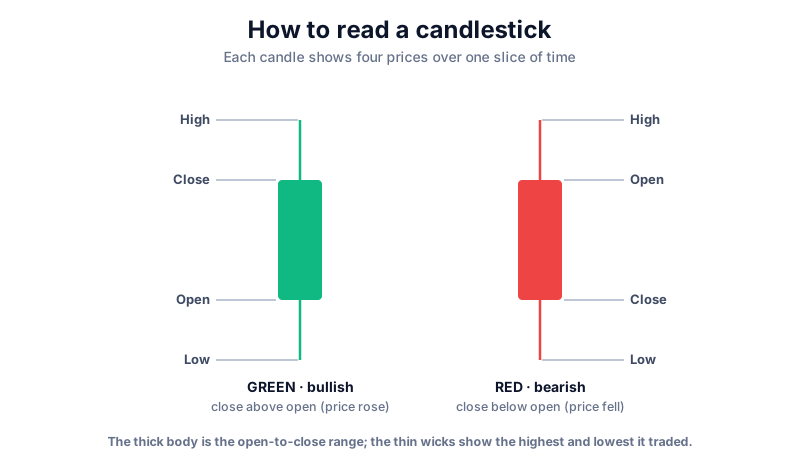
Each candle shows the open, high, low and close price over a set period. The body is the open-to-close range; the thin wicks show the highest and lowest points reached. Green usually means price finished higher; red means it finished lower.
The anatomy of a single candle
Every candlestick represents one slice of time — say one hour or one day. It records four prices, often abbreviated as OHLC: the Open (price at the start of the period), the High, the Low, and the Close (price at the end).
- The body is the thick rectangle between the open and close prices.
- The wicks (or 'shadows') are the thin lines above and below the body, marking the high and low.
- The colour tells you direction: a green (or white) candle closed higher than it opened; a red (or black) candle closed lower.
So a tall green body with short wicks means price rose steadily through the period. A small body with long wicks means price swung widely but ended near where it started.
Why the timeframe matters
The same chart looks completely different depending on the timeframe you choose. On a 1-minute chart, each candle is one minute; on a daily chart, each candle is a whole day. Switching timeframes is the single most common source of confusion for beginners.
- Short timeframes (1m, 5m, 15m) show lots of noise and tiny moves.
- Medium timeframes (1h, 4h) are popular for spotting the shape of a day or week.
- Long timeframes (1D, 1W) smooth out the noise and show the bigger picture.
Zoom out before you panic
A scary-looking drop on a 5-minute chart can be invisible on a weekly chart. When a move worries you, switch to a longer timeframe to see it in context.
Common candle shapes
Traders give names to certain candle shapes. You don't need to memorise them, but recognising a few helps you describe what you're seeing.
- Doji — open and close are almost equal, leaving a tiny body. Suggests indecision.
- Hammer — small body near the top with a long lower wick. Buyers pushed price back up after a dip.
- Shooting star — small body near the bottom with a long upper wick. Sellers pushed price back down after a rise.
- Marubozu — a long body with almost no wicks. One side dominated the whole period.
Patterns are not predictions
No candle shape reliably tells you what happens next. Chart reading is a way to describe what price has done, not a crystal ball. This guide is education, not trading or financial advice — and crypto is highly volatile.
How to practise safely
The best way to learn is to watch charts without risking money. Most exchanges let you view live charts for free, and you can follow along on a demo or testnet before any real activity.
- Open a price chart for a coin you know, like Bitcoin or Ethereum.
- Set it to a daily timeframe and identify the body, wicks and colour of a few candles.
- Hover over a candle to read its exact open, high, low and close.
- Switch between timeframes and watch how the same period reshapes into different candles.
Reading charts is a useful literacy skill, but it doesn't tell you whether to buy or sell. Pair it with the fundamentals — like how to avoid crypto scams and how to store crypto safely.
Key takeaways
- Each candle shows four prices: open, high, low and close (OHLC).
- The body is the open-to-close range; wicks mark the high and low.
- Green closed higher, red closed lower — but the timeframe changes everything.
- Patterns describe the past; they never predict the future. This is education, not advice.
Frequently asked questions
What do the colours on a candlestick mean?
By default a green or white candle closed higher than it opened, and a red or black candle closed lower. You can usually customise these colours in your charting tool.
What's the difference between a candlestick and a line chart?
A line chart only joins the closing prices, so it's simpler. A candlestick shows the open, high, low and close for each period, giving far more detail about what happened within it.
Can candlestick charts predict price?
No. They describe price history clearly, but no pattern reliably forecasts the future. Treat chart reading as a literacy skill, not a trading signal.
Keep reading
How to Set a Crypto Price Alert (Step by Step)
Price alerts notify you when a coin hits a level you choose, so you don't have to watch charts all day. Learn
How to Track Your Crypto Portfolio (Beginner's Guide)
Keep an organised, accurate view of your crypto holdings across exchanges and wallets. Learn the main ways to
How to Use a Crypto Testnet (Beginner's Guide)
A testnet lets you practise crypto transactions with worthless test coins before risking real money. Learn wha