What Is Bitcoin? A Plain-English Guide
Bitcoin is the world's first cryptocurrency — a form of digital money you can send to anyone, anywhere, without a bank in the middle. This is lesson one of our free Bitcoin course, and it sets up everything that follows. We'll explain what Bitcoin actually is in plain English, where it came from, how to picture it working, and how to think about it sensibly — with zero hype and no jargon walls. No prior knowledge needed; if you can use online banking, you can follow this.
The 20-second version
Bitcoin is digital money secured by a worldwide network of computers instead of a bank. There will only ever be 21 million. You hold it in a 'wallet', and you alone control it — which means nobody can freeze it, and nobody can recover it for you if you lose access.
What is Bitcoin, really?
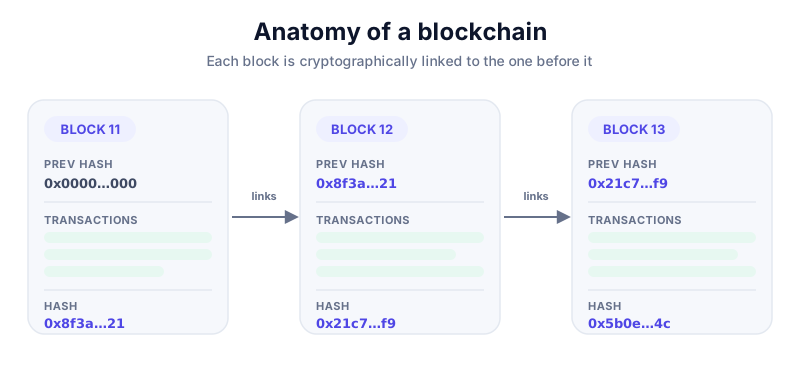
At its simplest, Bitcoin is money that lives on the internet. The pounds or dollars in your bank account are really just a number in your bank's private database — the bank records who has what, and the bank can change that record, freeze it, or hand it to a court if asked. That arrangement works because you trust the bank to be honest and to still be there tomorrow. Bitcoin flips that around. It's tracked on a shared public ledger called a blockchain that thousands of independent computers all keep an identical copy of. No single company or government runs it, so there's no one to phone, no central record to quietly edit, and no one who can print more on a whim.
A useful analogy: a normal bank account is like money in a locked vault that someone else holds the only key to — safe enough, until they decide otherwise. Bitcoin is more like cash in your own pocket, except the pocket is a string of secret numbers, and the 'cash' can travel across the world in minutes. That difference is the whole point, and it gives Bitcoin three properties ordinary money simply doesn't have.
- Borderless — you can send it to anyone with an internet connection, no bank, business hours, or border check required. A payment from London to Lagos works exactly like a payment to the next room.
- Limited in supply — the code caps it at 21 million coins forever, and nobody can vote to print more. That scarcity is enforced by maths, not a promise.
- Owned directly by you — you hold the keys yourself, rather than trusting an institution to hold your money for you. Total control, with all the responsibility that brings.
Where did it come from?
Bitcoin appeared in 2009, in the wreckage of the global financial crisis, when trust in banks was at rock bottom. An anonymous creator (or group) using the name Satoshi Nakamoto published a nine-page document — the Bitcoin white paper — describing 'a purely peer-to-peer version of electronic cash'. The goal was money you could send directly to someone else without a trusted middleman taking a cut, setting the rules, or holding the keys. Satoshi mined the very first block, left a wry headline about bank bailouts buried inside it, and a few years later vanished entirely. No one has ever credibly proven who they were — and the system has carried on running without them, which is rather the point.
What made it genuinely new wasn't the idea of digital money — that's old, and earlier attempts had all failed. The breakthrough was solving a problem nobody had cracked: how do you stop someone copying and spending the same digital coin twice, without a central authority keeping score? With ordinary computer files you can copy-paste forever, which is fine for photos and fatal for money. Bitcoin's answer — a public ledger maintained by a competitive network — is what makes it tick. We unpack exactly how that works in the next lesson.
How Bitcoin works, at a glance
You don't need to be technical to use Bitcoin, but a rough mental model helps everything else make sense. Every ten minutes or so, the network gathers up recent transactions, bundles them into a 'block', and adds that block to the chain — a permanent, public record stretching all the way back to 2009. Thousands of computers called miners compete to do this work, and the winner is rewarded with newly created bitcoin. That reward is what motivates them to keep the network honest and running, with no central payroll department in sight.
- The blockchain is a public record of every transaction ever made — anyone can inspect it, which is part of what keeps it trustworthy.
- Wallets hold the secret keys that prove you own your coins and let you spend them. We'll demystify these in Bitcoin wallets explained.
- Miners process transactions and secure the network in exchange for rewards. The full picture is in what is Bitcoin mining.
That's the helicopter view. If the machinery interests you, how Bitcoin works — the next lesson — walks through the ledger, mining and the 21-million cap in proper detail, still without a single equation.
A hardware wallet keeps your keys offline and out of reach of hackers. The Ledger Nano X is our top pick for beginners — but read our full review first, and only ever buy direct from the manufacturer, never second-hand.
Why Bitcoin matters (and the honest caveats)
Because its supply is capped at 21 million coins, Bitcoin can't be printed at will the way regular currencies can. Supporters see it as 'digital gold' — a scarce, neutral way to store and move value without anyone's permission. For people living under collapsing currencies, frozen bank accounts or strict capital controls, that can be genuinely useful rather than just a thought experiment. It's also open: anyone can read the code, run the software, or send a payment, with no application form and no gatekeeper deciding whether you're allowed in.
But let's be straight with you, because most of the crypto internet won't be. Bitcoin is also slow and pricey for everyday coffee-sized payments, its price swings wildly from week to week, and 'self-custody' means the responsibility for not losing your money is entirely yours — there's no fraud department to call and no forgotten-password link. None of that makes it a scam; it just makes it a tool with real trade-offs, like any other. Understanding those trade-offs honestly, instead of being sold a fantasy, is exactly what this course is for.
A fair warning
Bitcoin's price is highly volatile and can fall sharply. Only ever risk what you can afford to lose, and never borrow money to buy crypto. This guide is education, not financial advice, and nothing here is a price prediction or a recommendation to buy.
Where to go next
You now know what Bitcoin is, why it exists, and roughly how it hangs together. That's lesson one done — nicely done. The natural next step is to lift the bonnet and see how Bitcoin actually works: the blockchain, mining and why nobody can fake or double-spend it. After that, the course moves on to buying Bitcoin safely and, most importantly, storing it safely. Take it one lesson at a time — there's no rush, and understanding beats hurry every single time.
Key takeaways
- Bitcoin is decentralised digital money — no bank required, no central record to edit.
- Supply is capped at 21 million, making it scarce by design and impossible to inflate away.
- You hold it in a wallet and control it yourself, with no support desk to fall back on.
- It's volatile and has real trade-offs — only risk what you can afford to lose.
Frequently asked questions
Is Bitcoin legal?
In most countries, yes — though rules and taxes vary widely. A few places restrict or ban it. Always check the regulations where you live before buying or selling, and remember that selling or spending can be a taxable event.
How much do I need to start?
You don't need a whole coin. Bitcoin is divisible to eight decimal places — the smallest unit is called a satoshi — so you can own a tiny fraction and start with just a few pounds or dollars while you learn.
What's the safest way to store Bitcoin?
For larger amounts, a hardware wallet that keeps your keys offline is the gold standard. For small sums you're learning with, a reputable app is fine to begin with. We cover this properly in lessons four and five.
Keep reading
How Bitcoin Works (Without the Jargon)
A clear walk-through of how Bitcoin actually works: the blockchain, mining, transactions, the 21 million cap,
How to Buy Bitcoin Safely (Step by Step)
A careful, beginner-friendly walk-through of buying Bitcoin on a regulated exchange — verifying your account,
How to Store Bitcoin Safely (Step by Step)
Keep your Bitcoin safe from hackers and mistakes: hot vs cold wallets, hardware wallets, seed-phrase backups,