How to Spot Fake (and AI-Generated) Crypto Team Photos
Most people never read a smart contract, but everyone looks at the team page — and scammers know it. Fake teams are cheap to build: a stolen LinkedIn photo here, an AI-generated face there, a made-up 'ex-Google' bio on top. The counter-move costs one search and thirty seconds of looking closely at ears.
The 20-second version
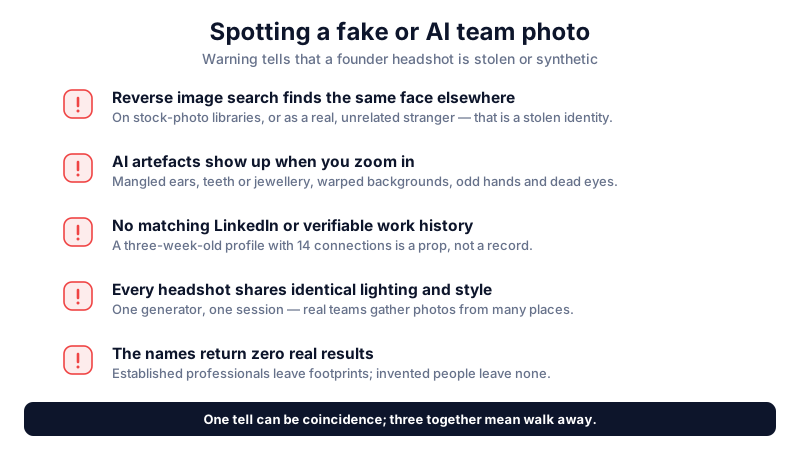
Run every founder photo through a reverse image search (Google Lens or TinEye). A real founder's face leads back to their own verifiable profiles; a stolen face leads to an unrelated person; an AI face leads nowhere and shows rendering glitches — mismatched glasses and earrings, melted backgrounds, oddly dead eyes.
Why fake faces work so well
A team page is a trust shortcut. Confident headshots, corporate titles, a sprinkle of big-brand history — it *feels* like due diligence even though you've verified nothing. Scam factories exploit exactly that gap: the faces come in two flavours, stolen identities (real photos lifted from LinkedIn, company sites or stock libraries) and synthetic faces (AI-generated portraits of people who don't exist).
Both fail the same two tests: the search test and the artifact test.
Test 1 — The reverse image search
- Right-click the team member's photo and copy the image (or its address).
- Open Google Lens (the camera icon in Google Images) or TinEye, and paste or upload it.
- Read the matches. A real founder resolves to *their own* profiles — LinkedIn, conference talks, GitHub — under the *same name* the presale uses.
- A stolen photo resolves to a different person entirely: an architect in Hamburg, a dentist's website, a stock-photo library. That's identity theft in service of the scam, and it's case closed.
- No matches at all for a supposedly senior industry figure? Combine that with the artifact test below — established professionals leave footprints; synthetic people don't.
Check the profile, not just the picture
A LinkedIn link on the team page proves little by itself — profiles can be created in an afternoon. Look for age and depth: years of activity, real connections, posts, employment history that other sources corroborate. A three-week-old profile with 14 connections is a prop.
Test 2 — The AI artifact check
AI portrait generators produce faces that pass a glance but fail a stare. Zoom in and check:
- Glasses and ears. Frames that change thickness mid-face, arms that don't meet the ears, or ears at different heights — rendering the sides of a head is still hard.
- Earrings and jewellery. Different earring in each ear, necklaces that fade into skin, glasses chains that go nowhere.
- The background. Real photos have real rooms behind them. AI backgrounds smear into abstract shapes, half-formed windows and impossible geometry.
- Hair and edges. Strands that merge into the backdrop, halos around the head, a collar that blends into the neck.
- The eyes. Perfectly centred, perfectly circular pupils looking dead ahead — technically flawless and subtly lifeless.
One artifact might be image compression. Two or more, on a face with no search footprint, attached to a bio you can't verify — that's a synthetic person fronting for whoever actually controls the wallet.
What an honest team looks like
Fairness matters — some legitimate builders are pseudonymous, especially in DeFi. The difference is that honest pseudonymous teams *compensate* with verifiable substance: public code with history, audits from named firms, on-chain track records, appearances under the same handle over years. What never adds up is the worst of both worlds: a team that shows you faces (so you'll trust them) that turn out to be fake (so you can't). Anonymity plus fabrication is a choice, and it tells you everything.
The team check is one of the four pillars in our full presale-checking guide — run it alongside the whitepaper check and the on-chain money check and you're ahead of 99% of buyers.
Key takeaways
- Reverse-image search every founder photo — one search settles most cases
- Stolen faces resolve to unrelated real people; AI faces resolve to nothing and glitch under scrutiny
- Ears, earrings, glasses, backgrounds and pupils are where synthetic portraits fall apart
- A LinkedIn link proves nothing — look for years of verifiable history under the same name
- Faces that turn out fake aren't a yellow flag; they're the verdict
Frequently asked questions
The team photos look completely normal — does that clear them?
No — it just means the artifact test passed. Stolen photos of real people look perfect because they are real photos. The reverse-image search and the profile-depth check are what actually verify identity.
Is an anonymous team always a scam?
Not always — some respected projects are pseudonymous. But anonymity removes accountability, so demand more from everything else: audited open-source code, a real on-chain history, credible backers. An anonymous team plus an unverifiable everything-else is an easy no.
What tools do I need?
Google Lens and TinEye are free in any browser. There's nothing to install and nothing to pay.
Keep reading
How to Check If a Crypto Presale Is a Scam (Step by Step)
The complete pre-flight check for any crypto presale: verify the team, the whitepaper, the audit and the actua
The Recycled Whitepaper Trick: Expose a Template Scam in One Search
Scam factories don't write whitepapers — they find-and-replace old ones. The quotation-mark Google trick catch
How Paid Crypto Listings and 5-Star Ratings Really Work
Presale directories and crypto 'news' sites look like independent journalism — but much of it is paid placemen