How to Check If a Crypto Presale Is a Scam (Step by Step)
Most crypto presale scams can be spotted in under fifteen minutes with free tools — before a penny leaves your wallet. This is the exact checklist we run before covering any presale on this site: the 90-second surface check, the on-chain evidence check, and the marketing red flags that scam factories reuse on every launch.
The 20-second version
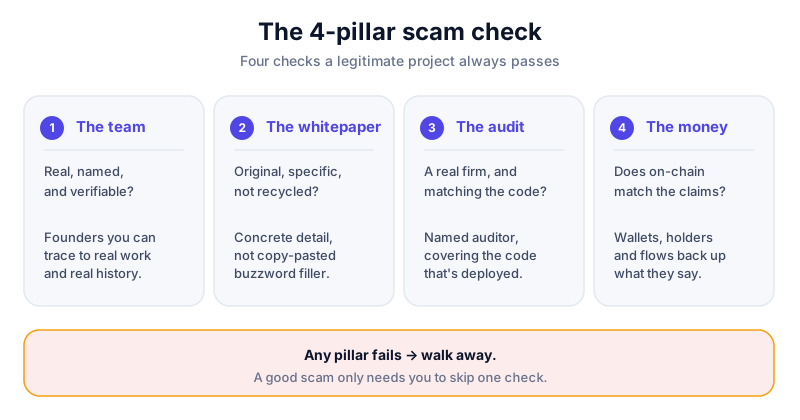
Never trust a presale's own dashboard. Verify four things independently: a named, checkable team, an original whitepaper, a real audit you've opened and read, and on-chain activity that matches the website's claims. If any one of the four fails, walk away — there will always be another train.
Why presales are the scammer's favourite format
A presale asks you to send money for tokens that don't trade anywhere yet. That means there's no market price to check, no chart to read, and no way to sell — everything you 'know' about the project comes from the project itself. For an honest team that's a fundraising tool. For a scammer it's a dream: they control the website, the countdown, the 'sold out' bar and the price ticker, and none of it has to be true.
It gets worse: presale marketing is industrialised. Scam networks run dozens of near-identical launches at once from shared templates, promoted through paid articles and paid directory listings that look like independent journalism. The biggest rug pulls in recent years all had glowing coverage right up to the moment the money vanished. So the job isn't to judge how professional a presale *looks* — templates are cheap — it's to check the few things a scammer can't fake.
The golden rule
A presale website is a sales page, not a source. Every number on it — raised total, holders, countdown, stage — is text the owner typed in. Only believe what you can verify somewhere the project doesn't control: the blockchain, a real audit firm's own site, or a named person's verifiable history.
The 90-second surface check
Before any deep digging, four quick looks catch a surprising share of scams:
- The team. Find the team page. Are there full names that lead to real, years-old LinkedIn or GitHub profiles with independent activity? 'John S., blockchain visionary' with a stock-photo smile is a fail. Our guide to spotting fake and AI-generated team photos shows how to check a face in one search.
- The whitepaper. Copy two or three technical sentences and Google them inside quotation marks. Template factories reuse the same document across dozens of tokens — the recycled whitepaper trick exposes them instantly.
- The audit badge. Don't trust the badge — click it. It should open a report on the audit firm's own domain (CertiK, Hacken, SolidProof and similar publish theirs). No report, a PDF hosted on the project's own site, or a report listing unresolved critical issues are all fails.
- The domain. Run the website through a free WHOIS lookup. A 'long-established global project' whose domain was registered three weeks ago behind an anonymity proxy is telling you something.
None of these alone is proof of a scam — but an honest project passes all four without breaking a sweat. Two or more fails and you already have your answer.
The on-chain check: verify the money, not the marketing
This is the check scammers can't beat, because public blockchains don't take instructions from marketing departments. A presale claiming '$20 million raised' has to have $20 million arriving *somewhere on-chain* — and you can look.
The short version: find the deposit address the site actually uses, paste it into a block explorer such as Etherscan or BscScan, and compare what the ledger shows against what the website claims. Empty wallets behind eight-figure claims, three transactions behind 'thousands of buyers', and the same whale 'buying' in a loop are the three classic fakes. We walk through the whole method, click by click, in how presales fake their 'total raised' meters — it takes about five minutes and needs no technical background.
Can't find the deposit address?
That's a finding in itself. Legitimate token sales publish their contract address prominently — it's how buyers avoid fake copycat sites. A presale that hides where the money goes has a reason to.
Marketing red flags the factories reuse every time
- The never-ending presale. 'Stage 18 of 20', countdowns that quietly reset, deadlines that always extend. Honest sales end; scams milk the queue for as long as it pays.
- Hardcoded scarcity. '98% sold out' bars that never move, or that show the same number to every visitor on every visit. Scarcity you can't verify is theatre.
- Guaranteed listing prices. 'Launching at $2 — that's a 40x from this stage!' No one can promise what an open market will pay. A written price promise is not optimism, it's bait — the same trick behind every rug pull.
- Absurd staking yields. '84% APY from day one' in a token with no revenue and no market just means the supply inflates until the price is zero. Yield has to come from somewhere; see what is staking for how real staking pays.
- Paid hype dressed as news. Identical 'articles' across a dozen crypto blogs, five-star ratings on presale directories, price predictions with no author. That machine is bought by the campaign — how paid crypto listings really work shows the tell-tale signs.
- Pressure everywhere. Bonuses expiring 'tonight', DMs from 'community managers', warnings that you'll miss the next Pepe. Urgency is the scammer's best friend, because it's the enemy of the checks on this page.
The UK angle: illegal promotions are a red flag in themselves
Since October 2023, promoting cryptoassets to UK consumers is a regulated activity. Compliant promotions must carry a prescribed risk warning, can't offer refer-a-friend bonuses, and must give first-time investors a 24-hour cooling-off period. Most presale campaigns you'll meet do none of this — which means they're likely breaking UK law before you've even read the whitepaper. That's remarkably useful as a filter, and we explain how to use it (and how to report the ones that fail) in the UK rule that exposes illegal crypto promotions.
If you've already sent money — or connected a wallet
Don't panic, and don't try to 'withdraw' through the scam site — above all, never pay a 'fee', 'tax' or 'gas unlock' to release your tokens. That second payment is the actual point of many of these scams. Go straight to our emergency guide for wallets connected to a scam site: revoking token approvals and moving what's left to a fresh wallet are the two steps that stop further losses, and both take minutes.
And if what you really wanted was exposure to crypto rather than a lottery ticket: buy established assets on a regulated venue, not from an anonymous dashboard. We've reviewed the major UK-available exchanges — our Kraken review covers the one with the strongest UK regulatory footing — and whatever you buy, keep long-term holdings in cold storage, not on a website.
Key takeaways
- A presale's website is a sales page — only trust what you can verify off-site
- Check four things: named team, original whitepaper, real audit, matching on-chain activity
- Resetting countdowns, hardcoded 'sold out' bars and guaranteed listing prices are factory red flags
- In the UK, a missing risk warning usually means the promotion itself is illegal — treat that as a verdict
- Never pay a 'fee' to withdraw presale tokens, and revoke wallet approvals the moment you smell a rat
Frequently asked questions
Are all crypto presales scams?
No — legitimate projects have raised early funding this way. But the presale format gives dishonest teams total control over what you see, so the burden of proof is on the project. If it can't pass the four checks on this page, treat it as a scam regardless of how polished it looks.
How much does it cost to run these checks?
Nothing. Block explorers, WHOIS lookups, reverse image search and quotation-mark Googling are all free. Fifteen minutes of checking is the cheapest insurance in crypto.
The presale has a CertiK audit badge — is it safe?
Only if the audit is real, current, covers the actual sale contract, and passed. Click through to the report on the audit firm's own website and read the findings table. Scam sites routinely paste badges for audits that don't exist, audited a different contract, or flagged critical issues the team never fixed.
What if I can see real money flowing into the presale wallet?
Real inflows prove people are buying — not that the project is honest. Plenty of rug pulls raised genuine millions before vanishing. On-chain checks are for catching fabricated claims; the team, code and audit checks are for judging what happens to the money afterwards.
Keep reading
How Presales Fake Their 'Total Raised' Meters (And How to Check in 3 Steps)
Many presale dashboards display fabricated fundraising totals to trigger FOMO. Here's the free, three-step blo
How to Spot Fake (and AI-Generated) Crypto Team Photos
Scam presales invent executive teams with stolen photos and AI faces. Learn the one-search reverse-image check
How Paid Crypto Listings and 5-Star Ratings Really Work
Presale directories and crypto 'news' sites look like independent journalism — but much of it is paid placemen