Impermanent Loss Explained (With a Simple Example)
Impermanent loss is the most misunderstood risk in DeFi — and the one that catches new liquidity providers off guard. The name makes it sound temporary and harmless. It isn't. This guide explains exactly what impermanent loss is, walks through a simple example, and helps you weigh it against the fees you earn.
The 20-second version
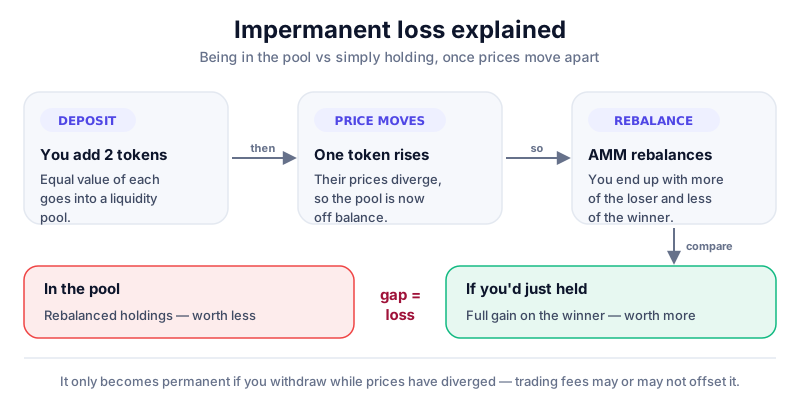
Impermanent loss is the gap between holding two tokens in your wallet and putting them in a liquidity pool when their prices move apart. The pool quietly rebalances toward the falling token, so you can end up with less value than if you'd done nothing. It's only 'impermanent' until you withdraw — then it's locked in.
Read this first
The loss becomes real when you exit
Impermanent loss is 'unrealised' while your funds stay in the pool, but it's locked in the moment you withdraw. Fees may or may not cover it. This guide is education, not financial advice.
What is impermanent loss?
When you provide liquidity, an automated market maker constantly rebalances your two tokens to keep the pool's formula in balance. If one token rises in price, the pool sells some of it; if one falls, the pool buys more of it. The result is that you end up holding more of the loser and less of the winner than if you'd simply held both in your wallet.
Impermanent loss is the difference in value between those two outcomes — being in the pool versus just holding. The bigger the price divergence between the two tokens, the bigger the loss.
A simple worked example
Suppose you deposit 1 ETH (worth £2,000) and £2,000 of a stablecoin into a pool — £4,000 in total. Now imagine ETH doubles to £4,000.
- If you'd just held: 1 ETH (£4,000) + £2,000 stablecoin = £6,000.
- In the pool: the AMM sold some ETH as it rose, so you might withdraw around £5,660 in total.
- Impermanent loss: roughly £340, or about 5.7% — purely from the price moving apart.
The exact figures depend on the formula, but the pattern always holds: the more the two prices diverge, the more the pool lags behind simply holding. If prices return to where they started, the loss disappears — which is why it's called 'impermanent'.
How to think about it
- Stablecoin pairs (e.g. two stablecoins) barely diverge, so impermanent loss is minimal.
- Volatile pairs can suffer large impermanent loss if one token moons or crashes.
- Fees are the offset: providers earn trading fees, which may or may not exceed the loss.
- Withdrawing locks it in: until you exit, the loss is only on paper.
Beginners often start with stable pairs
Pools of two stablecoins, or a coin paired with its own staked version, tend to have far less price divergence — and therefore far less impermanent loss to worry about.
Where to go next
Now revisit what are liquidity pools with fresh eyes, see why the AMM rebalances in what is an AMM, and learn how reward programmes layer on top in what is yield farming.
Key takeaways
- Impermanent loss is the value gap between pooling tokens and simply holding them.
- It grows as the two tokens' prices diverge, and shrinks if prices reconverge.
- It becomes a real, permanent loss the moment you withdraw from the pool.
- Trading fees may offset it — but stable pairs carry far less of it than volatile ones.
Frequently asked questions
Why is it called 'impermanent'?
Because if the two tokens' prices return to their original ratio, the loss vanishes. It only becomes permanent if you withdraw while prices are diverged.
Can fees cancel out impermanent loss?
Sometimes. In busy, high-fee pools, trading fees can outweigh the loss. In quiet or highly volatile pools, they often don't. There's no guarantee either way.
Which pools have the least impermanent loss?
Pairs of tokens that move together — like two stablecoins, or a coin and its liquid-staked version — diverge little, so impermanent loss stays small.
Keep reading
What Are Liquidity Pools? A Beginner's Guide
Liquidity pools explained simply: how depositing token pairs powers DeFi swaps, how providers earn fees, and t
What Is an AMM? Automated Market Makers Explained
How automated market makers (AMMs) price crypto trades without an order book — the x*y=k formula, slippage, an
What Is Yield Farming? Rewards and Risks Explained
Yield farming explained for beginners: how DeFi reward programmes work, what APR and APY really mean, and why