What Is Yield Farming? Rewards and Risks Explained
Yield farming is the practice of moving crypto between DeFi protocols to chase the best rewards — extra tokens paid on top of normal trading fees. In the 2020–21 boom it produced eye-watering advertised returns and just as many spectacular blow-ups. If you've seen a screenshot promising '900% APY' and wondered whether it's real, this is the guide for you. We'll explain how yield farming works, what the numbers actually mean, and the risks hiding behind the headline percentages.
The 20-second version
Yield farming means depositing crypto into DeFi protocols to earn rewards — usually trading fees plus bonus tokens. The advertised yields can look enormous, but they often rely on volatile reward tokens and stack several risks on top of each other. High numbers usually mean high risk.
Read this first
Big yields, bigger risks
A headline of '1,000% APY' almost always reflects extreme risk, a reward token that may crash, or a scheme that simply won't last. Yield farming stacks smart-contract, market and scam risks on top of one another. This guide is education, not financial advice — never farm with money you can't afford to lose, and never borrow to do it.
What is yield farming?
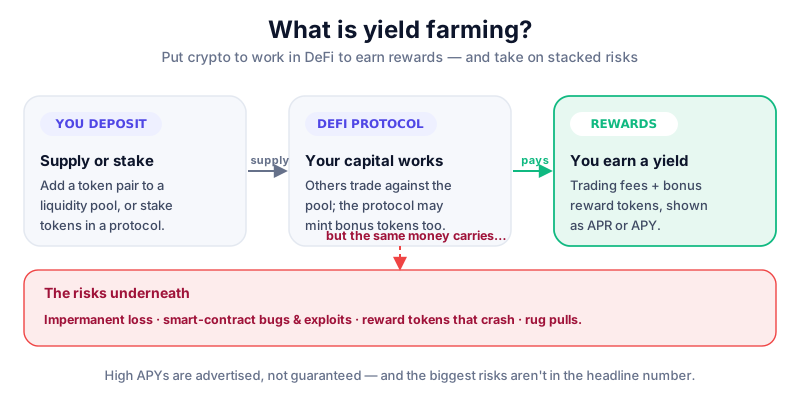
At its core, yield farming means putting your crypto to work in DeFi to earn a return, rather than letting it sit idle in a wallet. The simplest version is providing to a liquidity pool — depositing a pair of tokens so others can trade against them — and earning a slice of the trading fees in return. So far, so reasonable: it's a bit like earning interest for lending out an asset.
'Farming' usually adds a second layer on top. To attract deposits, a protocol pays you bonus reward tokens — often a brand-new token it has minted itself — just for parking your liquidity there. This practice is also called liquidity mining, and it's where the headline-grabbing numbers come from. The protocol is essentially printing tokens to rent your capital.
Keen farmers then chase the best deals, hopping between protocols as rewards shift, and sometimes 'stack' strategies — for example, taking the LP token they received for providing liquidity and depositing *that* into yet another contract to earn a second reward on the same money. Each extra layer can boost the headline yield, but it also adds another smart contract that could fail, be exploited, or simply vanish. Complexity is not your friend here.
APR vs APY — and why the numbers mislead
Two acronyms get thrown around constantly, and the difference matters when you're staring at a tempting percentage:
- APR is the simple annual rate, without compounding — what you'd earn in a year if you just collected the rewards and left them.
- APY assumes you reinvest your rewards over and over, so compounding makes it look higher than the APR for the very same farm.
- Reward tokens are often paid in a brand-new token whose price can collapse — so a '500%' yield can quietly become worth a fraction of what it advertised the moment everyone tries to sell.
- Yields fall fast: as more people pile into a pool, the same fixed pot of rewards gets split more ways, so today's eye-watering rate is rarely tomorrow's.
Always ask: paid in what?
A 200% yield paid in a token that drops 90% is a loss, full stop. Before you're dazzled by a number, check what the rewards are actually denominated in, how that token has held its value, and whether you could realistically sell your rewards without crashing the price yourself.
The risks underneath the rewards
The reason honest educators are so cautious about yield farming isn't snobbery — it's that the risks genuinely stack. You're rarely exposed to just one; you're exposed to all of these at once, and any single one can wipe out the others' gains: Whatever you connect to, sign carefully: an air-gapped wallet like the Keystone shows you the full transaction on its own screen before anything leaves your hands.
- Impermanent loss can quietly erode your principal when the two tokens in your pool move apart in price — sometimes more than the rewards make back.
- Smart-contract exploits can drain a farm in seconds; the more contracts your strategy stacks, the more doors an attacker can try.
- Reward-token crashes can turn a gaudy headline APY into a real-terms loss before you've had a chance to cash out.
- Rug pulls and 'ponzinomics' — some farms exist only to attract deposits before the founders pull the liquidity and disappear, leaving holders with worthless tokens.
Where to go next
Build the foundations before you go anywhere near a farm: what are liquidity pools and impermanent loss explained cover the mechanics you're actually exposed to, while what is staking is the simpler, often lower-risk cousin worth understanding first. And always, always read how to avoid crypto scams — yield farming is where a lot of them live.
Key takeaways
- Yield farming means depositing crypto into DeFi to earn trading fees plus bonus reward tokens.
- APY looks higher than APR because it assumes compounding — and rewards are often volatile new tokens.
- Headline yields are usually short-lived and signal high risk, not easy money.
- It stacks impermanent loss, contract and scam risks — only farm what you can afford to lose, and never borrow.
Frequently asked questions
Is yield farming the same as staking?
Not quite. Staking usually means helping secure a blockchain in return for fairly predictable rewards. Yield farming is broader and riskier, typically involving liquidity pools, stacked contracts and volatile bonus tokens — more moving parts, more ways to lose.
Why do advertised yields keep dropping?
Rewards are shared among everyone in the pool. As more capital floods in chasing the same fixed pot, each farmer's slice shrinks, so very high rates almost never last long. A sky-high yield often just means few people have arrived yet — or that something is wrong.
Are huge APYs a scam?
Not always, but extreme numbers are a serious red flag. They frequently rely on a freshly minted token that can crash, or on a scheme designed to collapse once deposits dry up. Treat anything that sounds too good to be true with deep scepticism.
Keep reading
What Are Liquidity Pools? A Beginner's Guide
Liquidity pools explained simply: how depositing token pairs powers DeFi swaps, how providers earn fees, and t
Impermanent Loss Explained (With a Simple Example)
What impermanent loss really is, why it happens to liquidity providers, a worked example, and how to think abo
What Is Staking? How It Works and What It Costs
A plain-English guide to crypto staking: how it secures proof-of-stake networks, how rewards work, and the loc