Market vs Limit Orders: What's the Difference?
When you place a trade on an exchange, you usually choose between two order types: market or limit. They sound interchangeable but behave very differently — one prioritises speed, the other prioritises price.
The 20-second version
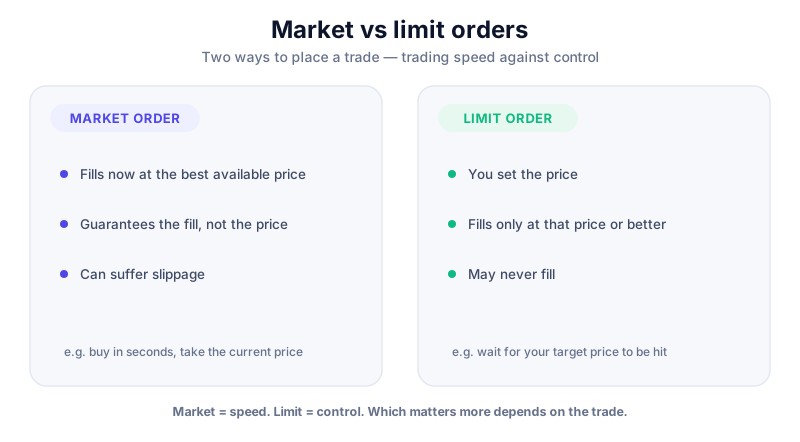
A market order fills immediately at the best available price. A limit order only fills at a price you set or better, but might not fill at all. Market = speed, limit = price control.
Market orders: speed first
A market order buys or sells right now at whatever prices are available in the order book. It almost always fills instantly, which is its main appeal.
The catch is slippage: on a thin market or a big order, you can sweep through several price levels and get a worse average price than the one you saw. Slippage is usually small on liquid coins and larger on small ones.
Limit orders: price first
A limit order lets you set the exact price you're willing to accept. A buy limit only fills at your price or lower; a sell limit only at your price or higher. You get price control — but if the market never reaches your price, the order may sit unfilled or expire.
- Use a market order when filling quickly matters more than a small price difference.
- Use a limit order when you want a specific price and can wait, or to avoid slippage on a thinner coin.
A note on fees
Many exchanges charge different fees for the two. Market orders 'take' liquidity from the book (taker fee); limit orders that wait 'make' liquidity (often a lower maker fee). It's a small detail, but it adds up if you trade often. And however you weigh the trade-offs, keep meaningful holdings in cold storage — a Keystone 3 Pro — rather than on an exchange.
Slow down before you confirm
Double-check the amount, price and total before placing any order — mistakes are hard to undo. Crypto is volatile, so only risk what you can afford to lose and never borrow to trade. This is education, not financial advice.
Key takeaways
- Market orders fill instantly at the best available price.
- Limit orders fill only at your chosen price or better, if at all.
- Slippage can make market orders fill worse on thin markets.
- Maker (limit) fees are often lower than taker (market) fees.
Frequently asked questions
Which order type is better for beginners?
For a simple one-off buy, a market order is straightforward. Limit orders give you more control and can reduce slippage, but require you to set a sensible price.
What is slippage?
The difference between the price you expected and the price you actually got, caused by the market moving or your order being larger than the orders sitting at the best price.
Keep reading
What Is an Order Book?
How a crypto order book works: bids, asks, the spread, market depth, and how to read it as a beginner.
Understanding Crypto Volatility
Why crypto prices swing so hard: the causes of volatility, what it means for you, and how to keep a level head
How to Buy Bitcoin Safely (Step by Step)
A careful, beginner-friendly walk-through of buying Bitcoin on a regulated exchange — verifying your account,