NFT Scams Explained: How to Spot and Avoid Them
NFTs attract scammers because trades are irreversible and self-custody puts security entirely in your hands. The good news: most NFT scams follow a handful of predictable patterns. Learn them and you'll dodge the vast majority. This guide breaks down the common traps and the habits that keep your wallet safe.
The 20-second version
Most NFT scams trick you into either revealing your seed phrase or approving a malicious transaction that drains your wallet. Never share your seed phrase, read every signature request, and verify links independently. When in doubt, do nothing.
The most common NFT scams
Scams in the NFT space reuse the same psychology — urgency, hype and fake authority — wrapped in new packaging. Here are the patterns that account for most losses:
- Wallet-draining approvals — a malicious listing or site asks you to sign a transaction that grants access to your tokens, then empties your wallet.
- Phishing links — fake versions of real marketplaces or 'official' announcements that capture your seed phrase or trick you into a bad signature.
- Rug pulls — a project hypes a collection, sells out, then abandons it, leaving holders with worthless tokens.
- Counterfeit collections — copies of popular NFTs listed to look like the genuine article.
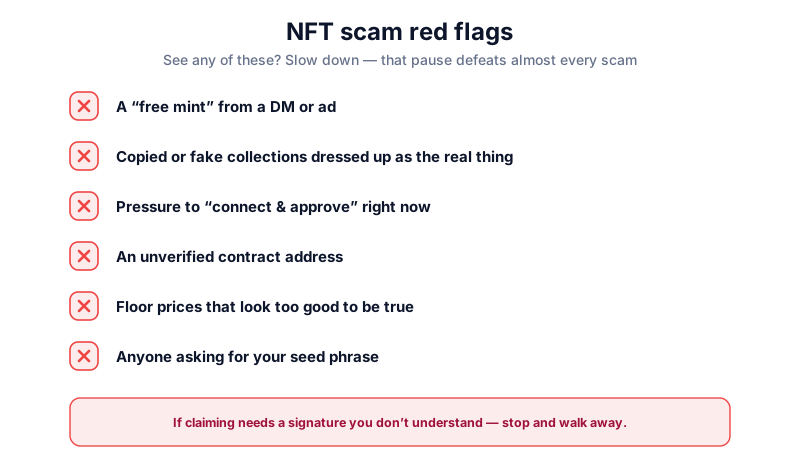
- Fake support and giveaways — 'support agents' or 'free mint' offers in your DMs that ask you to connect a wallet or share details.
The golden rule: protect your seed phrase
Never share your seed phrase or private key
Your seed phrase restores your entire wallet. No marketplace, mint, support agent or giveaway will ever legitimately ask for it. Anyone who does is trying to steal everything you hold. Never type it into a website or pop-up.
Just as important: understand what you're signing. Many NFT thefts don't involve a stolen seed phrase at all — the victim simply approved a malicious transaction. Treat every signature request as a contract you're agreeing to.
How to protect yourself
- Only visit marketplaces by typing the official URL yourself or using a saved bookmark — never click links from DMs or emails.
- Read every signature request. If you don't understand what an approval does, reject it.
- Use a separate 'burner' wallet with limited funds for minting and trying new mints or sites.
- Keep your main holdings in a hardware wallet, disconnected from day-to-day browsing.
- Regularly review and revoke token approvals you no longer use.
- Ignore urgency. 'Mint now or miss out' and 'verify your wallet immediately' are manipulation tactics.
A hardware wallet keeps your keys off the internet and makes you physically confirm every transaction. Buy it only from the manufacturer — never second-hand — and read our full review first.
If you think you've been scammed
Act fast. Move any remaining assets to a fresh, secure wallet, revoke the malicious approvals, and stop interacting with the site or account involved. Be wary of 'recovery services' that contact you afterwards — they are almost always a second scam. For the broader playbook, see how to avoid crypto scams.
Slow down — that's the whole defence
Nearly every NFT scam relies on you acting before you think. Pausing to verify independently defeats most of them. If something feels rushed, that itself is the red flag.
Key takeaways
- Most NFT scams aim to steal your seed phrase or trick you into a malicious approval.
- Never share your seed phrase, and read every signature request before signing.
- Use a burner wallet for new mints and keep main holdings in cold storage.
- Ignore urgency and verify every link independently — that defeats most scams.
Frequently asked questions
How do wallet drainers actually work?
They trick you into signing a transaction that grants a smart contract permission to move your tokens, or a blind signature that transfers assets directly. Once approved, the scammer empties the wallet. That's why reading every approval matters.
Can I recover NFTs or crypto stolen in a scam?
Usually not — blockchain transactions are irreversible and there's no central authority to reverse them. Treat prevention as your only real protection, and be wary of 'recovery' offers, which are typically follow-up scams.
Is a verified or 'blue tick' collection always safe?
Verification reduces risk but doesn't guarantee safety — badges can be faked or revoked, and projects can still rug pull. Always do your own checks and never rely on a badge alone.
Keep reading
What Is an NFT Marketplace? A Beginner's Guide
A plain-English guide to NFT marketplaces: what they are, how buying and selling works, the main platforms, fe
How to Mint an NFT (Step by Step)
A beginner's step-by-step guide to minting an NFT: choosing a chain, setting up a wallet, uploading your work,
How to Avoid Crypto Scams: The Cornerstone Safety Guide
The common crypto scams — fake support, phishing, giveaways, romance and rug pulls — and the simple habits tha