Polkadot Parachains Explained (Plain English)
Parachains are the part of Polkadot that does the actual work — the specialised blockchains that connect to the network's core. If you've read what Polkadot is, this guide goes one level deeper on parachains, in plain English and without the marketing.
The 20-second version
A parachain is an independent blockchain that plugs into Polkadot's central Relay Chain. It runs its own apps and features but borrows the Relay Chain's security, and can message other parachains. Chains connect by securing a slot on the network.
What is a parachain?
A parachain (short for 'parallelised chain') is a separate blockchain that connects to Polkadot. The 'parallel' part is the key idea: many parachains run side by side at the same time, each processing its own transactions, rather than everything queuing on a single chain.
Each parachain can be designed for a specific job — one might focus on decentralised finance (DeFi), another on gaming, identity, or stablecoins. Because they're purpose-built, they can be faster or more flexible than a one-size-fits-all chain.
How parachains connect to the Relay Chain
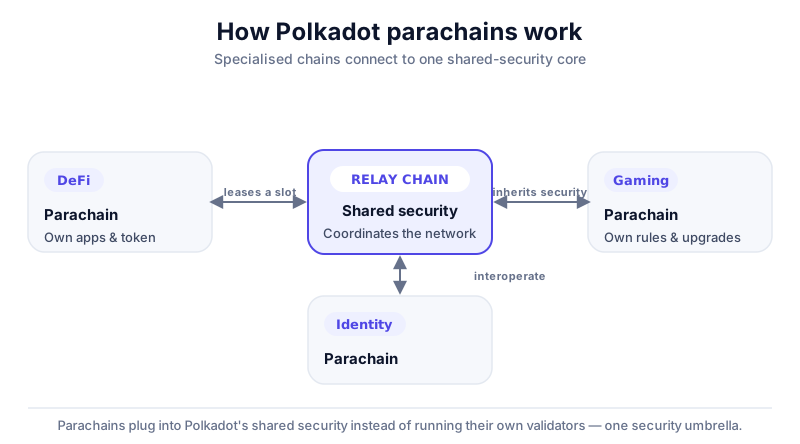
At the centre of Polkadot sits the Relay Chain. It doesn't run apps itself; its job is to coordinate the network and provide security. Parachains attach to it and, in doing so, inherit that security.
- Shared (pooled) security — instead of each new chain recruiting its own validators, parachains borrow the Relay Chain's. That's hard and expensive to build alone, so this is a major advantage for smaller projects.
- Cross-chain messaging — parachains can pass messages and assets to each other through Polkadot, so they don't operate as isolated islands.
- Independence — each parachain keeps its own rules, token (if it has one), and upgrade path.
A hardware wallet keeps the keys for your DOT and many parachain tokens offline. The Ledger Nano X is a popular choice — read our full review before buying.
How a chain gets a slot
There is a limited number of connection slots, so chains have to secure one. Historically, projects competed in parachain auctions, locking up DOT (often crowd-sourced from supporters in a 'crowdloan') to win a lease for a fixed period. The DOT was bonded, not spent, and returned when the lease ended.
Polkadot's approach to allocating these slots has continued to evolve toward more flexible, pay-as-you-go models so that smaller projects can access blockspace more easily. The exact mechanics change over time, so always check current documentation rather than relying on older explanations.
Why parachains matter
Parachains are Polkadot's answer to a hard problem: how do you let lots of different blockchains specialise and scale, while still keeping them secure and able to talk to each other? Whether that approach wins out against Ethereum layer-2s, Solana and others is an open question the market is still working through.
Keep perspective
Tokens tied to individual parachains can be even more volatile and less proven than DOT itself. Understanding the technology is not the same as endorsing any token. Only ever risk what you can afford to lose — this is education, not financial advice.
Key takeaways
- A parachain is an independent, purpose-built blockchain that connects to Polkadot.
- Parachains borrow the Relay Chain's security instead of building their own.
- They can message and move assets between each other through Polkadot.
- Chains secure limited connection slots, and the mechanics keep evolving.
Frequently asked questions
What's the difference between a parachain and the Relay Chain?
The Relay Chain is Polkadot's secure core; it coordinates the network but runs few apps. Parachains are the connected chains that do the actual work, borrowing the Relay Chain's security.
Do all parachains have their own token?
Many do, but not all. A token is optional and depends on what the parachain is built for. DOT remains the token of the core Polkadot network itself.
Are parachains safe to use?
They inherit Polkadot's shared security at the network level, but each parachain's own apps can still have bugs or risks. Treat any new chain or token with the same caution you'd apply anywhere in crypto.
Keep reading
What Is Polkadot (DOT)? A Plain-English Guide
A beginner-friendly explanation of what Polkadot (DOT) is, how its multi-chain design works, what the DOT toke
Polkadot Staking Explained (Plain English)
How staking DOT works: validators and nominators, rewards, lock-up and unbonding, slashing risks, and how to s
How to Store Polkadot (DOT) Safely (Step by Step)
Keep your Polkadot (DOT) safe from hackers and mistakes: hot vs cold wallets, hardware wallets, seed-phrase ba