Smart Contract Risk Explained (Plain English)
Smart contracts are the self-running programs behind almost everything in DeFi, NFTs and decentralised exchanges. When they work, they replace middlemen with code. When they don't, the bug is public, permanent, and often expensive. This guide explains smart contract risk in plain English and gives you practical ways to lower it.
The 20-second version
A smart contract is code that controls funds automatically. If that code has a flaw — or grants the wrong permission — money can be lost with no bank to call. Audits, time in the wild, and limiting the approvals you sign are your main defences.
What is a smart contract?
A smart contract is a program stored on a blockchain that runs exactly as written when its conditions are met. Send the right input, and it executes — moving tokens, swapping assets, or minting an NFT — without anyone approving it manually.
That automation is the appeal. But because the code controls real money and usually can't be changed once deployed, any mistake in it is baked in. There's no manager to reverse a faulty transaction.
Code is law — for better and worse
Smart contracts do precisely what they're programmed to do, not what you hoped they'd do. A flaw that lets funds leak isn't a glitch the developers can simply 'fix' after the fact on the affected transactions.
Where the risk comes from
Smart contract risk isn't one thing. It clusters into a few recognisable sources.
- Coding bugs — logic errors, math mistakes, or flaws like reentrancy that let an attacker drain a contract.
- Bad permissions — an 'admin key' that lets a developer (or a hacker who steals it) change rules or withdraw funds.
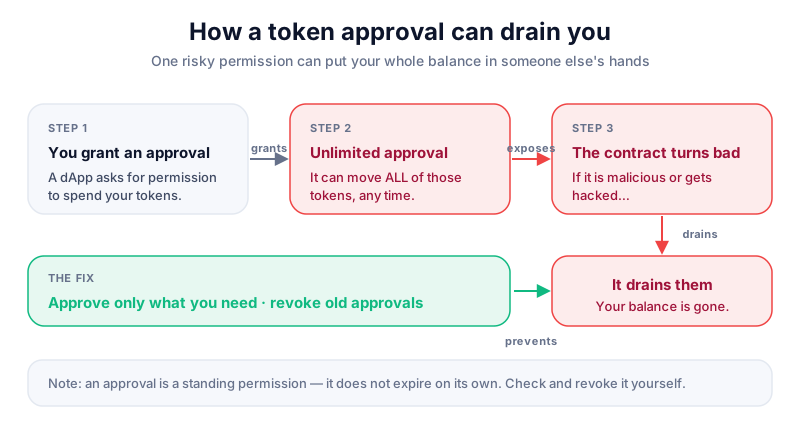
- Risky approvals you sign — granting a contract unlimited permission to spend your tokens, which a malicious or buggy contract can abuse.
- Composability risk — one contract relies on another, so a failure or price manipulation in a connected protocol cascades.
- Upgradeable contracts — flexibility that also means the rules can change under you after you've deposited.
Many real-world losses are detailed in common DeFi exploits explained, which walks through how these flaws are abused in practice.
The risk you control: token approvals
Most users can't audit code, but there's one risk you directly control every time you use a DEX or dapp: the approvals you sign. To let a contract trade your tokens, you grant it spending permission — and many apps request *unlimited* permission by default.
- Read what each transaction is actually asking for before you confirm. A wallet prompt that grants spending access is different from a simple transfer.
- Where the wallet allows it, set a spending limit equal to the amount you're using rather than 'unlimited'.
- Periodically review and revoke old approvals using a reputable approval-checker tool.
- Never sign a transaction you don't understand, especially one arriving from a link, airdrop, or DM.
Signatures can drain a wallet
A malicious approval or 'permit' signature can let a contract empty specific tokens without any further confirmation. If a site pushes you to sign something urgently, stop and verify — see how to avoid crypto scams.
What audits do and don't prove
A security audit is a professional review of a contract's code. Seeing 'audited' is a positive sign, but it's a floor, not a guarantee.
- An audit reflects the code *at the time of review* — later changes may be unaudited.
- Audits can miss bugs, and 'audited' projects have still been exploited.
- Who did the audit matters; an unknown or self-published 'audit' means little.
- An audit says nothing about the team's honesty, the economics of the token, or admin-key risk.
Treat audits as one input among several, alongside how long the contract has run unbroken and how much value it has safely held. A hardware wallet that displays exactly what you're approving — like the Keystone — turns most signing mistakes into near-misses.
How to protect yourself
- Favour established contracts with a long track record and large amounts safely locked over brand-new, unproven ones.
- Start small. Test a protocol with an amount you can afford to lose before committing more.
- Use a separate 'hot' wallet for experimenting, kept apart from the cold storage holding your savings.
- Limit and regularly revoke token approvals.
- Keep your main holdings in cold storage, away from any smart contract entirely.
Education, not advice
DeFi can offer rewards, but smart contract risk is real and losses are common. Only ever interact with funds you can afford to lose. This guide is education, not financial advice.
Key takeaways
- A smart contract is code that controls real funds and usually can't be reversed once deployed.
- Risk comes from bugs, admin keys, risky approvals, and connected-protocol failures.
- The risk you most directly control is the token approvals you sign — limit and revoke them.
- Audits help but don't guarantee safety; track record and starting small matter too.
Frequently asked questions
If a smart contract is audited, is it safe?
Safer, but not safe. An audit reviews code at a point in time and can still miss flaws. Audited projects have been exploited. Treat an audit as one signal alongside track record, transparency, and the contract's age.
Can a smart contract steal my whole wallet?
A contract can only move what you've approved it to access — but if you granted unlimited approval, that can be all of a given token. It cannot move funds you never approved, and it can't touch assets held in separate cold storage.
How do I revoke a smart contract's access to my tokens?
Use a reputable token-approval checker to view and revoke active approvals. Revoking costs a small network fee. Doing this periodically is one of the simplest ways to reduce your exposure.
Keep reading
What Is DeFi? Decentralised Finance Explained
A beginner's guide to decentralised finance: what DeFi is, how lending, trading and yield work without a bank
Common DeFi Exploits Explained (And How to Stay Safe)
Flash loan attacks, rug pulls, oracle manipulation, and malicious approvals — the most common ways DeFi users
What Is a DEX? Decentralised Exchanges Explained
A plain-English guide to decentralised exchanges (DEXs): how they let you swap tokens without an account, how