Tezos Staking Explained: Baking and Delegation
Tezos lets holders earn rewards for helping secure the network. There are two ways in: running your own validator (called 'baking') or simply delegating your XTZ to someone who does. This guide explains how Tezos staking works, the difference between baking and delegation, and the risks to weigh up.
The 20-second version
Tezos secures itself with proof-of-stake. Bakers validate blocks and earn rewards; everyone else can delegate XTZ to a baker and share in those rewards. Delegation is non-custodial — your coins never leave your wallet. Rewards are not guaranteed and vary over time.
How staking works on Tezos
Tezos uses a proof-of-stake system its community calls Liquid Proof-of-Stake. Instead of mining, participants put up XTZ as a stake for the right to create and sign new blocks. If you're new to the idea, start with what is staking and what Tezos is.
The bigger a baker's total stake — their own plus everything delegated to them — the more often they're chosen to add blocks and earn rewards. Those rewards are then shared with the people who delegated.
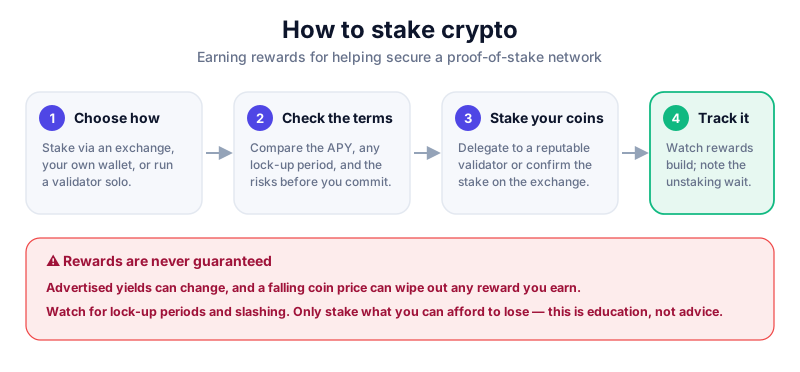
Baking vs delegating
- Baking means running the validator yourself. It traditionally needed a sizeable XTZ stake and an always-on, reliable server. Bakers carry the operational responsibility and the rewards that come with it.
- Delegating means pointing your XTZ at a baker you trust. You keep your coins; you just lend your stake's weight. This is the route most ordinary holders take.
Delegation never transfers ownership
When you delegate, the baker can never spend or withdraw your XTZ. Your keys stay with you, which means you can delegate even from a hardware wallet.
Rewards and how they're paid
Reward rates on Tezos change over time and depend on network conditions and how many coins are staked overall. Bakers typically take a fee from the rewards they distribute, so two bakers can pay out differently for the same delegation. One habit worth adopting from day one: delegate from a hardware wallet like the Trezor Safe 5, so staking never means exposing your keys.
- Reliability — a baker that misses its duties earns fewer rewards to share.
- Fees — compare the percentage a baker keeps before delegating.
- Payout timing — rewards are usually paid out after a delay set by the protocol.
Rewards are not free money
Staking rewards are real, but XTZ's price can fall by more than any reward you earn. Reward rates are not guaranteed and change over time. Treat staking as participation in a network, not a savings account. This is education, not financial advice.
Risks to weigh up
- Price volatility — the value of your XTZ can fall regardless of any rewards.
- Baker choice — an unreliable or dishonest baker can mean lower or missed rewards. Choose established bakers with a strong track record.
- Scam delegations — never connect your wallet to a site promising unusually high 'staking' returns. See how to avoid crypto scams.
How to start delegating
- Hold your XTZ in a non-custodial wallet you control — ideally a hardware wallet.
- Research bakers and compare their reliability, fees and history.
- Set your wallet's delegate to your chosen baker's address.
- Wait through the protocol's activation and reward delay — rewards don't start instantly.
- Check periodically that your baker is performing and paying out as expected.
Key takeaways
- Tezos staking means baking yourself or delegating to a baker.
- Delegation is non-custodial — your XTZ never leaves your wallet.
- Reward rates change over time and bakers charge a fee.
- Rewards don't offset price falls — only risk what you can afford to lose.
Frequently asked questions
What's the difference between baking and staking on Tezos?
'Baking' is Tezos's word for being a validator. 'Staking' is the general term for putting coins to work to secure a proof-of-stake network. Most holders take part by delegating rather than baking themselves.
Is delegating my XTZ risky?
Delegation never gives a baker control of your coins, so they can't steal them. The main risks are XTZ's price falling and choosing an unreliable baker that earns fewer rewards.
Can I unstake my Tezos whenever I want?
You can change or remove your delegation at any time. There may be protocol delays before changes and rewards take effect, so check the current rules before you start.
Keep reading
What Is Tezos (XTZ)? A Plain-English Guide
A beginner-friendly explanation of Tezos and its XTZ token: how its self-amending blockchain works, on-chain g
How to Buy Tezos (XTZ): A Step-by-Step Guide
A beginner's guide to buying Tezos (XTZ) safely: choosing a reputable exchange, verifying your account, placin
How to Store Tezos (XTZ) Safely
Keep your Tezos safe from hackers and mistakes: hot vs cold wallets, hardware wallets, seed-phrase backups, de