The DAO Hack Explained
In 2016, a project called The DAO raised a then-staggering amount of Ether through a crowdsale, only for an attacker to exploit a flaw in its code and drain roughly a third of the funds. The response split the Ethereum community in two and created Ethereum Classic. It remains one of crypto's most important case studies.
The 20-second version
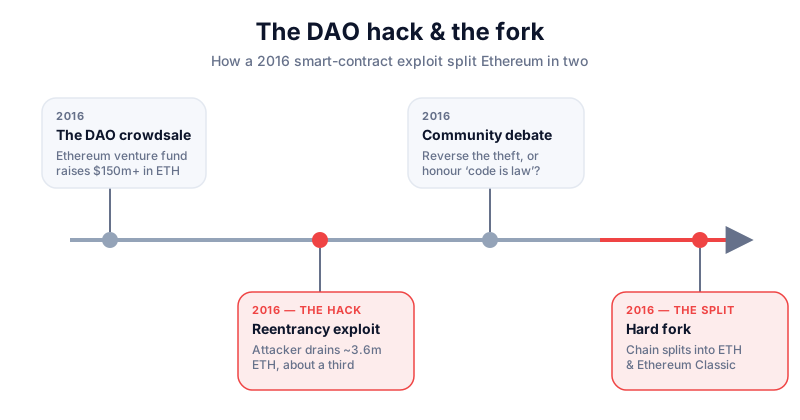
The DAO was a 2016 investor-directed fund built on Ethereum that raised over $150 million in ETH. An attacker exploited a 'reentrancy' bug to drain about a third of it. Ethereum's community controversially reversed the theft with a hard fork, splitting the chain into Ethereum (ETH) and Ethereum Classic (ETC).
What was The DAO?
A DAO — Decentralised Autonomous Organisation — is an organisation run by code and member voting rather than managers. 'The DAO' was a specific, famous example: a venture-fund-style project built on Ethereum in 2016, where token holders would vote on which projects to fund.
Its crowdsale was a sensation, raising more than $150 million worth of Ether and becoming one of the largest crowdfunding efforts ever at the time. That success made the flaw in its code enormously consequential.
How the exploit worked
The DAO's code let members withdraw their share of funds. The bug was in the *order* of operations: the contract sent the Ether out before updating its internal balance. An attacker exploited this with a 'reentrancy attack', repeatedly calling the withdrawal function before the balance was reduced — draining far more than they were owed.
- Around 3.6 million ETH — roughly a third of The DAO's holdings — was siphoned out.
- The flaw was in The DAO's contract, not in Ethereum itself.
- Reentrancy is now one of the best-known smart-contract vulnerabilities, taught in every security course.
The hard fork and the split
Because the stolen funds were locked for a period before the attacker could move them, the community had time to debate a response. The decision was deeply divisive: should they alter the blockchain to reverse the theft, or accept it to preserve the principle that 'code is law'?
The majority chose a hard fork that effectively undid the hack and returned funds — creating the chain we now call Ethereum (ETH). A minority refused on principle and continued the original chain, which became Ethereum Classic (ETC).
Smart contracts can have bugs
Code that handles money can contain flaws that drain funds instantly, and on most blockchains transactions can't simply be reversed. Be cautious with new or unaudited DeFi projects, and never put in more than you can afford to lose. This is education, not financial advice.
Why it still matters
The DAO hack forced a hard question crypto still wrestles with: when something goes badly wrong, is the blockchain truly immutable, or will humans step in? The fork showed the community *could* intervene — which some saw as a pragmatic rescue and others as a betrayal of decentralisation.
It also made smart-contract security a serious discipline. Today, audits, formal verification and bug bounties are standard for major projects. If you use DeFi, understanding that the code itself is a risk surface is one of the most valuable lessons The DAO left behind. The lasting lesson is the oldest one in crypto: coins on someone else's platform are an IOU. Long-term holdings belong offline, on a hardware wallet like the OneKey.
Key takeaways
- The DAO was a 2016 Ethereum fund that raised over $150 million in ETH.
- A reentrancy bug let an attacker drain about a third of the funds.
- Ethereum hard-forked to reverse it, splitting into ETH and Ethereum Classic.
- Smart-contract code can have serious bugs — and transactions are hard to undo.
Frequently asked questions
Was Ethereum itself hacked?
No. The bug was in The DAO's own smart contract, not in Ethereum's core protocol. But because The DAO held so much ETH, the fallout reshaped Ethereum's history.
What is Ethereum Classic?
Ethereum Classic (ETC) is the continuation of the original chain by those who rejected the hard fork. They held that the blockchain should be immutable even when it means the hack stands. ETH is the forked chain that reversed the theft.
What is a reentrancy attack?
It's when a malicious contract repeatedly calls back into a vulnerable function before that function finishes updating its state — for example, withdrawing funds many times before the balance is reduced. It's now a classic, well-documented smart-contract vulnerability.
Keep reading
What Is Ethereum? A Plain-English Guide
A beginner-friendly explanation of Ethereum: what it is, how it differs from Bitcoin, what smart contracts do,
What Is DeFi? Decentralised Finance Explained
A beginner's guide to decentralised finance: what DeFi is, how lending, trading and yield work without a bank
The Ethereum Merge Explained
What the September 2022 Ethereum Merge did, how the switch from proof-of-work to proof-of-stake cut energy use