The Ethereum Merge Explained
On 15 September 2022, Ethereum completed 'the Merge' — switching from energy-hungry proof-of-work mining to proof-of-stake. It cut the network's energy use by roughly 99.95% and was one of the most ambitious upgrades ever attempted on a live blockchain. Here's what actually changed, and what didn't.
The 20-second version
The Merge moved Ethereum from proof-of-work (mining) to proof-of-stake (validators staking ETH) on 15 September 2022. It slashed energy use by about 99.95%. It did not make fees cheaper or transactions faster, and it didn't change your ETH balance.
Proof-of-work vs proof-of-stake
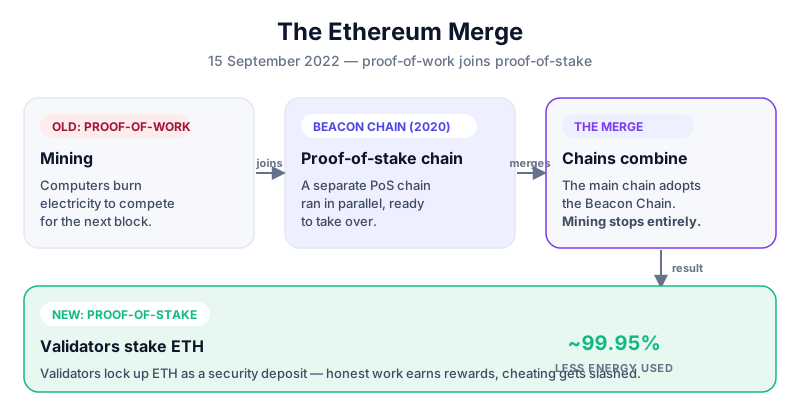
Blockchains need a way to agree on who can add the next block. Ethereum originally used proof-of-work, the same energy-intensive mining model as Bitcoin, where computers compete by burning electricity to solve puzzles.
The Merge replaced this with proof-of-stake. Instead of miners, the network relies on validators who lock up (stake) ETH as a security deposit. If they validate honestly they earn rewards; if they cheat, their stake can be slashed. No more racing computers, and a tiny fraction of the energy.
What the Merge actually did
The Merge joined Ethereum's existing main chain with a separate proof-of-stake chain (the Beacon Chain) that had been running in parallel since 2020. From that moment, proof-of-work mining on Ethereum stopped entirely.
- Energy use fell by around 99.95%, addressing Ethereum's biggest environmental criticism.
- New ETH issuance dropped sharply, since validators are rewarded far less than miners were.
- It enabled staking to secure the network — and laid groundwork for future scaling upgrades.
What it did NOT do
The Merge is widely misunderstood. It was a change to *how blocks are produced*, not a change to capacity or cost. Several common expectations were simply wrong.
- It did not make transactions cheaper — gas fees depend on network demand and scaling, not the consensus mechanism.
- It did not make Ethereum dramatically faster for users.
- It did not change your ETH holdings — balances carried over exactly.
Staking is not risk-free
Earning staking rewards on ETH still exposes you to ETH's price volatility, plus lock-up periods and, with some providers, counterparty risk. A network being more efficient says nothing about price. This is education, not financial advice.
Why it mattered
Beyond the energy savings, the Merge proved that a major live blockchain holding hundreds of billions in value could swap out its core engine without disruption. That was a significant engineering and coordination achievement.
It also set the stage for Ethereum's roadmap of scaling upgrades aimed at cheaper, higher-capacity transactions. To go deeper, read what is Ethereum and what is staking, and see how an earlier crisis — The DAO hack — shaped the network's culture of careful upgrades.
Key takeaways
- The Merge (Sept 2022) switched Ethereum from proof-of-work to proof-of-stake.
- It cut the network's energy use by roughly 99.95%.
- It did not lower fees, speed up transactions, or change your ETH balance.
- It enabled staking and proved a live blockchain can swap its core engine safely.
Frequently asked questions
Did the Merge make Ethereum cheaper to use?
No. Gas fees are driven by demand for block space and are addressed by separate scaling upgrades, not by the move to proof-of-stake. Many people wrongly expected lower fees from the Merge.
Do I need to do anything to my ETH?
No. Balances carried over automatically. Be wary of any message telling you to 'upgrade' or 'migrate' your ETH for the Merge — that's a common scam pattern.
Is proof-of-stake less secure than proof-of-work?
It's a different security model, not obviously weaker — validators risk losing staked ETH for misbehaving. Both approaches have trade-offs that are still debated, but proof-of-stake has secured Ethereum since 2022.
Keep reading
What Is Ethereum? A Plain-English Guide
A beginner-friendly explanation of Ethereum: what it is, how it differs from Bitcoin, what smart contracts do,
What Is Staking? How It Works and What It Costs
A plain-English guide to crypto staking: how it secures proof-of-stake networks, how rewards work, and the loc
The DAO Hack Explained
How a 2016 smart-contract exploit drained around a third of The DAO's funds, why Ethereum split into ETH and E