The Mt. Gox Hack Explained
Mt. Gox was once the largest Bitcoin exchange in the world, handling the majority of all BTC trades. In February 2014 it collapsed, having lost roughly 850,000 bitcoin. More than a decade later it remains the most infamous failure in crypto history — and a permanent lesson in why custody matters.
The 20-second version
Mt. Gox, a Tokyo-based exchange handling most Bitcoin trading by 2013, lost around 850,000 BTC (about 750,000 belonging to customers) and filed for bankruptcy in February 2014. The losses built up over years of poor security and bookkeeping. Creditors only began receiving repayments more than a decade later.
What was Mt. Gox?
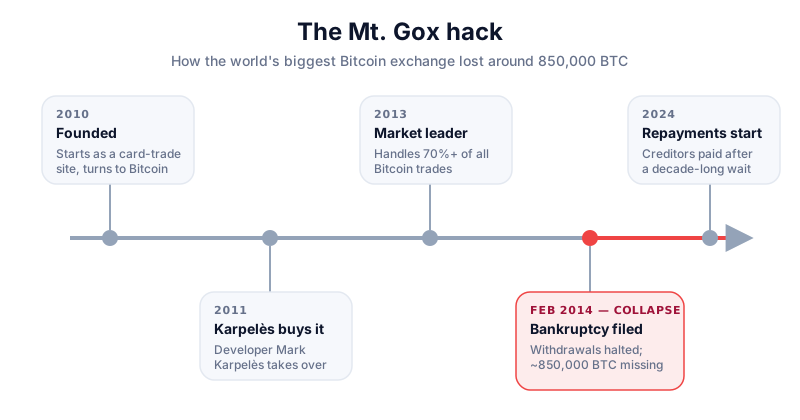
Mt. Gox started life in 2010 and was originally built on code for trading 'Magic: The Gathering Online' cards — the name stands for 'Magic: The Gathering Online eXchange'. It was soon repurposed for Bitcoin trading and bought by developer Mark Karpelès in 2011.
At its peak in 2013, the Tokyo-based exchange handled an estimated 70% or more of all Bitcoin transactions worldwide. For many early adopters, Mt. Gox simply *was* the place you bought and sold Bitcoin.
What actually happened
In February 2014, Mt. Gox abruptly halted withdrawals, then went offline entirely. On 28 February 2014 it filed for bankruptcy protection in Japan, revealing that roughly 850,000 bitcoin were missing — around 750,000 belonging to customers and 100,000 of its own.
Crucially, this was not a single dramatic break-in. Investigations suggested coins had been quietly leaking from the exchange's wallets for years, due to a mix of theft and chronically poor record-keeping that hid the shortfall.
- Around 200,000 BTC were later recovered from an old-format wallet, reducing the net loss.
- A long-standing software flaw known as transaction malleability was initially blamed, though it explained only part of the gap.
- Mark Karpelès was later convicted in Japan of falsifying data, but cleared of embezzlement.
The long aftermath
Because the recovered bitcoin rose enormously in value over the following years, the bankruptcy turned into a unique 'civil rehabilitation' process. Creditors faced a more than decade-long wait, with repayments to former customers only beginning in 2024.
The custody lesson
Money left on any exchange is in that exchange's custody, not yours. If it is hacked, mismanaged or goes bankrupt, your funds can be frozen or lost. For anything you'd be upset to lose, learn how to store Bitcoin safely in your own wallet.
What it changed
Mt. Gox shaped how the industry thinks about exchange risk. It popularised the phrase 'not your keys, not your coins', drove demand for self-custody and hardware wallets, and pushed serious exchanges toward independent audits and proof-of-reserves. If this story leaves one habit behind, make it this: keep long-term holdings in your own cold storage — a Trezor Safe 5 — not on any platform's balance sheet.
It was not the last exchange failure — the later FTX collapse showed many of the same lessons had to be re-learned. Understanding both is the best defence against repeating them.
Key takeaways
- Mt. Gox once handled the majority of global Bitcoin trades.
- It lost roughly 850,000 BTC and filed for bankruptcy in February 2014.
- The losses built up over years of poor security and accounting, not one hack.
- The core lesson: funds on an exchange are in its custody, not yours.
Frequently asked questions
Did Mt. Gox customers ever get their money back?
Partly, and very slowly. Because some bitcoin was recovered and rose hugely in value, a rehabilitation plan was agreed, with repayments to creditors only beginning more than a decade later in 2024.
Was anyone blamed for the collapse?
Former CEO Mark Karpelès was convicted in Japan of falsifying financial records but acquitted of embezzlement. The full picture of how the coins were lost was never fully resolved.
Could a Mt. Gox-style failure happen again?
Yes — exchanges can still be hacked or mismanaged, as later events showed. The way to reduce your personal exposure is to keep long-term holdings in self-custody rather than on any exchange.
Keep reading
The FTX Collapse Explained
How FTX went from a top crypto exchange to bankruptcy in days, what went wrong with Alameda Research and custo
How to Store Bitcoin Safely (Step by Step)
Keep your Bitcoin safe from hackers and mistakes: hot vs cold wallets, hardware wallets, seed-phrase backups,
How to Avoid Crypto Scams: The Cornerstone Safety Guide
The common crypto scams — fake support, phishing, giveaways, romance and rug pulls — and the simple habits tha