The Terra/Luna Collapse Explained
In May 2022, the Terra ecosystem imploded in one of the fastest wealth destructions in crypto history. Its 'stablecoin' UST lost its dollar peg, its sister token LUNA fell to near zero, and tens of billions of dollars evaporated within days. The cause was a design flaw that many had warned about — here's how it worked.
The 20-second version
Terra's UST was an algorithmic stablecoin meant to hold $1, backed not by cash reserves but by a linked token, LUNA. When confidence broke in May 2022, the mechanism spiralled: UST fell below $1, vast amounts of LUNA were created to defend it, and both collapsed to near zero in days.
What was Terra/Luna?
Terra was a blockchain ecosystem built around two linked tokens. UST (TerraUSD) was a stablecoin designed to stay at $1. LUNA was the network's volatile token, used to absorb price swings and keep UST stable.
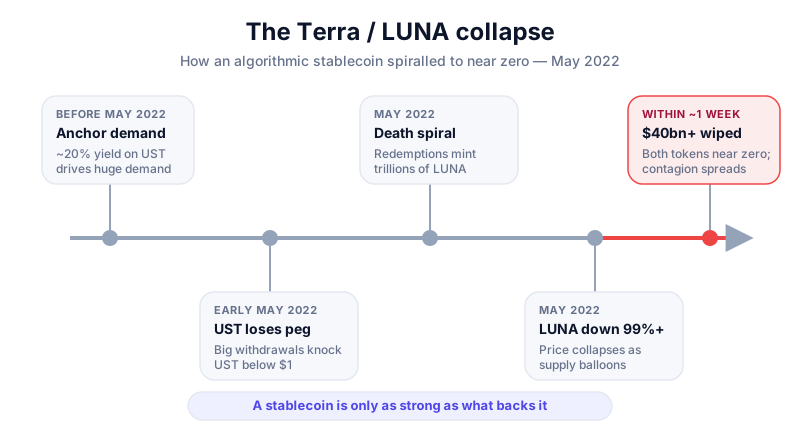
Much of UST's demand came from Anchor Protocol, a DeFi platform offering roughly 20% yield on UST deposits. That rate was unusually high and heavily subsidised — a major draw that many later saw as unsustainable.
Why the design was fragile
Unlike a stablecoin backed by real dollars in a bank, UST was algorithmic. It held its peg through a swap mechanism: $1 of UST could always be exchanged for $1 of newly created LUNA, and vice versa. In theory, arbitrage traders would keep UST at $1.
The flaw is that this depends entirely on confidence in LUNA. If UST falls below $1 and people rush to redeem it, the system mints huge amounts of new LUNA — crashing LUNA's price, which destroys the very value meant to back UST. This feedback loop is sometimes called a 'death spiral'.
The collapse, day by day
In early May 2022, large withdrawals and sales knocked UST below its $1 peg. Confidence cracked, redemptions surged, and the death spiral took hold. The lasting lesson is the oldest one in crypto: coins on someone else's platform are an IOU. Long-term holdings belong offline, on a hardware wallet like the BitBox02.
- UST broke its peg and never recovered, eventually trading at a few cents.
- LUNA's supply ballooned into the trillions as the system tried to defend UST, collapsing its price by over 99%.
- An estimated $40 billion-plus in value was wiped out within roughly a week.
'Stable' is not a guarantee
A stablecoin is only as strong as what backs it. Algorithmic stablecoins with no real reserves have repeatedly failed. Even reserve-backed stablecoins carry risk. Never assume any token is truly 'safe', and only ever risk what you can afford to lose. This is education, not financial advice.
Aftermath and lessons
The collapse triggered contagion across the industry, contributing to the failure of several major lenders and funds, and it drew intense regulatory scrutiny of stablecoins worldwide. Terra's founder, Do Kwon, faced legal action in multiple jurisdictions.
The clearest lesson is to understand *how* a stablecoin holds its value before trusting it, and to be sceptical of unusually high yields. Read what is a stablecoin for the difference between reserve-backed and algorithmic designs, and pair it with the wider FTX story to see how 2022's failures fed into one another.
Key takeaways
- UST was an algorithmic stablecoin backed by a token (LUNA), not cash reserves.
- When confidence broke in May 2022, a 'death spiral' crashed both to near zero.
- Over $40 billion in value vanished in about a week.
- Understand what backs any stablecoin, and distrust unsustainable yields.
Frequently asked questions
What's the difference between UST and a normal stablecoin?
UST was algorithmic — it tried to hold $1 through a swap mechanism with the LUNA token, not by holding real dollars. Reserve-backed stablecoins instead aim to hold cash or equivalents for each coin issued, though they carry their own risks.
Was the 20% Anchor yield the cause?
Not directly, but it was a major factor. The high, subsidised yield drove huge demand for UST that wasn't sustainable, so when sentiment turned the unwinding was far more violent.
Could an algorithmic stablecoin work in future?
Designs continue to be attempted, but several algorithmic stablecoins have failed in similar ways. Treat any 'stable' token as something to understand fully before relying on it, not a guaranteed dollar.
Keep reading
What Is a Stablecoin? How the Peg Works (and Fails)
A clear guide to stablecoins: how they aim to hold a steady value, the different types, and the very real peg
The FTX Collapse Explained
How FTX went from a top crypto exchange to bankruptcy in days, what went wrong with Alameda Research and custo
What Is DeFi? Decentralised Finance Explained
A beginner's guide to decentralised finance: what DeFi is, how lending, trading and yield work without a bank