What Are Privacy Coins? The Regulatory Debate, Fairly
Most cryptocurrencies are surprisingly public — anyone can read a Bitcoin wallet's entire history. Privacy coins were built to change that, hiding who paid whom and how much. This guide explains what privacy coins are, why people use them, and the genuine debate between privacy rights and regulation — presented fairly, with no spin in either direction.
The 20-second version
Privacy coins hide transaction details that ordinary blockchains expose. Monero hides them by default; Zcash makes privacy optional. They protect legitimate financial privacy but also draw heavy regulatory scrutiny and exchange delistings.
What is a privacy coin?
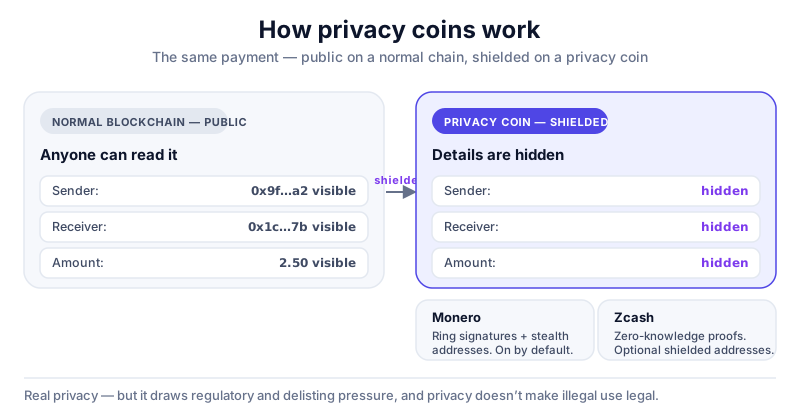
A privacy coin is a cryptocurrency designed to conceal the details of a transaction — typically the sender, the receiver, and the amount. This is the opposite of a 'transparent' chain like Bitcoin or Ethereum, where every transaction is permanently visible to anyone.
The two best-known are Monero, which makes privacy mandatory for every transaction, and Zcash, which lets users choose between transparent and shielded transactions. We compare them directly in Monero vs Zcash.
How they work
Different projects use different cryptography, but the goal is the same — break the link between a payment and an identifiable wallet:
- Monero uses ring signatures, stealth addresses and confidential transactions to hide all three parts of a payment, on by default.
- Zcash uses advanced maths called zero-knowledge proofs (zk-SNARKs) to let you prove a transaction is valid without revealing its details — but only when you use a 'shielded' address.
- Other approaches include mixing services and optional privacy layers added to existing coins.
Why people use them
There are entirely legitimate reasons to want financial privacy:
- Not wanting employers, exes, landlords or strangers to see your full spending history.
- Protecting against being targeted because a public wallet reveals you hold significant funds.
- Fungibility — every coin is interchangeable, with no 'tainted' history attached.
- Living under a regime where financial surveillance is used to suppress dissent.
Privacy advocates point out that cash already offers this kind of privacy, and that wanting it for digital money is not inherently suspicious.
The regulatory debate, fairly
There are two honest sides here, and a balanced view holds both at once.
The case for regulation: governments and regulators argue that untraceable money makes tax evasion, money laundering, sanctions-dodging and ransomware easier. Several exchanges have delisted privacy coins to stay compliant with anti-money-laundering rules, and some jurisdictions have restricted them. These are real concerns, not imaginary ones.
The case for privacy: advocates counter that privacy is a basic right, that most crypto crime still happens on transparent chains because they're far more liquid, and that blanket bans punish ordinary users for the actions of a few. They argue surveillance of all spending is the bigger danger.
Both positions contain truth. The practical takeaway for you is simply that privacy coins carry extra regulatory risk: they can be delisted or restricted, sometimes quickly, and the rules differ by country and change over time.
Know the rules where you live
Privacy coins are legal in many places but restricted in others, and exchange access can vanish. Stay within the law in your jurisdiction. All crypto is volatile — only risk what you can afford to lose, never borrow to buy. This is education, not financial advice.
A VPN encrypts your traffic and hides your IP — vital on public Wi-Fi and a sensible default before logging into any exchange. NordVPN also blocks known malicious and phishing sites.
Key takeaways
- Privacy coins hide transaction details that ordinary blockchains make public.
- Monero hides everything by default; Zcash makes privacy optional via zero-knowledge proofs.
- There are legitimate reasons to want financial privacy — and real regulatory concerns about misuse.
- They carry extra regulatory risk: delistings and restrictions vary by country and can change fast.
Frequently asked questions
Are privacy coins legal?
It depends on where you live. They're legal in many countries but restricted in some, and several exchanges have delisted them. Always check your local rules.
Are privacy coins only used by criminals?
No. Plenty of ordinary people value financial privacy for the same reasons they value cash. Criticism of misuse is fair, but so is the case for legitimate privacy — both are true.
Which is the most private?
Monero is widely regarded as the most private because protection is on by default for every transaction. Zcash can be equally strong but only when users choose shielded addresses.
Keep reading
What Is Monero (XMR)? A Plain-English Guide
A beginner-friendly explanation of Monero (XMR) — the privacy-focused cryptocurrency. How it works, why it's c
Monero vs Zcash: How the Two Privacy Coins Compare
A fair, plain-English comparison of Monero (XMR) and Zcash (ZEC) — privacy by default vs optional, technology,
How to Buy Monero (XMR) Safely: Step by Step
A safe, beginner-friendly walkthrough of how to buy Monero (XMR) — choosing an exchange, the privacy-coin catc