What Are Wrapped Tokens? WBTC and WETH Explained
A wrapped token is a stand-in for another coin that lets it work on a blockchain it doesn't natively belong to — like using Bitcoin inside Ethereum's DeFi apps. Wrapped Bitcoin (WBTC) and Wrapped Ether (WETH) are the best-known examples. This guide explains what wrapping means, why it exists, and the custody and bridge risks you should weigh before holding one.
The 20-second version
A wrapped token is a 1:1 IOU for another coin, usable on a different blockchain. Each wrapped token is meant to be backed by the real asset held in reserve. The catch: you have to trust whoever holds that backing — or the bridge that issued it.
Read this first
A wrapped token is only as safe as its backing
Wrapped tokens depend on a custodian or bridge actually holding the underlying asset. Bridges have been among the biggest hacks in crypto history. This guide is education, not financial advice — understand who holds the backing before you rely on a wrapped token.
What is a wrapped token?
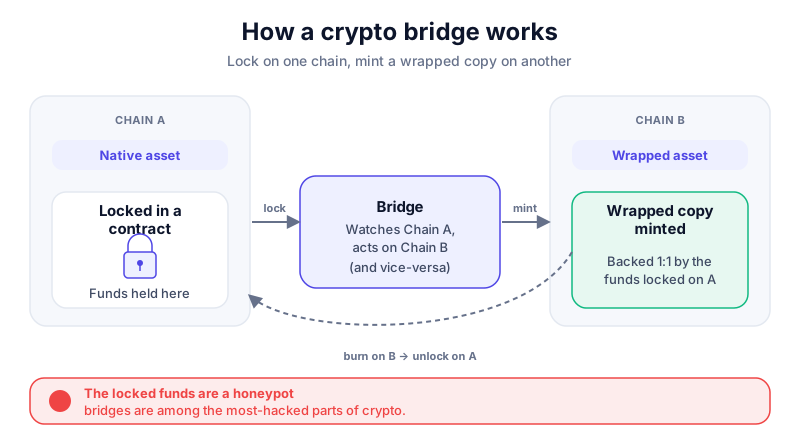
Blockchains don't naturally talk to each other. Bitcoin lives on Bitcoin's network; it can't be used directly in an Ethereum app. Wrapping solves this by locking the original coin and minting a matching token on the other chain. Wrapped Bitcoin (WBTC) is an ERC-20 token on Ethereum that's meant to be backed 1:1 by real Bitcoin held in custody.
Wrapped Ether (WETH) is a slightly different case: ETH predates the token standard most apps expect, so WETH simply 'wraps' ETH into that standard format so it behaves like any other token in DeFi and on a DEX.
Why wrapped tokens exist
- Cross-chain use: bring Bitcoin's value into Ethereum's liquidity pools, lending markets, and trading.
- Standardisation: WETH lets ETH plug into apps that expect the ERC-20 token format.
- Liquidity: wrapped assets deepen pools and make swaps smoother across ecosystems.
The risks of wrapping
- Custody risk: with WBTC, a custodian holds the real Bitcoin. If it's mismanaged or the backing isn't fully there, the token's peg can break.
- Bridge risk: wrapped tokens minted by cross-chain bridges have been targets of enormous hacks (the Wormhole and Ronin exploits each lost hundreds of millions).
- Smart-contract risk: the wrapping contract itself could contain bugs.
- Depeg risk: in a panic, a wrapped token can trade below the asset it represents.
Know what backs it
Before using a wrapped token, check who issues it and how the backing is verified. Well-established, transparently audited wrappers carry less risk than obscure bridge tokens promising exotic rewards.
Where to go next
Wrapped tokens are a stepping stone to other cross-asset ideas: see what is liquid staking for tokens that represent staked coins, and revisit what is DeFi and what is a stablecoin for the wider picture.
Key takeaways
- A wrapped token is a 1:1 representation of another coin usable on a different blockchain.
- WBTC brings Bitcoin into Ethereum DeFi; WETH puts ETH into the standard token format.
- Each wrapped token relies on a custodian or bridge holding the real asset.
- Bridge and custody failures are real risks — verify who backs a wrapped token before relying on it.
Frequently asked questions
Is WBTC actually backed by real Bitcoin?
It's designed to be, with custodians holding Bitcoin 1:1 and published proof-of-reserve. The trade-off is that you must trust those custodians and the system around them.
Why does ETH need to be 'wrapped' into WETH?
ETH came before the ERC-20 token standard most apps use. Wrapping it into WETH makes ETH behave like any other token, so it plugs neatly into DeFi apps.
Can I always unwrap back to the original coin?
Normally yes — the system is designed to redeem 1:1. But if the custodian fails or a bridge is hacked, redemption can break, which is the core risk.
Keep reading
What Is Liquid Staking? stETH and LSTs Explained
Liquid staking explained: how tokens like stETH let you stake crypto while keeping it usable in DeFi, plus the
What Is DeFi? Decentralised Finance Explained
A beginner's guide to decentralised finance: what DeFi is, how lending, trading and yield work without a bank
What Is a Stablecoin? How the Peg Works (and Fails)
A clear guide to stablecoins: how they aim to hold a steady value, the different types, and the very real peg