What Is Liquid Staking? stETH and LSTs Explained
Normally, when you stake crypto to help secure a network, your coins are locked up and can't be used for anything else. Liquid staking changes that: it gives you a tradeable token representing your staked coins, so you earn staking rewards and stay active in DeFi at the same time. This guide explains how it works and the risks behind the convenience.
The 20-second version
Liquid staking lets you stake a coin and receive a 'liquid staking token' (LST) like stETH in return. The LST earns staking rewards and can still be traded, lent, or pooled. The trade-offs are depeg risk, smart-contract risk, and concentration in a few big providers.
Read this first
Liquid does not mean risk-free
Liquid staking tokens can trade below the coin they represent (a 'depeg'), and they add smart-contract risk on top of normal staking risk. This guide is education, not financial advice — never stake more than you can afford to lose.
What is liquid staking?
When you stake ETH directly, it's locked to help secure Ethereum, and you can't spend or trade it while it's working. Liquid staking solves that lock-up. You deposit your coin with a liquid staking protocol, it stakes on your behalf, and it hands you a liquid staking token (LST) in return — for example, Lido issues stETH for staked ETH.
That LST keeps earning staking rewards, but you can also use it elsewhere: trade it on a DEX, supply it to a liquidity pool, or use it as collateral in lending. In effect, your capital does two jobs at once.
How it works
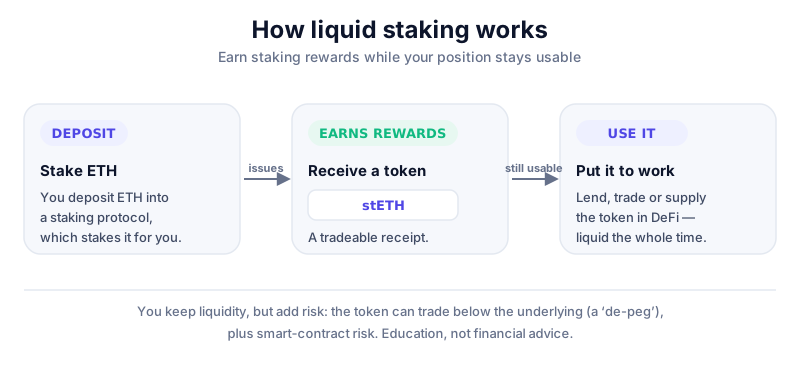
- You deposit a coin (e.g. ETH) with a liquid staking provider.
- The provider stakes it across validators and handles the technical work.
- You receive an LST (e.g. stETH) representing your stake plus accruing rewards.
- You stay liquid — the LST can be used across DeFi while the underlying coin stays staked.
The risks to weigh
- Depeg risk: an LST can trade below the coin it represents, especially in market stress — stETH briefly traded at a discount during the 2022 turmoil.
- Smart-contract risk: a bug in the protocol could put deposits at risk.
- Validator/slashing risk: if validators misbehave, a portion of stake can be penalised.
- Centralisation risk: a few providers control a large share of staking, which raises concerns about network concentration.
Don't stack risk blindly
Using an LST as collateral to borrow and stake again ('looping') multiplies your exposure to every one of these risks at once. The extra yield comes with sharply higher danger of liquidation.
Where to go next
Start with the basics in what is staking, then see the next layer in what is restaking. LSTs are close cousins of wrapped tokens and are widely used across DeFi. If you do stake, do it from cold storage — a hardware wallet like the Ledger Nano X lets you delegate while your keys stay offline.
Key takeaways
- Liquid staking gives you a tradeable token (an LST) representing your staked coins.
- The LST keeps earning rewards while staying usable across DeFi.
- stETH from Lido is the best-known example for staked ETH.
- Risks include depegs, contract bugs, slashing, and provider centralisation — only stake what you can afford to lose.
Frequently asked questions
What is stETH?
stETH is a liquid staking token issued by Lido that represents ETH staked through its protocol. It accrues staking rewards and can be used elsewhere in DeFi.
Why would an LST trade below the coin it represents?
In times of stress or limited withdrawals, sellers may accept a discount for instant liquidity, causing a temporary 'depeg'. It usually narrows once redemptions are smooth.
Is liquid staking the same as restaking?
No. Liquid staking frees your staked coin into a usable token. Restaking goes a step further, reusing that staked security to back other services — adding more reward and more risk.
Keep reading
What Is Staking? How It Works and What It Costs
A plain-English guide to crypto staking: how it secures proof-of-stake networks, how rewards work, and the loc
What Is Restaking? EigenLayer and the Risks Explained
Restaking explained for beginners: how protocols like EigenLayer reuse staked ETH to secure other services, wh
What Are Wrapped Tokens? WBTC and WETH Explained
Wrapped tokens explained simply: how WBTC and WETH let coins move across blockchains, who holds the backing, a