What Is a Crypto Market Maker?
Every time you buy or sell crypto instantly, someone — or something — is on the other side of that trade. That role is played by a market maker. Market makers keep markets liquid so you can trade without waiting and without moving the price too much. This guide explains who they are, the two main types, and why they matter for the prices you see.
The 20-second version
A market maker stands ready to buy and sell an asset, quoting both a price to buy and a price to sell. They provide liquidity so trades happen smoothly. In DeFi, software called an automated market maker (AMM) does this job using pooled funds and a formula.
What is a market maker?
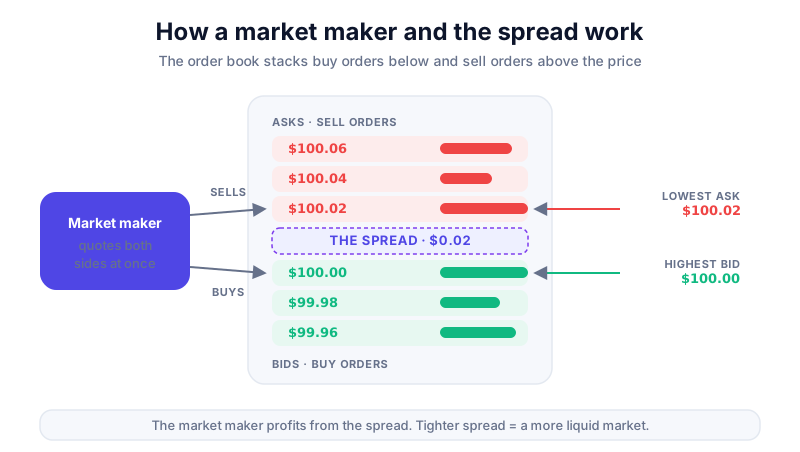
A market maker is a participant that continuously offers to both buy and sell an asset, posting a price for each. The gap between those two prices is the spread, and capturing it is how market makers typically earn money. By always being willing to trade, they make it easy for everyone else to buy or sell quickly.
Without market makers, you might place an order and wait — sometimes a long time — for someone with the exact opposite need to appear. Liquidity is the difference between a smooth market and a sticky one.
Liquidity, spreads and slippage
- Liquidity — how easily an asset can be traded without big price moves. Market makers supply it.
- Spread — the gap between the best buy price and the best sell price. Tighter spreads mean cheaper trading.
- Slippage — the difference between the price you expect and the price you get, common in thin or low-liquidity markets.
Deep liquidity from active market makers usually means tighter spreads and less slippage, which is better for ordinary traders.
Traditional market makers
On a centralised exchange, professional trading firms act as market makers. They run software that posts buy and sell orders around the clock, adjusting prices as the market moves. They take on the risk of holding inventory in exchange for earning the spread and, sometimes, exchange rebates.
These firms are powerful but not all-powerful — they can lose money when prices move sharply against the inventory they hold.
Automated market makers (AMMs)
In DeFi, there are no professional firms behind the scenes. Instead, a decentralised exchange uses an automated market maker: a smart contract that holds a pool of two assets and prices trades using a fixed mathematical formula. Anyone can deposit funds into the pool to become a 'liquidity provider' and earn a share of the trading fees.
Providing liquidity carries risk
Becoming a liquidity provider in an AMM exposes you to 'impermanent loss' — you can end up worse off than simply holding the two assets if their prices diverge. The total deposited across these pools is often tracked as Total Value Locked.
Why this matters to you
You rarely interact with market makers directly, but they shape every trade you make: how fast it fills, how close to the quoted price, and how much it costs. Thin markets with little market-making can be dangerous to trade in. Whichever way you lean, the storage rule doesn't change: serious amounts belong offline, on a hardware wallet like the BitBox02.
A fair warning
Low-liquidity tokens can be hard to sell and easy to manipulate. Be especially careful with thinly traded coins. Crypto is volatile — only risk what you can afford to lose. This guide is education, not financial advice.
Key takeaways
- Market makers quote both buy and sell prices to keep markets liquid.
- Tighter spreads and deeper liquidity mean cheaper, smoother trading.
- Traditional market makers are firms; AMMs are smart contracts using pooled funds.
- Providing liquidity to an AMM carries risks like impermanent loss.
Frequently asked questions
Do market makers control the price of a coin?
Not on their own. They provide liquidity and quote prices, but the broader market of buyers and sellers sets value. In thin markets, however, large players can have an outsized effect.
What's the difference between a market maker and a market taker?
A market maker posts orders that wait to be filled, adding liquidity. A taker accepts an existing order, removing liquidity. Most casual trades are taker trades.
Can I be a market maker in DeFi?
In a sense, yes — by depositing into an AMM liquidity pool you act as a passive liquidity provider and earn fees. Be aware of impermanent loss and smart-contract risk first.
Keep reading
What Is a DEX? Decentralised Exchanges Explained
A plain-English guide to decentralised exchanges (DEXs): how they let you swap tokens without an account, how
What Is Total Value Locked (TVL) in Crypto?
Total Value Locked (TVL) explained: what it measures in DeFi, how it's calculated, why it can mislead, and how
What Is DeFi? Decentralised Finance Explained
A beginner's guide to decentralised finance: what DeFi is, how lending, trading and yield work without a bank