What Is Tokenomics? How Crypto Supply and Incentives Work
Tokenomics is shorthand for 'token economics' — the rules that govern how a crypto token is created, distributed and used. Get the tokenomics right and a project can align everyone's incentives; get them wrong and even good technology can collapse. This guide explains the moving parts in plain English so you can read a token's economics for yourself.
The 20-second version
Tokenomics covers how many tokens exist, how new ones are created, who holds them, and why anyone would want them. Scarcity, distribution and real utility matter more than any logo or slogan. Always read these before trusting a project.
What is tokenomics?
Tokenomics describes the economic design of a crypto token: how it is issued, how supply changes over time, who received it at launch, and what role it plays in its network. Think of it as the constitution of a token's economy. For coins like Bitcoin the rules are famously simple; for many newer tokens they are far more complex.
Because these rules are usually written into code, they are hard to change after launch. That makes understanding them upfront essential — the design you see today is often the design you are stuck with.
Supply: how many will ever exist?
Supply is the first thing to check. A few terms come up again and again:
- Maximum supply — the hard cap on how many tokens can ever exist. Bitcoin's is 21 million; many tokens have no cap at all.
- Circulating supply — how many are actually in the market right now, excluding locked or unreleased tokens.
- Emissions — the rate at which new tokens are created, often as staking or mining rewards.
- Burns — tokens permanently removed from supply, which can offset emissions.
A token can look cheap per unit but still have a huge total supply, so always look at the full picture rather than just the price of one token.
Distribution: who got the tokens?
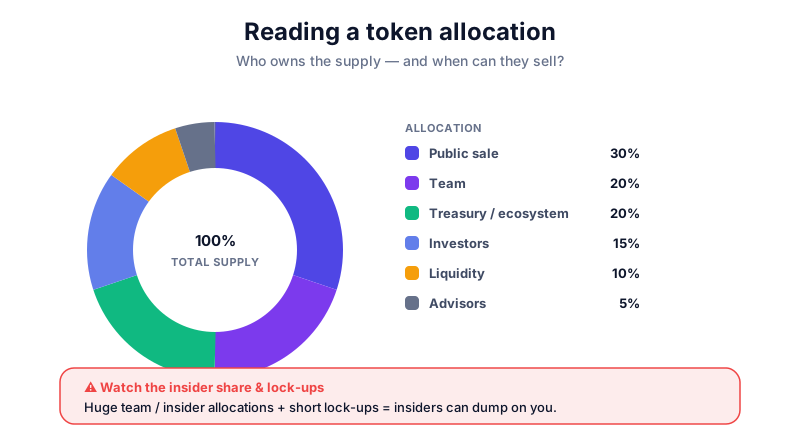
How a token was first handed out tells you a lot about who holds power and who might sell. Common allocations include the team, early investors, a community treasury, and public sale buyers.
Watch for concentration
If a small group of insiders holds most of the supply, they can move the price sharply or sell into the market once their tokens unlock. A heavily concentrated distribution is a genuine risk worth understanding before you get involved.
Many projects publish a 'vesting schedule' showing when insider tokens unlock. Large unlocks can add selling pressure, so it's worth knowing when they happen.
Utility: why would anyone want it?
A healthy token usually has a job to do. It might pay network fees, secure the chain through staking, grant governance votes, or back a stablecoin. Tokens with no real purpose rely purely on speculation, which tends to be fragile. And however you weigh the trade-offs, keep meaningful holdings in cold storage — a Trezor Safe 5 — rather than on an exchange.
- Gas / fees — paying to use the network (for example ETH on Ethereum).
- Staking — locking tokens to help secure the network and earn rewards.
- Governance — voting on how a protocol is run.
- Access — unlocking features, products or services.
How to read tokenomics sensibly
When you look at a new project, the whitepaper and official docs should spell out supply, distribution and utility clearly. Vague or missing tokenomics is itself a warning sign.
A fair warning
Good tokenomics does not make a token a good investment, and clever-sounding designs can still fail. Crypto is highly volatile — only ever risk what you can afford to lose. This guide is education, not financial advice.
Key takeaways
- Tokenomics is the economic rulebook for how a token is created, shared and used.
- Check maximum vs circulating supply, plus the rate of new emissions.
- Concentrated distribution and big insider unlocks are real risks.
- Real utility beats hype — but good design never guarantees a good outcome.
Frequently asked questions
Is good tokenomics enough to make a token succeed?
No. Sound tokenomics helps align incentives, but execution, demand, security and luck all matter too. Treat it as one factor among many, not a guarantee.
Where do I find a token's tokenomics?
Start with the project's official whitepaper and documentation. Independent data sites can also show circulating supply and distribution. Be cautious if these details are hard to find.
What does 'fully diluted valuation' mean?
It estimates a token's total value if every token in the maximum supply were in circulation. It can be far higher than today's market value when many tokens are still locked.
Keep reading
What Is a Crypto Whitepaper?
A crypto whitepaper explained: what it is, what a good one contains, how to read one critically, and the red f
What Is Total Value Locked (TVL) in Crypto?
Total Value Locked (TVL) explained: what it measures in DeFi, how it's calculated, why it can mislead, and how
What Is Staking? How It Works and What It Costs
A plain-English guide to crypto staking: how it secures proof-of-stake networks, how rewards work, and the loc