What Is a Crypto Validator? A Plain-English Guide
Validators are the computers that keep a proof-of-stake blockchain running, checking transactions and adding new blocks. They're the modern successor to Bitcoin's miners — but instead of solving puzzles with electricity, they put up crypto as a deposit. This guide explains what validators do, how they earn, and what it takes to become one.
The 20-second version
A validator is a computer that verifies transactions and proposes new blocks on a proof-of-stake network. It stakes crypto as a security deposit, earns rewards for honest work, and can be penalised through slashing for breaking the rules.
What is a validator?
A validator is a computer (and the operator running it) that helps secure a proof-of-stake blockchain. Its job is to check that transactions are valid, agree with other validators on the network's true state, and take turns proposing new blocks to add to the chain.
Validators are the proof-of-stake equivalent of Bitcoin's miners. The difference is in how they earn the right to add blocks: instead of competing with computing power and electricity, validators lock up crypto as a deposit and are chosen to propose blocks based partly on how much they've staked.
How validators work
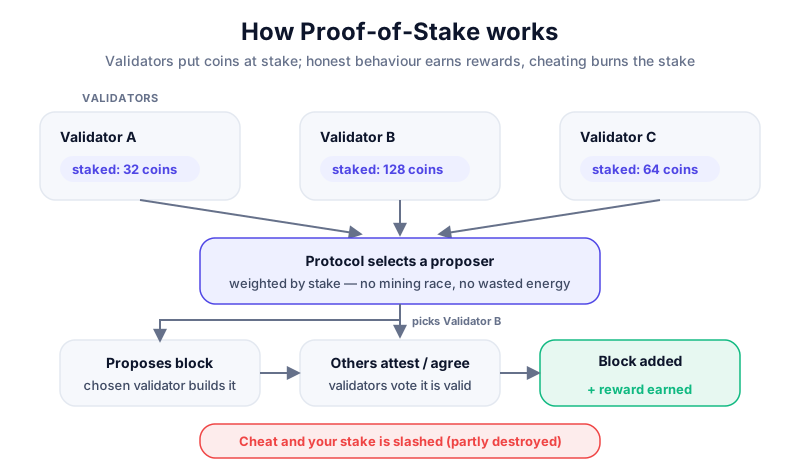
To become a validator on a network like Ethereum, an operator stakes a required amount of the network's coin and runs validator software around the clock. The network then assigns duties.
- Proposing — when chosen, a validator bundles transactions into a new block.
- Attesting — the rest vote on whether each proposed block is valid, reaching agreement ('consensus').
- Staking — the locked deposit is what gives a validator skin in the game.
- Earning — validators receive rewards for performing their duties reliably and honestly.
Because validators must stay online and follow the rules, reliability matters. A validator that misbehaves can be penalised — see what slashing is.
How to become a validator
There are broadly three ways to take part, with very different effort and risk levels.
- Run your own validator — the most hands-on option. You need the full stake, technical know-how, and reliable, always-on hardware.
- Join a staking pool — combine your coins with others so you don't need the full amount or your own node.
- Stake through an exchange — the simplest route; the exchange runs everything, but you trust it with the process.
Start by understanding staking
Becoming a validator is really an advanced form of staking. If you're new, read that first — most people start by delegating to a pool or staking through a platform before ever running their own node.
Rewards and risks
Validators earn rewards, but it isn't free money. The risks are real and worth weighing carefully.
Know what you're signing up for
Validating carries slashing risk, lock-up periods where you can't withdraw, technical responsibility for staying online, and exposure to the coin's price swings. Only commit what you can afford to tie up. This is education, not financial advice.
If you run your own validator, you're also responsible for your keys and seed phrase. As always, no legitimate service will ever ask you to share your seed phrase — learn how to avoid crypto scams before you begin.
Where to go next
Validators are central to how modern blockchains work. To go deeper, read what staking is, what slashing is, and how networks scale through sharding. Whichever way you lean, the storage rule doesn't change: serious amounts belong offline, on a hardware wallet like the OneKey.
Key takeaways
- A validator verifies transactions and proposes blocks on a proof-of-stake network.
- Validators stake crypto as a deposit instead of mining with electricity.
- You can run your own, join a pool, or stake through an exchange.
- Rewards come with slashing risk, lock-ups, and price volatility.
Frequently asked questions
What's the difference between a validator and a miner?
Miners secure proof-of-work chains like Bitcoin using computing power. Validators secure proof-of-stake chains by staking crypto. Both add and confirm blocks, but the security mechanism differs.
Do I need to run my own validator to earn staking rewards?
No. Most people stake through a pool or exchange, which handles the validator work for them. Running your own gives more control but requires the full stake and technical effort.
How much do I need to become a validator?
It depends on the network — some require a fixed amount to run a solo validator, while pools let you take part with far less. Check the specific network's requirements.
Keep reading
What Is Staking? How It Works and What It Costs
A plain-English guide to crypto staking: how it secures proof-of-stake networks, how rewards work, and the loc
What Is Slashing? Validator Penalties Explained
A plain-English guide to slashing: what it is, why proof-of-stake networks use it, what triggers it, and what
What Is Sharding? Blockchain Scaling Explained
A plain-English guide to sharding: what it means, how it helps blockchains scale, where it's used, and the tra