What Is a DAO? Decentralised Organisations Explained
A DAO — a decentralised autonomous organisation — is an internet-native group that runs on shared rules written in code rather than a traditional management hierarchy. Members make decisions together, often by voting with tokens. This guide explains what DAOs are, how they work, where they're used, and the real limitations behind the hype.
The 20-second version
A DAO is a group that coordinates and makes decisions through blockchain-based rules and member voting, with no central boss. Funds and rules often live in smart contracts. It's a powerful idea — but DAOs face real challenges around participation, security and the law.
What a DAO is
Picture a club, an investment group or an open-source project — but instead of a board of directors, the rules are enforced by smart contracts on a blockchain like Ethereum, and decisions are made by members rather than executives. That's a DAO. The 'autonomous' part refers to those self-executing rules; the 'decentralised' part means control is spread across members.
Many DAOs hold a shared treasury — a pool of crypto controlled collectively. Members propose how to use it, and the group votes. Because the rules and the treasury live on-chain, they're transparent: anyone can inspect them.
How DAOs work
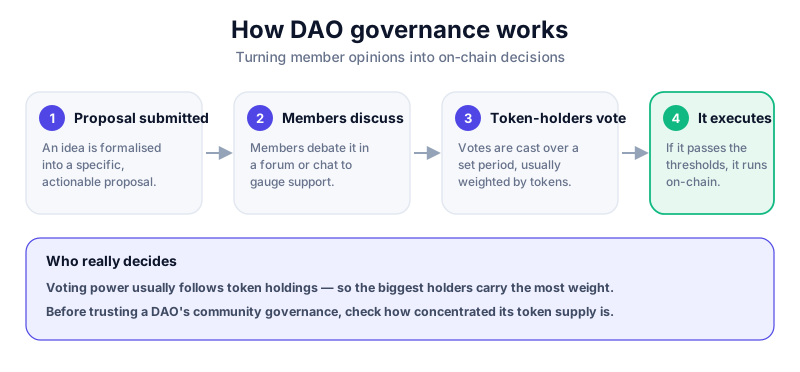
Most DAOs combine three ingredients: a set of smart contracts that hold funds and enforce rules, a way to make proposals, and a voting mechanism. Voting power is often tied to a governance token or sometimes membership NFTs.
- Smart contracts hold the treasury and execute approved decisions automatically.
- Proposals let members suggest actions — funding, rule changes, partnerships.
- Voting decides which proposals pass, usually weighted by tokens held.
We unpack the mechanics in detail in DAO governance explained, including how proposals and quorums actually function. Whichever way you lean, the storage rule doesn't change: serious amounts belong offline, on a hardware wallet like the Ledger Nano X.
What DAOs are used for
- Protocol governance — communities steering DeFi platforms and their parameters.
- Investment and grants — pooling funds to back projects or causes.
- Collector and social clubs — groups organised around shared interests or NFT membership.
- Public goods funding — directing money to open-source and community projects.
The limits and risks of DAOs
DAOs are an experiment, not a finished system. Voter turnout is often low, which can hand control to a small group of large token holders. Smart-contract bugs can be exploited — the original 2016 'The DAO' was famously drained due to a code flaw. And the legal status of DAOs remains unsettled in many places, which can expose members to unexpected liability.
Governance tokens are not investments
Governance tokens are highly volatile and exist to enable voting, not to deliver returns. Never buy one expecting profit, and only risk what you can afford to lose. This is education, not financial advice.
Read the rules before joining
Before participating in any DAO, understand how its voting works, who holds the most tokens, and what the treasury controls. Concentration of power is common even in 'decentralised' groups.
Key takeaways
- A DAO is an internet-native group governed by code and member voting, not bosses.
- Smart contracts often hold a shared, transparent treasury.
- Voting power is usually tied to governance tokens or membership NFTs.
- DAOs face real risks: low turnout, code bugs and unclear legal status.
Frequently asked questions
Do I need money to join a DAO?
Often, yes — many DAOs require holding a governance token or membership NFT to participate, and there may be transaction fees. Some, though, allow contribution through work or discussion alone.
Are DAOs legal?
Their legal status is still unsettled and varies by jurisdiction. A few places have created DAO-specific legal structures, but in many cases members could face uncertain liability. Always check the rules where you live.
What happens if a DAO's code has a bug?
It can be catastrophic. Because smart contracts execute automatically, a flaw can let funds be drained, as happened with 'The DAO' in 2016. Audits reduce but never eliminate this risk.
Keep reading
DAO Governance Explained: How On-Chain Voting Works
How DAO governance works in practice: proposals, governance tokens, quorums, on-chain vs off-chain voting, del
What Is an NFT Marketplace? A Beginner's Guide
A plain-English guide to NFT marketplaces: what they are, how buying and selling works, the main platforms, fe
Real-World NFT Use Cases Beyond Digital Art
Practical NFT use cases beyond profile-picture art: ticketing, memberships, gaming, identity, certificates and