What Is a Perpetual DEX? Perps Trading Explained
A perpetual DEX lets you trade leveraged 'perpetual' futures directly from your own wallet, with no central company holding your funds. It is one of the most powerful — and most dangerous — corners of DeFi. This guide explains how perps work and, just as importantly, why leverage can wipe you out fast.
The 20-second version
A perpetual DEX is a decentralised exchange for perpetual futures — contracts that track an asset's price with no expiry date. You can use leverage to make bigger bets than your deposit. That same leverage means a small price move against you can trigger liquidation and lose your entire margin.
Read this before anything else
Leverage can liquidate you in seconds
Perpetuals are leveraged products. A move of just a few percent against a 10x position can wipe out 100% of your margin. Most retail traders lose money trading leverage. Only ever risk what you can afford to lose, never borrow to trade, and treat this as education — not financial advice.
Perps are an advanced topic. If you are new to crypto, start with what is DeFi and what is a DEX before going anywhere near leverage.
What is a perpetual DEX?
A perpetual future ('perp') is a contract that tracks the price of an asset — say Bitcoin — but never expires. You can hold it as long as you keep enough margin in the account. A perpetual DEX is a decentralised exchange that offers these contracts on-chain, so you trade from your own wallet instead of depositing with a central company.
- No expiry — unlike traditional futures, perps roll on indefinitely.
- Self-custody — funds stay in your wallet or a smart contract you can verify, not a company's books.
- Leverage — you can open positions worth several times your deposit.
How perps stay pegged: the funding rate
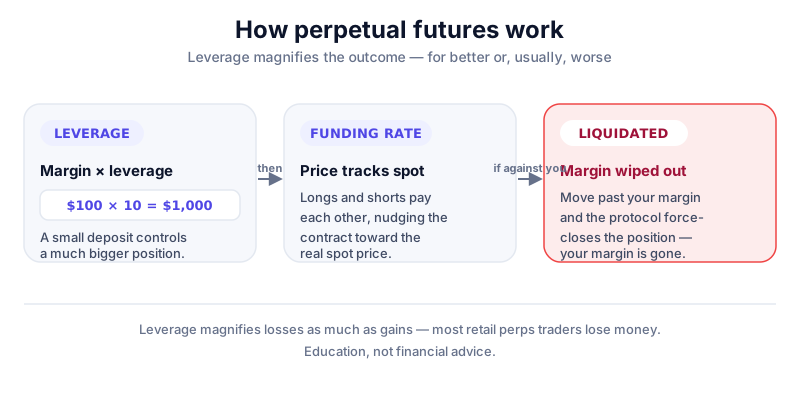
Because a perp never settles, something has to keep its price tethered to the real ('spot') price. That mechanism is the funding rate — a small payment exchanged between long and short traders, usually every hour or eight hours.
- When more traders are long, longs pay shorts — nudging the price back down toward spot.
- When more traders are short, shorts pay longs — nudging it back up.
- Funding is a recurring cost or income on your position, separate from price moves.
Perpetual DEXs typically use one of two models: an order book (matching buyers and sellers, like a traditional exchange) or a liquidity pool / oracle model where you trade against a shared pool. Each has different trade-offs around price accuracy, slippage and the risk the pool can't pay out.
Margin, leverage and liquidation
Your margin is the collateral backing a position. Leverage multiplies your exposure: with 10x leverage, $100 of margin controls $1,000 of exposure. The catch is that losses are multiplied too.
How liquidation works
If the price moves against you enough that your margin can no longer cover the losses, the protocol automatically closes ('liquidates') your position — and you lose your margin, often plus a liquidation fee. At 10x, roughly a 10% adverse move is enough.
On-chain, liquidations are handled by smart contracts and 'keeper' bots that watch positions constantly. In fast, volatile markets, prices can gap and liquidations can cascade — which is exactly when many traders get caught. Whatever you connect to, sign carefully: an air-gapped wallet like the Keystone shows you the full transaction on its own screen before anything leaves your hands.
The risks beyond leverage
- Smart-contract risk — a bug or exploit in the protocol can drain funds. Even audited code has failed.
- Oracle risk — if the price feed is manipulated or lags, positions can be liquidated unfairly.
- Liquidity risk — thin markets mean worse pricing and bigger slippage on entry and exit.
- Regulatory risk — leveraged derivatives are restricted or banned for retail users in many countries. Check your local rules.
Protect your wallet first
Connecting to any DeFi app means signing transactions. Use a hardware wallet, double-check the URL, and learn how to avoid crypto scams before approving anything. No one legitimate will ever ask for your seed phrase.
Key takeaways
- A perpetual DEX offers leveraged, never-expiring futures traded from your own wallet.
- Funding rates keep the perp price tethered to the real spot price.
- Leverage cuts both ways — a small adverse move can liquidate your entire margin.
- Smart-contract, oracle and regulatory risks stack on top of market risk; trade only what you can afford to lose.
Frequently asked questions
How is a perpetual DEX different from a normal DEX?
A normal DEX lets you swap one token for another at the current price. A perpetual DEX lets you trade leveraged futures contracts that track a price over time, with funding rates and liquidations involved.
Is trading perps a good way to make money?
We can't tell you that — and we'd be wary of anyone who does. Most retail leverage traders lose money. This guide is education, not financial advice, and perps carry a real risk of losing everything you put in.
Do I need to give up custody of my funds?
Not in the same way as a centralised exchange — you trade from your own wallet via smart contracts. But your collateral is locked in those contracts while a position is open, and contract bugs are a genuine risk.
Keep reading
What Is a DeFi Vault? Automated Yield Explained
A beginner-friendly guide to DeFi vaults: how automated yield strategies work, what 'auto-compounding' means,
What Is a Liquid Staking Token (LST)?
A clear guide to liquid staking tokens: how LSTs let you earn staking rewards while keeping your assets usable
What Is DeFi? Decentralised Finance Explained
A beginner's guide to decentralised finance: what DeFi is, how lending, trading and yield work without a bank