What Is a Smart Contract? A Plain-English Guide
A smart contract is a small program that lives on a blockchain and runs exactly as written, with no company in the middle. It's the technology behind almost everything beyond simple payments in crypto — from DeFi to NFTs. Get this one concept and a huge amount of the crypto world suddenly makes sense. This guide explains what smart contracts are in plain English, how they work, and what can go wrong.
The 20-second version
A smart contract is code stored on a blockchain that automatically does what it says when its conditions are met — like a vending machine for digital money. Once deployed, no one can quietly change it, but bugs in the code are permanent too.
What is a smart contract?
A smart contract is a program that is stored on a blockchain and runs automatically when certain conditions are met. The name is a little misleading on both counts — it's not a legal document, and it's not especially 'smart'. It's simply code that does exactly what it was written to do, every single time, without needing a person or company to carry it out or be trusted to do so fairly.
The classic comparison is a vending machine. You put in the right amount of money, press the button, and the machine releases your snack — no shopkeeper required, no negotiation, no 'come back tomorrow'. The rules are baked into the machine, and it follows them mechanically. A smart contract works the same way: the rules are fixed in advance, written into code, and the blockchain enforces them automatically for anyone who interacts with it.
Why is that a big deal? Because it lets total strangers cooperate without a trusted middleman. Normally, agreements need a referee — a bank, a lawyer, an escrow agent — someone you both trust to hold the money and play fair. A smart contract replaces that referee with transparent code that can't take sides. Smart contracts were popularised by Ethereum, which launched in 2015 as the first blockchain built to run general-purpose code. Today many networks, including Solana, support them too.
How smart contracts work
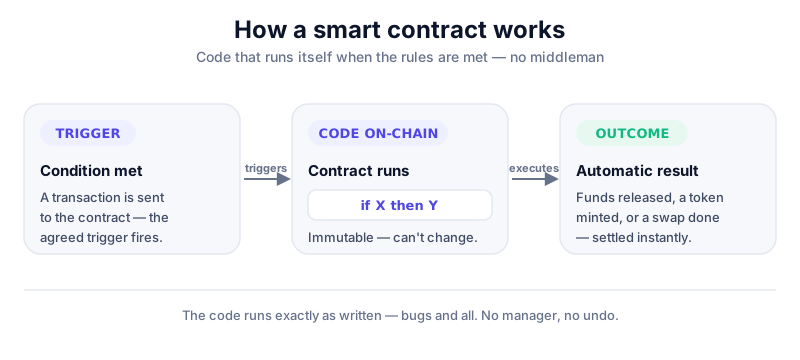
A developer writes the contract's code — often in a language such as Solidity — and 'deploys' it to the blockchain. Deploying is a bit like publishing: from that moment the contract has its own address on the network, lives there permanently, and anyone in the world can interact with it by sending it a transaction. There's no app store approval, no gatekeeper, and no off switch.
A few properties make smart contracts behave very differently from ordinary software running on a company's server:
- Deterministic — given the same input, the contract always produces the same result, on every computer in the network. No surprises, no hidden randomness.
- Transparent — the code is usually public, so anyone can read exactly what it will do before trusting it with their money.
- Immutable — once deployed, the code generally can't be changed. That's both its great strength (no one can sneak in a back door later) and its great risk (a bug can't simply be patched).
- Self-executing — no bank, broker or middleman is needed to make it run. It executes itself the moment its conditions are met.
Running code on a blockchain isn't free, though. Every computer in the network has to execute and record your interaction, and that work has to be paid for. On Ethereum this fee is called 'gas', and it rises when the network is busy. It's a small but real cost that keeps people from clogging the network with junk — a kind of toll for using shared infrastructure.
What smart contracts are used for
Once you can run code on a blockchain, you can build a lot more than simple payments. In fact, almost everything in crypto beyond plain coin transfers is built from smart contracts stacked together like Lego bricks. A few of the most common examples:
- DeFi — lending, borrowing and trading on a decentralised exchange (DEX) without a broker, all enforced by code instead of a financial institution.
- Stablecoins — tokens designed to track a currency like the US dollar, with contracts managing how they're issued and redeemed.
- NFTs — proof of ownership of a digital item, where the contract keeps the public record of who owns what.
- DAOs — online communities that pool funds and vote on shared decisions directly through code, with no board of directors.
The real power comes from 'composability' — because contracts are open, one can call another, so developers build new tools on top of existing ones like stacking blocks. It's also why a flaw in a single popular contract can ripple outward and affect everything built on it.
The risks to understand
Immutability cuts both ways. Because a smart contract can't be changed once deployed, a bug in the code is permanent — and attackers actively hunt for those bugs around the clock, because finding one can mean walking off with a fortune. Hundreds of millions of dollars have been lost to flawed or malicious contracts over the years, often in a single transaction that drained a project in seconds.
Code is law — for better and worse
A smart contract has no customer-support line and no 'reverse transaction' button. If you approve a malicious one, or a contract you rely on has a flaw, there may be no way to get your funds back. Stick to well-known, independently audited projects, and never approve a contract you don't understand.
Scammers also weaponise smart contracts to drain wallets directly. A common trick is a tempting website that asks you to 'approve' or 'sign' something which actually grants the attacker permission to move your tokens. The contract did exactly what it said — you just didn't realise what you were agreeing to. Learning how to avoid crypto scams and being genuinely careful about what you sign in your wallet is essential, not optional.
Where to go next
Smart contracts are the foundation for the rest of the ecosystem, so this is a great launchpad. From here it's worth understanding what DeFi is, what an NFT is, and the network that started it all, Ethereum. A hardware wallet that displays exactly what you're approving — like the Keystone — turns most signing mistakes into near-misses.
Key takeaways
- A smart contract is code on a blockchain that runs automatically when its conditions are met.
- It needs no middleman — the network enforces the rules, so strangers can cooperate safely.
- Once deployed it usually can't be changed, so bugs and back doors are permanent.
- Only interact with audited, well-known contracts, and be careful what you approve or sign.
Frequently asked questions
Is a smart contract legally binding?
Not by default. It's computer code, not a legal agreement, though it can be used alongside one. It enforces its own rules automatically, rather than rules a court would interpret — so 'the code did what it said' won't always match what you intended.
Can a smart contract be changed after it's deployed?
Usually not — immutability is a core feature and a big part of why people trust them. Some projects build in upgrade mechanisms for fixing bugs, but that reintroduces a degree of central control and its own trust trade-offs.
Keep reading
What Is Ethereum? A Plain-English Guide
A beginner-friendly explanation of Ethereum: what it is, how it differs from Bitcoin, what smart contracts do,
What Is DeFi? Decentralised Finance Explained
A beginner's guide to decentralised finance: what DeFi is, how lending, trading and yield work without a bank
What Is an NFT? A Clear Beginner's Guide
What NFTs actually are, how they work as proof of ownership on a blockchain, what they're used for, and the ri