What Is an NFT? A Clear Beginner's Guide
An NFT is a record on a blockchain that says 'this specific item belongs to this wallet' — a way to prove ownership of something digital. This guide explains what that does and doesn't mean, cuts through the hype, and shows you where the scams hide.
The 20-second version
NFT stands for 'non-fungible token' — a one-of-a-kind entry on a blockchain that points to a specific item, like an image or a ticket. It proves who owns that token, but it doesn't always mean you own the underlying artwork or its copyright. The market is wildly speculative and full of scams.
What 'non-fungible' means
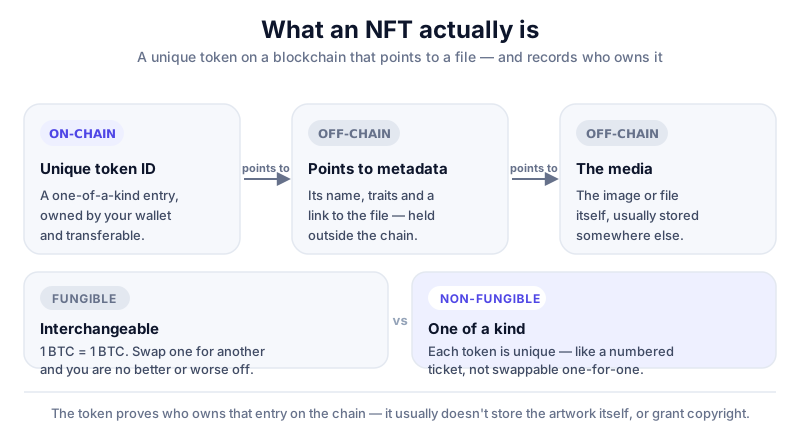
'Fungible' is a slightly clunky word for a simple idea: interchangeable. One pound coin is identical to any other pound coin — swap yours for mine and neither of us is better or worse off. Money is fungible, and that's exactly what makes it useful as money. Non-fungible means the opposite: unique, not interchangeable. Each NFT is distinct and can't be swapped one-for-one with another without it actually mattering which one you have.
A helpful comparison: a £10 note is fungible, but a signed concert ticket with your seat number on it is not — it's tied to a specific seat, a specific night, a specific signature. Trading it for a different ticket would change what you hold. An NFT is the digital version of that one-of-a-kind ticket, and its uniqueness is recorded permanently on a blockchain so it can be checked by anyone.
In practice, then, an NFT is a token that points to a specific thing — a piece of art, a collectible, an event ticket, an in-game item — and records which wallet currently holds it. It's less a picture and more a publicly verifiable receipt that says 'this exact item belongs to this exact wallet, right now'.
How NFTs work
Most NFTs live on Ethereum or other smart-contract networks. The blockchain stores a permanent, public record of the token and who owns it, and because that record is maintained by thousands of independent computers, it's extremely hard to fake or quietly alter. That's the genuine, useful bit of the technology: a way to prove ownership of a digital thing without a central authority vouching for it.
But there's a detail that trips almost everyone up, so it's worth being precise. The token and the artwork are two different things:
- The token is the unique entry on the blockchain that you actually own — the receipt, if you like.
- The asset (the image or file) is usually stored somewhere else entirely, with the token simply linking to it. The picture itself rarely lives on the blockchain.
- Transfers happen wallet-to-wallet, with the blockchain updating its record of who holds the token, all without any company's permission.
Owning the token vs owning the art
Buying an NFT usually means you own the token, not the copyright or the image. Anyone can still right-click, view, or copy the picture — and they can, endlessly. What you hold is a verifiable record of owning that specific token, which may or may not come with any legal rights at all. It depends entirely on the project's fine print, which most buyers never read.
What NFTs are used for
Profile-picture art got all the headlines and most of the mockery, but the underlying idea — a unique, transferable proof of ownership that no single company controls — has uses well beyond cartoon apes. Stripped of the hype, an NFT is just a tool for saying 'this is mine and you can verify it'. That turns out to be handy in a few places:
- Digital art and collectibles — the use most people have heard of, for better or worse.
- Event tickets and memberships — where holding the token grants you access, and reselling can be tracked, in theory cutting out the fake-ticket trade.
- In-game items — owned by the player rather than locked inside one company's account, so they can in principle move or sell them.
- Certificates and credentials — proving something happened or was earned, like a qualification or a record of attendance.
Whether any of these become genuinely mainstream is still an open question, and honestly, a lot of the early NFT boom was speculation dressed up as innovation. The technology is real; the prices people paid for jpegs were a different thing entirely. It's worth keeping the two apart in your head. And treat valuable NFTs like any other asset: they can sit behind a hardware wallet like the SafePal S1, safely offline.
The risks and the hype
The NFT market has seen enormous booms and even bigger busts. Collections that sold for the price of a house at the peak later traded for the price of a coffee — or couldn't be sold at all. The space attracts a lot of scams precisely because it mixes big money, fast hype, and beginners who don't yet know what to look for. It's important to separate the technology, which is neutral, from the speculation and fraud that have swirled around it.
- Wild price swings — values can collapse to nothing, and many NFTs end up illiquid, meaning there's simply no one willing to buy them back at any price.
- Scams — fake collections impersonating real ones, 'free mint' traps, and phishing links that drain your whole wallet the moment you connect it.
- Wash trading — fake sales between accounts the same person controls, used to make a project look far more popular and valuable than it really is.
Not an investment guide
Never buy an NFT expecting it to rise in value — we make no price predictions, and most NFTs have lost value heavily. The market is thin, speculative, and easy to manipulate. Only ever spend what you can afford to lose entirely, treat 'guaranteed returns' or 'this floor only goes up' as outright red flags, and never borrow to buy one. This is education, not financial advice.
Staying safe with NFTs
Most NFT scams don't pick your pocket — they get you to hand it over yourself, by tricking you into signing a malicious transaction or connecting your wallet to a fake site. Be deeply wary of anything offering a 'free' mint or an unmissable deal, since urgency and free stuff are the bait. Verify a collection's official links independently — through the project's own verified accounts, not a link someone messaged you — and never connect your wallet to a site you can't confirm is the real one.
Before you go anywhere near a marketplace, read how to avoid crypto scams, because the same handful of tricks show up again and again. And memorise the one unbreakable rule: no legitimate project, mint, or 'support agent' will ever ask for your seed phrase. Buying or minting an NFT never requires it. Anyone who asks is a thief, full stop — and the Latest Crypto team would much rather you walked away bored than excited and robbed.
Key takeaways
- An NFT is a unique blockchain token proving who owns a specific item.
- Owning the token isn't the same as owning the copyright or the artwork itself.
- Uses range from art and tickets to memberships and in-game items.
- The market is volatile and scam-prone — never buy expecting a return.
Frequently asked questions
If I buy an NFT, do I own the image?
You own the token, which is the blockchain receipt. Whether you own the copyright or any usage rights depends entirely on the project's terms — and often you don't. Anyone can still view or copy the image itself.
Are NFTs a good investment?
We don't give investment advice or make price predictions, and we'd be wary of anyone who tells you they're a sure thing. Prices are highly speculative and most NFTs have lost value. Treat them as collectibles you might enjoy, not a savings plan.
Where are NFTs stored?
The ownership record lives on the blockchain, tied to your wallet. The actual file is usually stored separately elsewhere, which is why the link can sometimes break or the image disappear if that storage goes offline.
Keep reading
What Is DeFi? Decentralised Finance Explained
A beginner's guide to decentralised finance: what DeFi is, how lending, trading and yield work without a bank
What Is Ethereum? A Plain-English Guide
A beginner-friendly explanation of Ethereum: what it is, how it differs from Bitcoin, what smart contracts do,
How Blockchain Works (Without the Jargon)
A plain-English explanation of what a blockchain actually is, how blocks are linked and confirmed, what makes