What Is Cosmos (ATOM)? A Plain-English Guide
Cosmos is an ambitious project with a simple goal: let independent blockchains talk to each other. Often called the 'internet of blockchains', it gives developers tools to build their own chains and a standard way to connect them. This guide explains what Cosmos is, what the ATOM token does, and how to think about it without the hype.
The 20-second version
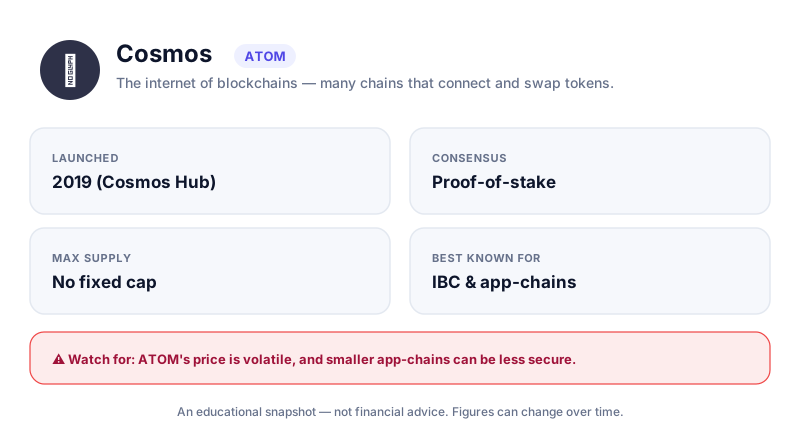
Cosmos isn't one blockchain — it's a network of many. Its software lets anyone build a custom chain, and its IBC protocol lets those chains swap tokens and data. ATOM is the token that secures the Cosmos Hub, the network's central marketplace of connections.
What is Cosmos?
Most blockchains are islands. Bitcoin can't easily talk to Ethereum, and neither can talk to Solana. Cosmos was designed to fix that. Rather than building one giant chain that does everything, Cosmos provides a toolkit so developers can launch their own purpose-built blockchains — and a shared language so those chains can connect.
Each chain built this way is called an 'app-chain' or 'zone'. A zone might be a lending platform, a gaming network, or an exchange. They all run independently, but thanks to a protocol called IBC (Inter-Blockchain Communication), they can pass tokens and messages between one another.
At the centre sits the Cosmos Hub, one of the first chains in the network. The Hub helps route connections between zones, and its native token is ATOM.
How Cosmos works
Three pieces of technology make Cosmos tick. Together they're sometimes called the 'Cosmos stack', and you don't need to be a developer to grasp the idea.
- Tendermint / CometBFT is the engine that lets a chain agree on transactions quickly and finalise them in seconds. Developers reuse it instead of writing their own from scratch.
- The Cosmos SDK is a set of building blocks for creating a custom blockchain — staking, governance and token modules come ready-made.
- IBC is the messaging standard that lets finished chains connect and transfer assets, much like email lets different mail servers exchange messages.
Because each app gets its own chain, it isn't competing for space with everyone else — a busy game won't clog up a lending app, the way unrelated apps can congest a single shared network. We cover the connection layer in detail in Cosmos IBC explained.
What does ATOM do?
ATOM is the native token of the Cosmos Hub. It has a few specific jobs rather than being a general 'fuel' for the whole network — remember, each zone has its own token.
- Security through staking. ATOM holders can stake their tokens to help validate the Hub and earn rewards, or delegate to a validator who does it for them. We explain this in Cosmos staking explained.
- Governance. Staked ATOM lets you vote on proposals that change how the Hub works.
- Fees. ATOM pays for transactions on the Hub itself.
A fair warning
ATOM's price is highly volatile, and staking rewards are not guaranteed income. Only ever risk what you can afford to lose, and never borrow to buy crypto. This guide is education, not financial advice.
Why Cosmos matters — and the criticisms
Cosmos pioneered the idea that the future might be many specialised blockchains rather than one chain to rule them all. Major projects — including some large stablecoin and exchange chains — were built with Cosmos technology, and IBC moves significant value between them every day.
It isn't without debate, though. Critics point out that because each app-chain secures itself, smaller chains can be less secure than apps living on a single large network. Others argue ATOM 'captures' less value than tokens that are required across an entire ecosystem, and the project has seen public disagreements over its roadmap and tokenomics. A balanced view holds both the genuine innovation and these open questions.
Where to go next
Now you know what Cosmos is, sensible next steps are understanding how IBC connects chains, then — if you choose to get involved — how to buy ATOM safely and, most importantly, how to store it safely. To learn the staking mechanics, see Cosmos staking explained. Whichever way you lean, the storage rule doesn't change: serious amounts belong offline, on a hardware wallet like the Ledger Nano X.
Key takeaways
- Cosmos is an 'internet of blockchains' — many connected chains, not one.
- The Cosmos SDK and Tendermint let developers build custom chains fast.
- IBC is the standard that lets those chains exchange tokens and data.
- ATOM secures the Cosmos Hub via staking — and it's volatile, so only risk what you can afford to lose.
Frequently asked questions
Is Cosmos the same as ATOM?
Not quite. Cosmos is the wider network of connected blockchains and the technology behind it. ATOM is the native token of the Cosmos Hub, one chain within that network.
Does every Cosmos chain use ATOM?
No. Each app-chain usually has its own token for fees and staking. ATOM specifically secures and governs the Cosmos Hub.
How is Cosmos different from Ethereum?
Ethereum hosts many apps on one shared chain. Cosmos gives each app its own independent chain and connects them with IBC. They're different design philosophies, each with trade-offs.
Keep reading
Cosmos IBC Explained: The Inter-Blockchain Communication Protocol
A plain-English guide to IBC, the Cosmos protocol that lets independent blockchains transfer tokens and data —
Cosmos Staking Explained: How Staking ATOM Works
A plain-English guide to staking ATOM on Cosmos: how delegation works, where rewards come from, the unbonding
How to Buy Cosmos (ATOM) Safely — Step by Step
A calm, beginner-friendly walkthrough of how to buy Cosmos (ATOM) safely: choosing an exchange, verifying your