What Is DeFi? Decentralised Finance Explained
DeFi means rebuilding financial services — lending, borrowing, trading — as open software anyone can use, with no bank in the middle. This guide explains how it works, what you can actually do with it, and exactly where the dangers lie.
The 20-second version
DeFi (decentralised finance) replaces banks and brokers with code running on a blockchain. You can lend, borrow, trade and earn directly from your own wallet — but you also take on all the risk yourself, with no safety net, no insurance and no one to reverse a mistake.
What DeFi means
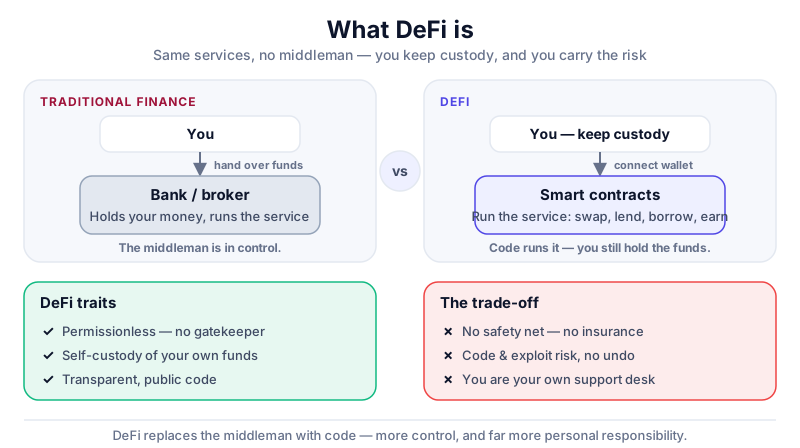
DeFi is short for decentralised finance. Instead of a bank deciding who can open an account, DeFi apps are programs — smart contracts — that run on a blockchain like Ethereum. Anyone with a wallet can use them, around the clock, without filling in a form, passing a credit check, or asking anyone's permission. A farmer in one country and a student in another connect to the exact same app under the exact same rules.
Think of a traditional bank as a private members' club: there's a door, a doorman, opening hours, and a manager who can let you in or turn you away. A DeFi app is more like a vending machine bolted to a public wall. It doesn't know who you are, it doesn't care, and it serves anyone who follows the instructions — at 3am on a bank holiday just the same as midday on a Monday. That's the appeal: the code is public, the rules are identical for everyone, and you keep custody of your own funds the whole time.
The catch is the flip side of that same coin. With no doorman, there's also no one to call when something goes wrong — no fraud line, no chargeback, no manager to override a mistake. The vending machine will happily dispense your funds to a thief if you press the wrong buttons, and it won't feel a thing. You get all the freedom, and you carry all the responsibility. That bargain is the single most important thing to understand about DeFi before you touch any of it.
What you can do with DeFi
Most of DeFi is just the familiar services of a high street bank, rebuilt as open code that anyone can plug into. If you've ever used a savings account, a currency exchange, or a loan, you already understand the goals — only here there's no institution in the middle, just a smart contract. The main categories are:
- Trading on a decentralised exchange (DEX), swapping one token for another wallet-to-wallet, with no broker holding your money in between. See centralised vs decentralised exchanges for how that differs from a normal platform.
- Lending and borrowing, where you supply assets to a pool to earn interest, or post crypto as collateral to borrow against — a bit like a digital pawnbroker that never closes.
- Stablecoins, used as a steadier unit of account so you can park value without the wild swings — though they carry their own risks, covered in what is a stablecoin.
- Yield, earning returns by providing liquidity (lending your tokens so others can trade) or staking — often the most complicated and the riskiest corner of the whole space.
All of this connects to your wallet, such as MetaMask, which acts as your login and your signature for every action. There's no username and password handed to a company; instead, you approve each step yourself by signing it with your wallet. That's powerful — you're never asking permission — but it also means a single careless signature can do real damage, which is exactly why we keep coming back to caution.
Smart contracts: the engine
Underneath every DeFi app is a smart contract — a program stored on the blockchain that runs exactly as written, automatically, with no human in the loop. If you deposit funds and meet the conditions it was coded to check, it pays out the moment those conditions are met. No clerk approves it, no committee reviews it, no office hours apply. It's the financial equivalent of a contract that signs and enforces itself the instant the terms are satisfied.
That automation is genuinely useful: it's fast, it's predictable, and it can't quietly change its mind or apply a hidden charge. But automation cuts both ways. A smart contract has no judgement and no common sense. If the code contains a flaw, the contract executes the flaw with the same cheerful obedience as everything else — and because it's all automatic, an attacker can drain it faster than any human could react.
Code is law — for better and worse
Smart contracts do precisely what they're coded to do, no more and no less. If there's a bug, it executes the bug too, and there's no customer service to reverse a mistaken or exploited transaction. 'The code is the rules' sounds reassuring right up until the rules have a typo in them.
The risks, honestly
DeFi can be powerful, but we're not going to pretend it's gentle. It is genuinely high-risk, and far less forgiving than a regulated bank — which exists, in part, precisely to absorb the mistakes DeFi leaves entirely on your shoulders. The main dangers are worth taking seriously rather than skimming past: Whatever you connect to, sign carefully: an air-gapped wallet like the Keystone shows you the full transaction on its own screen before anything leaves your hands.
- Smart-contract bugs — flawed code can be drained by attackers, sometimes within minutes, taking everyone's deposited funds with it. Even audited projects have been hacked.
- Scams and rug pulls — anyone can launch a project, and many are built from day one to steal. The polished website tells you nothing. See how to spot a rug pull.
- Volatility and liquidation — borrowing against crypto can force an automatic sell-off if prices drop, often at the worst possible moment, leaving you with less than you started.
- No protection — no deposit insurance, no chargebacks, no regulator to recover funds. If it goes wrong, it's gone, and that's the whole story.
Treat 'yield' claims with deep suspicion
Advertised returns are not guaranteed and often hide serious risk — that eye-watering '120% APY' is usually a flashing warning light, not an opportunity. High yields frequently collapse or turn out to be unsustainable, paid in a token whose price is quietly cratering. Only ever use funds you can afford to lose entirely, and never borrow to chase a yield. This is education, not financial advice.
Staying safer if you explore
If you do decide to experiment, do it the way a cautious person would dip a toe into cold water rather than diving in. Start tiny — with an amount whose total loss would only annoy you, not hurt you. Stick to well-known protocols that have been around for years and independently audited, rather than the shiny new thing being shilled in your feed. And never connect your wallet to a site you can't independently verify is the real one.
Above all, learn how to avoid crypto scams before you risk a penny, because the scams in DeFi are constant and well-disguised. And remember the one rule with no exceptions: never share your seed phrase. No legitimate app will ever ask for it — connecting a wallet to use a DeFi app never requires typing your recovery words anywhere. If a 'DeFi' site asks for them, you've found a thief, and the right move is to close the tab. None of this is advice to invest; it's just the honest groundwork from the Latest Crypto team for anyone determined to look.
Key takeaways
- DeFi rebuilds finance as open code on a blockchain — no bank in the middle.
- You keep custody, but you also carry all the risk with no safety net.
- Smart contracts run exactly as written, bugs and all, with no undo.
- Scams, exploits and unsustainable 'yields' are common — start tiny and verify everything.
Frequently asked questions
Is DeFi safe?
It's considerably riskier than a regulated bank. There's no deposit insurance and no one to reverse a hack or mistake. Many people lose money to bugs and scams, so caution is essential — start with amounts you'd be fine to lose entirely.
Do I need to know how to code to use DeFi?
No, but you do need to understand what you're signing. Most apps have a simple interface, yet a single careless approval can drain your wallet, so go slowly, double-check the site is genuine, and never rush a signature.
What blockchain is DeFi on?
Ethereum hosts the most DeFi activity, but Solana, Avalanche and others have their own ecosystems too. The same risks — bugs, scams, volatility, no safety net — apply across all of them.
Keep reading
What Is Ethereum? A Plain-English Guide
A beginner-friendly explanation of Ethereum: what it is, how it differs from Bitcoin, what smart contracts do,
What Is Staking? How It Works and What It Costs
A plain-English guide to crypto staking: how it secures proof-of-stake networks, how rewards work, and the loc
What Is a Stablecoin? How the Peg Works (and Fails)
A clear guide to stablecoins: how they aim to hold a steady value, the different types, and the very real peg