How to Spot a Rug Pull
The last lesson named the rug pull as the headline danger. This one teaches you to see it coming. A rug pull is when the people behind a coin pull the value out from under holders and vanish — but they follow recognisable patterns, and once you know the patterns, most are avoidable. Here's how to read the warning signs before you lose money.
The 20-second version
A rug pull leaves holders with worthless tokens. The biggest tells are unlocked liquidity, an anonymous team, a few wallets owning most of the supply, and a contract you can buy into but not sell out of. If you can't verify these, assume the worst and walk away.
What a rug pull actually is
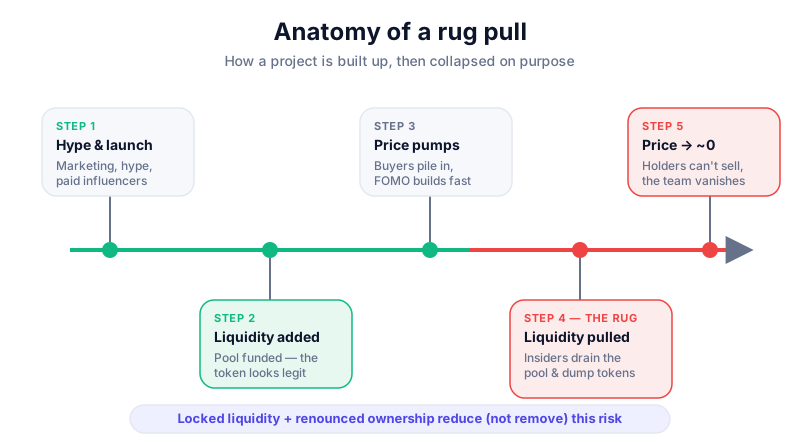
A rug pull is a scam where a coin's creators extract its value and disappear, collapsing the price to near-zero in moments. It's the most common single way people lose money on new meme coins, because — as we covered in how meme coins work — anyone can launch a token anonymously in minutes, with no licence, no checks and no one watching.
Rug pulls come in a few recognisable flavours, and each maps onto a mechanic you've already met: draining the liquidity pool so there's nothing to sell against, dumping a hidden insider stash to flood the market, secretly minting new supply to dilute everyone, or coding the contract so holders can never sell at all. Spotting a rug pull is simply a matter of checking for each of these before you part with any money. The good news is that most of these checks take minutes and cost nothing.
No check is a guarantee
These signals reduce risk; they never remove it. A coin can pass every test here and still collapse the next day. Treat any meme-coin money as money you could lose entirely. This is education, not financial advice.
1. Is the liquidity locked?
This is the most important check of the lot, so start here. If the creator can withdraw the liquidity pool, they can pull it at any moment and leave you holding tokens you literally cannot sell — there'd be nothing on the other side of the trade. Legitimate projects usually lock liquidity for a set period using a third-party locker, or burn the liquidity tokens (send them to an address no one controls) so that nobody, including the creator, can ever remove the pool.
- Look for proof that liquidity is locked or burned, with a verifiable on-chain link — not just a cheerful claim in a Telegram chat.
- Check how long it's locked for. A lock that quietly expires next week offers almost no real protection; a one-day lock is barely a lock at all.
- Unlocked liquidity on a brand-new coin is one of the single strongest rug-pull signals there is. On its own, it's usually enough to walk away.
2. Who holds the supply?
Use a blockchain explorer — a free, public website that shows every wallet and transaction on the chain — to view the holder distribution. If a handful of wallets, especially the creator's, control most of the supply, those holders can crash the price by selling whenever they choose. You'd be playing a game where a few people can flip the table at will.
| What you see | What it suggests |
|---|---|
| Top wallet holds a large share | Single point of failure; that holder can dump on you at any time |
| Many wallets hold tiny, similar amounts | Could be organic — or sybil wallets all secretly controlled by one person |
| Team allocation not locked or vested | Insiders can sell their entire stake immediately after launch |
| Broad, genuine distribution | Lower (but never zero) concentration risk |
Be aware of the obvious counter-trick: a creator can split their holdings across dozens of wallets to look decentralised while still controlling everything. So distribution is a strong clue, not cast-iron proof. Look at wallet ages and funding patterns too — a hundred wallets all funded by the same source minutes before launch is not a real community.
3. What does the contract allow?
The smart contract defines what is and isn't possible, and it's the rulebook the creator wrote. Even if you can't read a line of code, you can paste the contract address into free contract-scanner tools that flag dangerous functions automatically. Treat their output as a strong starting point rather than gospel — but a red flag here is a serious red flag.
- Honeypot — the contract blocks selling, so you can buy but never cash out. A scanner that reports you 'cannot sell' is a hard stop, no further questions.
- Mint function — the creator can print new tokens at will and dilute your stake toward nothing.
- High or changeable transfer taxes — fees that look reasonable now but can be cranked up to 99% later to trap holders.
- Ownership not renounced (or renounced misleadingly) — renouncing ownership can reduce some risks, but scammers also use it as theatre for false reassurance. Judge it alongside everything else, never in isolation.
Test with a tiny amount
If you do proceed, buy a very small amount and immediately try to sell a portion straight back. If the sale won't go through, it's almost certainly a honeypot — and you've learned that for pennies instead of your whole stake. It's the cheapest insurance in crypto.
4. The human red flags
On-chain data tells you what's mechanically possible. The human signals tell you about intent — and rug pulls share a remarkably consistent social fingerprint. Once you've seen a few, the pattern jumps out at you.
- An anonymous team with no track record and nothing to lose by disappearing.
- Promises of guaranteed returns or 'risk-free' gains — which, as the last lesson stressed, no honest project ever makes.
- Heavy manufactured urgency: countdowns, 'last chance', 'about to list on a major exchange any minute now'.
- Engagement that looks botted — thousands of identical one-word replies and followers with no posts of their own.
- A whitepaper or roadmap that's vague, plagiarised, or all hype and no substance when you actually read it.
- Locked or heavily censored community chats where critical questions get deleted and the asker gets banned.
These overlap heavily with the meme coin risks and red flags lesson and our general how to avoid crypto scams guide. The patterns repeat across the whole of crypto for one simple reason: they work, so scammers keep using them.
Quick pre-buy checklist
Pull it all together into a short routine you run every time, in order. If any step fails or you can't complete it, that's your answer. However you play it, one rule keeps meme-coin damage survivable: your serious holdings live elsewhere, offline, on a hardware wallet like the Keystone 3 Pro.
- Confirm liquidity is locked or burned, with a verifiable link and a meaningful duration.
- Check holder distribution on a block explorer for dangerous concentration.
- Run the contract through a scanner for honeypot, mint and tax flags.
- Verify the team's identity and track record, if any exists at all.
- Ignore urgency and hype; if anything pressures you to hurry, that's the answer.
- If you still proceed, use a separate wallet and an amount you can lose entirely.
When in doubt, don't
If you can't verify these basics, that uncertainty is itself the signal. Walking away from a coin costs you nothing — there's always another one tomorrow. A rug pull can cost you everything.
Key takeaways
- A rug pull drains a coin's value and leaves holders with nothing.
- Check for locked liquidity, distributed ownership and a safe contract before buying.
- Honeypots let you buy but not sell — test with a tiny amount first.
- Anonymous teams, guaranteed returns and urgency are classic rug-pull tells.
Frequently asked questions
Can a coin pass every check and still rug?
Yes. These checks lower the odds but never eliminate them — creators can split wallets, time their exit for later, or invent new tricks entirely. Always treat meme-coin money as money you could lose entirely, even after a clean check.
What does 'liquidity locked' mean?
It means the pool of money that backs trading can't be withdrawn by the creator for a set period, usually via a third-party locker or by burning the liquidity tokens so no one can ever pull them. Unlocked liquidity is a major rug-pull risk.
What is a honeypot?
A contract coded so you can buy the token but never sell it, trapping your money while the chart looks like it's only going up. A free contract scanner — or a tiny test buy followed by an attempted sell — can reveal one before you commit real funds.
Keep reading
Meme Coin Risks and Red Flags
The core safety lesson on meme coins: the real risks, the warning signs to look for, and the scams that separa
How to Research a Meme Coin (Due-Diligence Checklist)
A step-by-step due-diligence checklist for vetting a meme coin: contract checks, liquidity, ownership, team an
How Meme Coins Work (Under the Hood)
How meme coins are created, traded and priced — tokens, liquidity pools, market caps and the mechanics that ma