What Is Hashgraph? The Consensus, Simply
Hashgraph is the engine that powers Hedera. It's a way for thousands of computers to agree on what happened and in what order — without a central referee. This guide explains it in plain English, with no maths degree required.
The 20-second version
Hashgraph is a consensus method that uses 'gossip' — nodes telling each other what they've heard — to agree on the order of transactions quickly and fairly. It powers Hedera, and it's an alternative to the chain-of-blocks design Bitcoin uses.
The problem consensus solves
Any public ledger needs a way for many computers, run by strangers, to agree on a single shared history. Bitcoin solves this with mining and blocks. Hashgraph solves the same problem a different way — without bundling transactions into blocks at all.
The goal is the same: everyone ends up with the same record, and no single party can quietly rewrite it.
Gossip about gossip
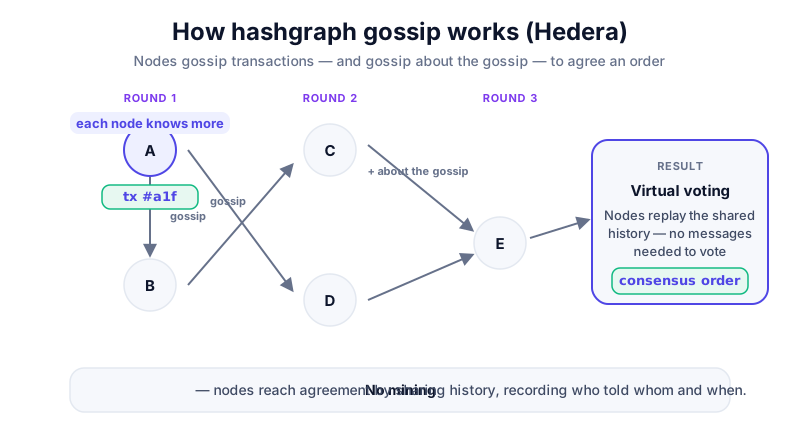
Hashgraph spreads information using a gossip protocol. Each node randomly picks another node and shares everything it knows. That node does the same, and within moments news of a transaction reaches the whole network — the way rumours spread through a crowd.
Crucially, each message also carries a small history of *who told whom, and when*. This 'gossip about gossip' lets every node reconstruct the same picture of events independently.
Virtual voting
Once nodes share that history, they can work out how everyone *would* have voted on the order of transactions — without sending any extra voting messages. This is called virtual voting, and it's what makes Hashgraph fast and efficient.
- No mining — there's no energy-hungry race to solve puzzles.
- No blocks — transactions are ordered individually as they arrive.
- Fair ordering — timestamps are agreed by the network, not chosen by one node.
Strengths and trade-offs
Hashgraph is designed for high throughput, low fees, and fast finality. Those are real strengths. But the version used by Hedera runs on a permissioned set of council-operated nodes, which makes it less open than networks anyone can join.
Tech is not a verdict
A clever consensus design doesn't tell you whether a token is a good buy — that's not what this guide is about. Judge the technology on its merits, and never treat 'better tech' as financial advice.
Where to go next
Now you understand the consensus, see how it's put to use in what is Hedera. To compare approaches, it helps to know how blockchains work and what staking is. And however you weigh the trade-offs, keep meaningful holdings in cold storage — a Trezor Safe 5 — rather than on an exchange.
Key takeaways
- Hashgraph is a consensus method, not a coin.
- It uses 'gossip about gossip' to spread and order transactions.
- Virtual voting reaches agreement without extra messages or mining.
- Hedera's version runs on permissioned council nodes — fast, but less open.
Frequently asked questions
Is Hashgraph the same as blockchain?
No. Both are distributed ledgers, but Hashgraph orders transactions through gossip and virtual voting rather than chaining them into blocks.
Does Hashgraph use mining?
No. There's no proof-of-work mining and no energy-intensive puzzle race. Hedera uses staking to secure its network instead.
Where is Hashgraph used?
Its best-known public deployment is Hedera, whose native token is HBAR.
Keep reading
What Is Hedera (HBAR)? A Plain-English Guide
A beginner-friendly explanation of Hedera and its native token HBAR — how the Hashgraph network works, what it
How to Buy Hedera (HBAR): A Beginner's Guide
A step-by-step, no-hype guide to buying HBAR safely — choosing an exchange, verifying your account, placing an
How to Store Hedera (HBAR) Safely
Keep your HBAR safe from hackers and mistakes: hot vs cold wallets, hardware wallets, seed-phrase backups, and